


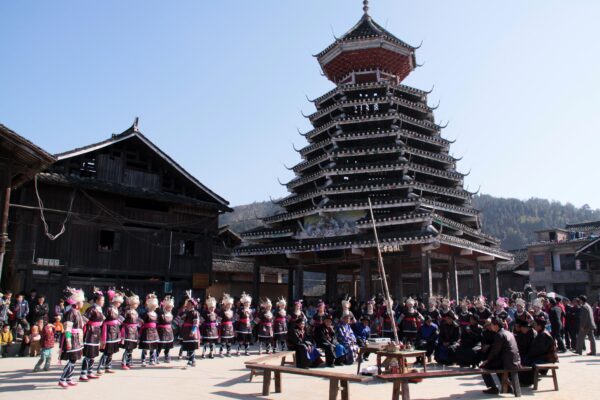
The Dong people of China are an indigenous ethnic group known to have lived in the mountainous regions of southwest China for approximately 600 years. They have no written language, but their cultural knowledge is shared by word of mouth. This means that the outside world doesn’t know much about them.
But an ambitious university research project document the distinctive architecture of the Dong people reveals a a lot about that marginalized indigenous groups lifestyle.
An estimated 3 million Dong live in the provinces of Guizhou, Hunan and Guangxi. They are renowned for their polyphonic choral singing, listed by UNESCO since 2009 as an example of world-class intangible cultural heritage. Their architecture, landscapes and refined agricultural terraces are also distinctive, but less known and never digitally recorded.
Dong buildings and settlements are usually hidden in fir forests with direct access to waterways at the bottom of valleys or halfway up hills. A Dong settlement typically has around 200 households of four to five people, although some larger villages can have up to 500 households.
These villages tend to have a gatehouse marking their boundary, defining their territory in relation to neighboring settlements. Many feature a distinctive “wind and rain bridge” – a mix of village gate and covered bridge – used for community gatherings and blockade ceremonies. Ponds, wells and granaries are scattered across the landscape.
At the heart of most villages, surrounded by two- or three-story wooden houses, is a “drum tower” and a “Sa-Sui Shrine.” The first represents the link between the people’s sacred belief in clan kinship and the fir trees, while the second represents the center of the Dong’s worship of the “Sa” or grandmother. They are the most important buildings in a village – for security, social and spiritual reasons.

Exterior view of the drum tower in Zeng Chong village. Photo by Xiang Ren.
Nowadays, the built and cultural heritage of the Dong is increasingly threatened. This is due to a combination of climate change, natural disasters, urban infrastructure development and the expansion of rural tourism.
Global warming is triggering more and more forest fires and causing flooding in the mountains. We are also witnessing the encroachment of urban planning into the rural areas of the Dong. While improving quality of life, this often presents risks of home fires due to poor electrical infrastructure. And in recent years, the growth of tourism and the encroachment of roads, railways and bridges risk transforming these villages into decorated settings. This may bring in money, but threatens the unique architecture and landscape of the Dong people.
This is an urgent challenge for these indigenous people and for those of us dedicated to preserving their historic environment, culture and highly ritualized way of life.
Tragically, resource scarcity means that repair, restoration and regeneration projects, as well as insufficient conservation policies and frameworks, have been slow to help preserve these precious villages. The very remote mountainous environment doesn’t help. Local communities and government authorities have extremely limited resources to manage almost any change in their historic environment.
Despite the remoteness of many of these villages, they are now encroached upon by modern development. We are seeing the growth of contemporary housing developments using modern structures and materials. This is part of China’s rapid urbanization in recent decades – but, as elsewhere, it is irreversibly changing the image and identity of Dong settlements and their architecture.

Modern infrastructure is irreversibly changing the context and historical fabric surrounding the Drum Tower in Ju Dong Village. Photo by Xian Ren.
The problem with modern tourism development can be seen in the way traditional style drum towers are built as theme park attractions. At Danzhai Wanda VillageA recently developed theme park near Kaili in Guizhou, the closest city to the Dong indigenous areas, there are five newly constructed drum towers, billed as “iconic”, which are presented as stand-alone monuments with no relationship to the surrounding houses and forests.

Dong Drum Tower, as a distinctive building type, is also in danger of being fully developed as a tourism object and product. Photo by Xiang Ren.
The need to document and protect authentic indigenous Dong culture is what motivated the Decode Dong project. This was launched in 2023 and completed in 2025 and aims to digitally document Dong’s physical and cultural heritage.
This interdisciplinary project draws on human and social science disciplines ranging from architecture, anthropology, heritage sciences, sociology and digital humanities.
He brought together a series of innovative and complementary research methods. This involved 3D LiDAR Scanningaerial and terrestrial photogrammetry (the science of applying mathematics to photographs to extract accurate 3D measurements), 3D reality capture modeling, measured drawing, documentary filmmaking, and cartography. This was supplemented by oral histories provided by the Dong people.
The project achieved a first of its kind digital documentation of Dong architectural heritage, by building digital tools and audiovisual documentaries of around 100 historic buildings spread across a dozen isolated Dong villages.
A key part of the research process was consulting key stakeholders, including clan leaders, elderly villagers and provincial policy makers, where possible.
Dong indigenous heritage is still under threat, due to the lack of resources faced by both local authorities and the communities themselves.
But this project represents a radical change. By creating a mutually beneficial store of information, supported by cutting-edge digital technologies, we hope to draw more attention to this distinctive people without threatening what makes them unique.
This article was originally published on The conversation. Read the original article. 