


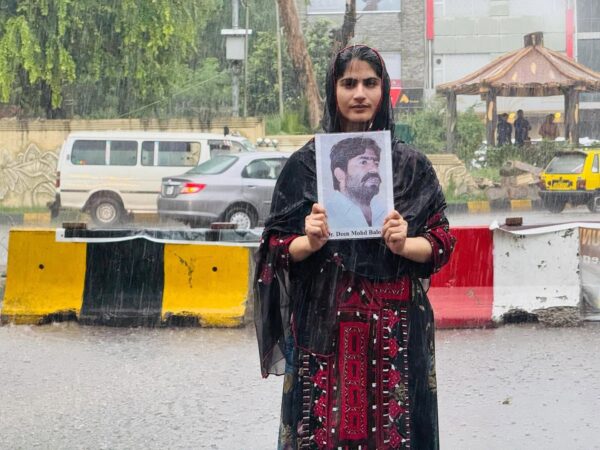
Even today, I remember vividly the enforced disappearance of my father, Dr. Deen Mohammed Baloch. It was June 28, 2009, at 5 a.m. The cell phone rang and continued to ring until my mother picked it up. The caller was a nurse at a government hospital in Khuzdar, Balochistan province. He delivered the worst news: my father had been kidnapped by the intelligence agencies while working night shifts.
I was 10 years old at the time.
June brings the tormenting flashback in its worst forms. That day, 17 years ago, stole my childhood and led me to take to the streets to protest for the release of my forcibly disappeared father – or at least for his family to finally know where he is.
Over time, my father’s disappearance became not only an emotional absence, but also an administrative absence. He followed me in every form, in every office, in every space where identity must be complete.
When a child grows up without a father in Balochistan, even ordinary tasks become complicated. School admission forms require the father’s name. National ID cards and passports require details that people like me cannot provide. Even in moments of crisis, when my mother, a diabetic patient, needed urgent medical attention, hospital staff requested guardianship documents that I do not have.
Uncertainty rules our lives. After 17 years, we still don’t know if my mother is a widow or a wife, if my sister and I are orphans or girls waiting for a father who might still return.
My mother’s life has changed the most. In our societal norms and Islamic tradition, she could no longer move through the world as a woman considered complete on her own terms. Expectations were imposed on her that went beyond grief: how she should dress, how she should appear in public. Over time, she withdrew from the public life that once belonged to her.
But I’m not the only one who suffers, although I may be one of the few who has suffered for 17 years. I have participated in demonstrations and marches alongside hundreds of young girls, elderly women, sick men and teenagers whose loved ones have been victims of enforced disappearance. I walked almost on foot 3,000 kilometers from Quetta to Islamabad in 2013 and 2014. I participated in rallies, staged sit-ins in front of press clubs across Pakistan, and demonstrated peacefully to demand my father’s return.
I never had a peaceful childhood after my father was kidnapped; today, I am a human rights activist calling for an end to forced disappearances and extrajudicial killings.
But in response, the state beat me, humiliated me, imprisoned me, and charged me under anti-terrorism laws. I was also placed on the exit control list, which prohibits me from leaving the country.
It’s not just my story. This is the story of hundreds of mothers, sisters and children of missing people in Balochistan, people taken by Pakistani security agencies to contain a long-running insurgency. As conflict intensifies in Balochistan, with suicide bombings and militant attacks threatening to derail a Pakistan-US pactPakistan’s response has become harsher, and peaceful activists like me continue to face increasing restrictions from security forces. Security forces are blurring the line between peaceful activism and militancy while trying to contain the insurgency.
Violence by insurgents seeking separation from Pakistan in Balochistan has intensified in recent years and the overall security situation has deteriorated. But at the same time, the space for peaceful activism has shrunk considerably. I, along with over a thousand others, have been placed locally on a national terrorism watch list. called the fourth schedule. As a result, we face travel bans and are blacklisted, making even the most basic tasks in life – renting a house, getting a SIM card, opening a bank account or boarding a domestic flight – difficult if not impossible.
On March 24, 2025, around 5:30 p.m., I was one of many human rights defenders arrested in Karachi as they peacefully demonstrated against the crackdown on Baloch rights activists, days after Baloch activists hijacked a train in March 2025 in Balochistan. Following the hijacking, dozens of my other human rights activists arrestedcharged under anti-terrorism laws and imprisoned.
Enforced disappearances remain one of the most serious human rights violations in Pakistan today, particularly in Balochistan. Thousands of people, including students, political activists and ordinary citizens, were missing since 2000when the insurrection broke out. Hundreds of people were later found dead, their bodies mutilated – bearing signs of torture – and abandoned. Others, like my father, remain missing for decades, with no information on their fate or whereabouts.
Over the years, I have also witnessed a change in the state’s position. Sometimes the authorities recognize the problem; in 2011, the government even created the Commission of Inquiry into Enforced Disappearances. Politicians from urban Pakistan, including Rana Sanaullah, Maryam Nawaz Sharif and Imran Khan, when in opposition, publicly acknowledged the problem and promised action. But once in power, these same leaders did not keep their commitments.
The same state responsible for thousands of forced disappearances, extrajudicial executions and other serious human rights violations now seeks to present itself as a mediator and peacemaker on the international stage. Diplomatic efforts and talks between the United States and Iran took place in Islamabad – the same city I have visited more than seven times alongside other families of the missing. We carried photos of our missing loved ones, seeking answers from those who hold the power to reveal their fate. We have faced arrests, crackdowns, intimidation, empty promises and deliberate invisibility.
Yet today, domestic and international media are praising Pakistan for its role in promoting dialogue and reducing tensions between the United States and Iran.
My mother, who has lived the life of a half-widow for 17 years, watched these reports on television. “My heart aches for Iran. I want the suffering of its people to end,” she said with a sigh. “But if Pakistan is allowed to become the face of peace there, I fear it will continue to crush us here and then smile in front of the world and say: how can we be oppressors when we are peacemakers?
For the families of the missing, the concern is not that Pakistan is seeking peace abroad, but that its international image as a peacemaker could be used to obscure the suffering, repression and unresolved injustices that persist within its own borders. A state should not be judged only by the conflicts it helps resolve abroad, but also by how it treats its own people at home.
Today, as the world’s attention is focused on Pakistan becoming a key mediator between the United States and Iranthe human rights situation, particularly in Balochistan, is deteriorating but remains overshadowed. In the first six months of 2026, the Baloch Yekjehti Committee (BYC), a peaceful civil rights movement, documented 403 cases of enforced disappearances and 117 extrajudicial killings.
Pakistan’s military is accused of serious human rights violations in its campaign against insurgents in Balochistan and Field Marshal Asim Munir faces domestic criticism for jailing opposition leaders and undermining democracy. However, the United States President Donald Trump repeatedly saluted Munir as an “exceptional man”, a “great fighter” and “my favorite marshal”.
Today, the world turns a blind eye to human rights movements. This is the world dominated by Trump and the Russian Vladimir Putin. But even in those moments, we would continue our struggle.
During these 17 years, governments have changed. Policies have changed – from a Senate bill on solving the problem of enforced disappearances to the amendment of the anti-terrorism law, which grants authorities the power to detain individuals for up to three months without charge. Official narratives have shifted – from acknowledging that enforced disappearances are a serious problem in the county to asserting that no one has disappeared. Public statements have changed. But my story has never changed. My father’s disappearance has never changed. My demand to know my father’s fate has never changed
The greatest tragedy is no longer just the suffering itself. This is because families like mine are forced to spend their lives proving that our suffering is real. We are forced to prove that our loved ones have been kidnapped. We are led to prove that our fathers, brothers and sons existed. We are driven to prove that our grief is genuine, that our trauma is not fabricated, and that our pain deserves to be acknowledged. After 17 years, the burden before us is not just to survive the injustice, but also to convince the Pakistani authorities and the world that the injustice really happened.
This year, even the most basic act of remembrance was denied me. Seventeen years after my father passed away, I was not allowed to stand quietly in front of a press club, holding his photo. The police and security forces prevented me from carrying the image of the man whose fate remains unknown.
Imagine the cruelty of a state that not only kidnaps a father, but also seeks to erase his memory from public view.
We want nothing more than the return of our loved ones. As Pakistan has acquired an image as a global peacemaker, I hope that Pakistan’s ruling elites and policy makers will also bring some peace into our lives.