


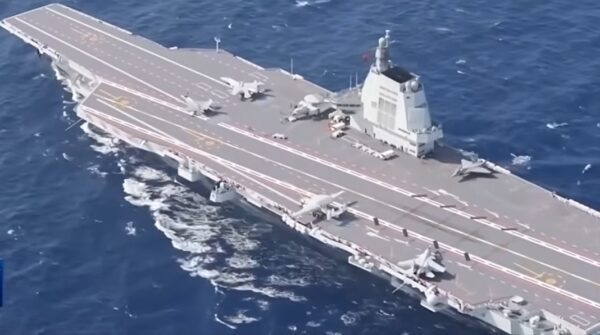
On June 23, China’s third aircraft carrier, Fujian, transited the Taiwan Strait. According to an official statementTaiwan’s Ministry of National Defense confirmed that the aircraft carrier had crossed the strait, prompting the Taiwanese military to activate “its joint intelligence, surveillance and reconnaissance measures to closely monitor” the ship’s movements.
The ministry also released a black-and-white aerial image of Fujian, taken from high altitude. Notably, no carrier-based aircraft was visible on the flight deck, although the ministry did not disclose the precise time or location where the photo was taken.

This image, released by Taiwan’s Ministry of National Defense on June 23, 2026, shows the Chinese aircraft carrier Fujian during a transit through the Taiwan Strait.
At first glance, this transit may appear to be part of routine training for China’s new aircraft carrier. But its strategic importance should not be underestimated. The passage through Fujian through one of Asia’s most sensitive waterways is part of a broader pattern of Chinese military and maritime law enforcement activities around Taiwan. Beijing’s Ministry of National Defense described the operation as routine training and said similar activities would continue in the future.
Foreign media have largely interpreted the transit in the context of Taiwan’s recent rapid combat readiness exercises and China’s increasing use of coast guard and maritime security vessels east of Taiwan. Taken together, these developments suggest that Beijing is experimenting with a multi-layered pressure campaign, combining naval and air power, coast guard control, and aircraft carrier training to test Taiwan’s responses in multiple domains.
However, the transit must also be assessed in light of the current status of the People’s Liberation Army Navy’s (PLAN) three-carrier force. Liaoning recently returned to its home port of Qingdao after more than 40 days of operations in the Western Pacific. Fujian’s current southward movement suggests that its next phase of training could focus on the South China Sea, potentially involving coordination with Shandong’s carrier air units or operating within the broader framework of China’s southern maritime strategy.
Yet the current size and maturity of China’s air force remains insufficient to fully support three operational carriers at the same time. Although China now has three aircraft carriers, its carrier-based aircraft, pilots, deck crew and maintenance capacity do not yet appear sufficient to meet the full operational requirements of a three-carrier navy.
This limitation is closely related to the different launch and recovery systems used by Chinese carriers. The PLA has long emphasized a “small steps, rapid” approach to naval modernization, using successive platforms to test and integrate new technologies. This approach enabled rapid technological progress, but it also gave rise to two distinct transport aviation systems. Liaoning and Shandong rely on ski jump launching systems, while Fujian is equipped with an electromagnetic aircraft launching system. As a result, China’s fleet of three aircraft carriers is not just three hulls. This requires the development and management of two different transport aviation ecosystems.
China’s industrial capacity is unlikely to be the main bottleneck; the Chinese navy can almost certainly build additional aircraft. The more difficult question is whether it has enough qualified carrier pilots and flight deck personnel capable of operating under two different launch and recovery systems.
Transport aviation is not simply an extension of land-based air operations. Pilots must master night operations, recoveries in bad weather, high-cadence launch and recovery cycles, complex electromagnetic environments, and the unique requirements of operating from a mobile deck at sea. The transition from ski jump operations to electromagnetic catapult operations adds another layer of complexity. Although the commissioning and testing of the Fujian marks a new milestone in Chinese aviation, it does not mean that the PLAN immediately acquired a mature combat capability.
If the PLAN were to attempt simultaneous full-deck deployments of all three carriers, the pressure would be considerable. If Fujian were to carry around 40 aircraft, Liaoning and Shandong would each also need their own air wings. In addition, the Navy would need backup aircraft, training aircraft, maintenance reserves, replacements for operational losses, and land-based training units. Concretely, China would need around 100 planes capable of transporting aircraft, as well as a corresponding pool of pilots, deck crew, maintainers and logistics personnel.
Under these conditions, Fujian could actually intensify the developmental pressure created by the coexistence of old and new systems. Liaoning and Shandong remain focused on the J-15 system, while Fujian is expected to integrate aircraft such as the J-15T, J-35, KJ-600 and J-15D. This will complicate training, maintenance, munitions support, avionics integration, cockpit procedures and pilot conversion.
Fujian’s southward movement also highlights the continued importance of the South China Sea in China’s maritime strategy. For Beijing, the South China Sea is not simply a sovereignty dispute; it is also a training ground for blue water naval operations. By moving Fujian south, the PLAN appears to shift the carrier’s training environment from near-shore waters to the semi-operational environment of the South China Sea. There, the carrier can take advantage of the supporting infrastructure in Sanya, Hainan Island, while putting pressure on the Philippines and U.S. military activities in the region.
The timing is also important: Fujian’s move came as Liaoning was returning to port, suggesting that China may gradually seek to establish a training and deployment circuit linking the Taiwan Strait, the South China Sea and the Western Pacific.
At the same time, China still does not have the capacity to support full operations on three aircraft carriers. The Shandong has reportedly been in a dry dock capable of carrying an aircraft carrier at the Yulin Naval Base in Sanya since late January 2026. Media reported in February that China was conducting its first aircraft carrier maintenance operation at Yulin, using dry dock facilities developed after 2022 to support repairs and maintenance of aircraft carriers. This suggests that the Shandong is undergoing a significant maintenance period rather than a short stopover. Open source satellite observers also noted in early May that images from April 26 still showed the Shandong in dry dock, more than three months after it entered the facility on January 20.
This trend suggests a probable division of labor between the three Chinese carriers. Liaoning is used for long-range power projection and operational signaling; Fujian remains in testing and training as China’s first electromagnetic catapult carrier; and Shandong is undergoing major maintenance work. In other words, China may have entered the era of three aircraft carriers, but it has not yet entered the era of three fully mature air wings and three complete maintenance and logistics systems operating simultaneously.
The strategic implication of transiting the Taiwan Strait through Fujian is therefore twofold. On the one hand, it demonstrates China’s continued determination to normalize aircraft carrier operations in politically sensitive waters and integrate aircraft carriers into its broader pressure campaign against Taiwan. On the other hand, it also reveals the constraints on the expansion of Chinese carriers.
The PLAN is evolving rapidly, but it is still learning how to support large-scale transport aviation. The key question is not simply whether Fujian can sail across the Taiwan Strait, but whether China can generate enough aircraft, pilots, deck crews, and maintenance capacity to support two or more carrier strike groups in continued, credible operations.
For Taiwan and the wider Indo-Pacific region, this means that Fujian should not be seen as a symbolic platform. Its transit reflects the direction of China’s naval modernization and its desire to connect the Taiwan Strait, the South China Sea and the Western Pacific into a single operational theater. But this event must also be interpreted with caution. The Chinese naval air force is becoming more and more efficient, but it remains in transition. Beijing has entered the three-carrier era, but not yet the era of fully mature three-carrier operations.