


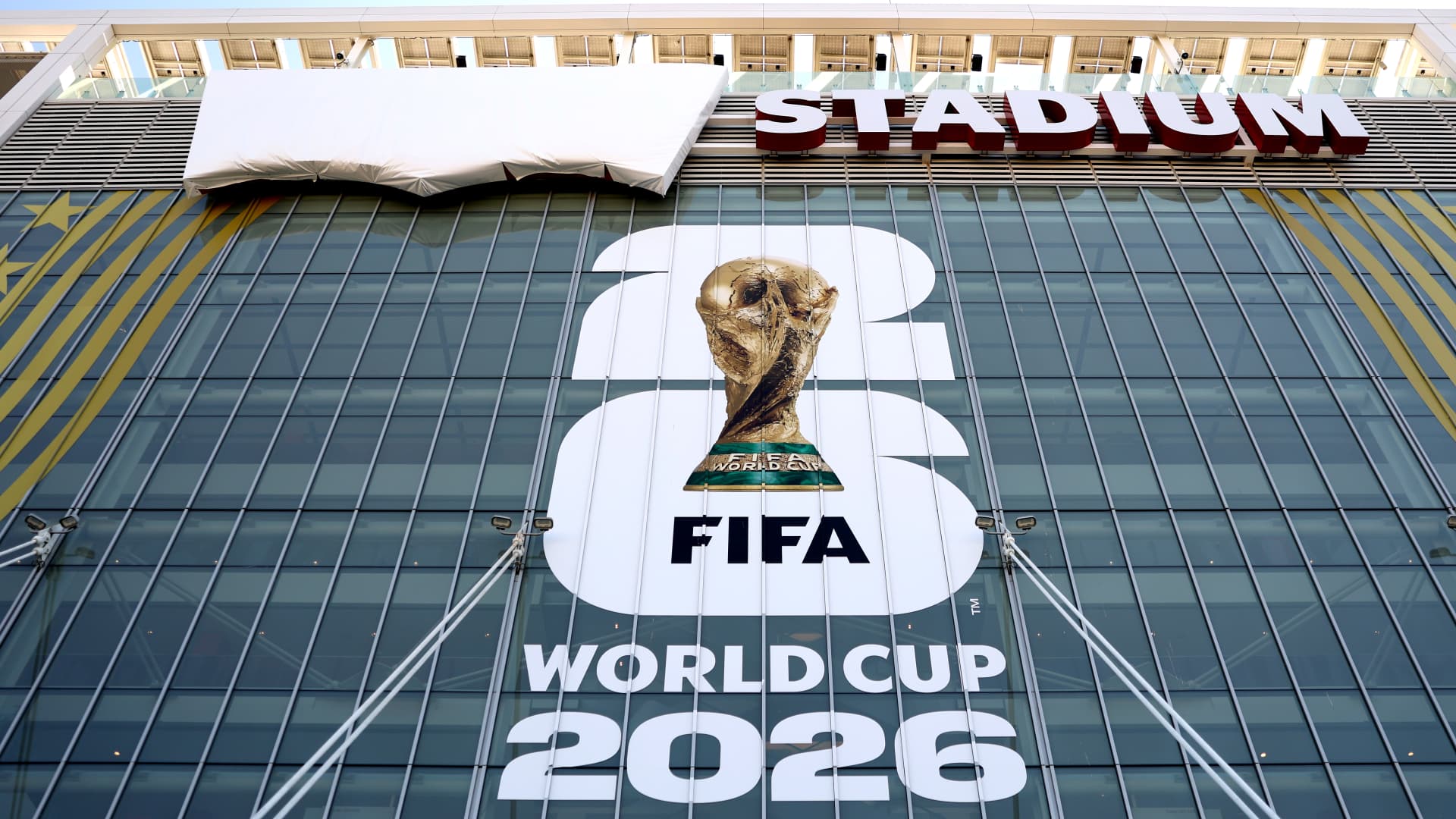
General view of the exterior of San Francisco Bay Stadium before the 2026 FIFA World Cup Group B match between Qatar and Switzerland on June 13, 2026 in Santa Clara, California.
Fran Santiago | Getty Images
As people around the world look ahead to this summer’s World Cup, some of the brands generating the most buzz aren’t even official sponsors of the tournament.
The list of official sponsors for this year’s World Cup, hosted in cities across the United States, Canada and Mexico, includes well-known names around the world like Adidas, Coca-Cola and Qatar Airways.
But before the tournament even began, the spotlight turned to companies like Lévi Strauss & Cie., Taco Bell and Texas-based convenience store chain Buc-ee’s. Some have gained traction on social media with their creative marketing strategies, while others have enjoyed an organic customer response thanks to the influx of international players and fans.
McDonald’s celebrated the tournament with limited-time dishes and cups. Taco Bell has leaned into a new campaign to support fans in celebrating or supporting depending on the outcome of a game.
Advertising spending for this year’s World Cup is expected to reach $10.5 billion, according to marketing research firm WARC Media. That’s just below spending on the 2018 World Cup, hosted by Russia, which totaled about $12.6 billion.
Market intelligence company Sensor Tower told CNBC that ad spending for the World Cup increased 42% week-over-week in the days leading up to the first match. The company found that Taco Bell and Duracell have both increased their ad spending in recent weeks, although the top 10 World Cup advertisers by spending over the past three months have been sponsors or broadcast partners of the event.
According to market research firm Meltwater, in the run-up to the World Cup, collaborations with unsponsored brands generated almost double the engagement of official sponsors, reaching around 61 million engagements compared to just 33 million.
The company told CNBC that while sponsored ads led in volume, distribution and creative quality, they helped propel non-sponsors to higher engagement, with the most social media engagement coming from TikTok.
Since the start of the tournament, non-sponsored brands have exceeded 57,000 mentions on social media, compared to just over 43,000 for official sponsors, the company said.
“A big takeaway from this World Cup is that you no longer need an official sponsorship to own the cultural moment,” Meltwater CEO John Box told CNBC. “The brands that will win the next tournament are not necessarily those with the biggest budgets, but rather those that are set up to see trends in real time, the creativity to connect them to your brand, and the speed to act before the moment passes.”
World Cup results
Kylian Mbappé’s Nike soccer cleats during a French national team training session at Bentley University in Boston, Massachusetts, June 20, 2026. The number 58 on the cleats represents goals scored by Mbappé for the national team.
Johnny Fidélin | Sports Icon | Getty Images
According to Meltwater, Coca-Cola and Adidas made up half of all sponsors mentioned in the build-up to the tournament. But in the last 11 days leading up to the June 11 opener, McDonald’s emerged as the big winner, with its engagement share rising from 2.6% to 23%.
Among non-sponsors, Lego accounted for 82% of the top 50 most engaging non-sponsor posts on social media platforms, Meltwater said. The construction toy company’s World Cup campaign produced a result 12 times higher than the sponsor average in the days leading up to the tournament.
Nikewhich is not an official sponsor of the tournament, has seen its World Cup advertising – featuring celebrities like Kim Kardashian, Travis Scott and Lebron James as well as dozens of World Cup stars like Norway’s Erling Haaland and Portugal captain Cristiano Ronaldo – garner more than 70 million views on YouTube.
Sneaker rival Adidas has around 7 million views for its ad featuring actor Timothée Chalamet, Argentina captain Lionel Messi and others.
That gap is indicative of the winners and losers in the off-court advertising battle during the tournament, according to Andrew Rohm, a marketing professor at Loyola Marymount University.
“It was just interesting to see how these two brands took totally different approaches to their four-to-five-minute content, and I loved Nike’s approach because it was totally on-brand, irreverent, unexpected, on the surface,” Rohm told CNBC. “You don’t have to be an official sponsor to be linked to the cultural and social importance of a global event like the World Cup, especially if you have assets like Nike that you can deploy in this direction.”
As for the advertising winners of this year’s World Cup, Rohm said it was a battle between “the expected and the unexpected.” Companies that are not official sponsors and therefore not restricted by FIFA are the ones that can have the most fun with their marketing, he said.
One brand that is making the most of its non-sponsor status is denim brand Levi’s.
Since the company was not an official tournament backer, its branding on the host stadium in Santa Clara, California had to be removed before matches.
The Levi’s logo, shaped like a jean pants pocket, was wrapped in a white coating – but the move counterintuitively generated buzz for the company on social media from amused fans. In the same spirit, the cover of the Gillette razor brand for its logo on the Massachusetts stadium imitated shaving cream foam to make light of the situation.
“What started as a restriction on sponsorship rights at Levi’s Stadium has become the most commented on and shared post in Levi’s history,” Kenneth Mitchell, Levi’s chief marketing officer, wrote last week. “Relying on it fully by changing profiles on our social media sealed the deal.”
Mitchell added that “strong brand iconography” worked on the company’s side, as its distinctive logo remained recognizable even under the covering.
According to Meltwater, Levi’s is the best example of non-sponsor visibility through its marketing, with its mentions increasing by 44% since the start of the World Cup. Engagement with the company increased nearly fourfold after it leaned into the stadium to cover marketing, the research firm found.
A changing advertising strategy
Jared Watson, an assistant professor of marketing at New York University’s Stern School of Business, said he saw brands having more fun with their marketing at this year’s tournament.
“I think what you’re seeing, especially this year, are these brands taking a rebellious or brazen approach when they’re not officially aligned with FIFA, and so a lot of consumers are supporting these marketing initiatives, in part because it seems somewhat contradictory to what’s going on,” Watson told CNBC. “It kind of removes that capitalist intention from FIFA.”
Watson said the brand’s success came not just from marketing, but also from some companies sensing consumer frustration with the commercialization of world football.
FIFA has introduced mandatory hydration breaks during matches, for example allowing more time for adverts without interrupting play. The breaks have drawn criticism from fans who say they are unnecessary and a financial drain.
“There’s a mentality of stick it to the man, we like to see these brands rebel and push back because it’s a bit of the spirit of the World Cup, which is unity and meritocracy,” Watson said.
FIFA said in December that the three-minute breaks were aimed at prioritizing “player well-being” and “were part of a targeted attempt to ensure the best possible conditions for players”.
Some brands have also seen more organic success as fans around the world experience the culture of World Cup host cities, posting about their newfound affinity for American general store chain Buc-ee’s and salad dressing company Hidden Valley Ranch.
“One of the things that we saw, which I think helped a lot of brands that maybe hadn’t decided to proactively jump into the advertising fray, was that we saw the joy that comes from basic American products,” Watson said. “This has allowed a lot of these brands to adapt or respond somewhat reactively to these trends and gain earned media.”
And in the age of artificial intelligence, marketing that creates an emotional connection and has human appeal stands out, according to Kelly Cutler, associate professor of marketing at Northwestern University.
“I think it’s particularly timely, because I think people are feeling a little sensitive right now with all the media around AI and all the talk around AI,” Cutler said. “So understanding on that human level how important it is whether your team wins or loses is so fundamental and creates such a bond.”
Cutler also said that marketing crosses generations: Younger consumers are more aware of when they are being sold to and are more often resistant. Companies that can develop a deeper connection with Gen Z will find “the golden goose of marketing,” she said.
For corporate sponsors constrained by FIFA regulations, she added, the World Cup could have broader implications for future brand partnerships.
“Organizations obviously want those sponsorship dollars, and they don’t want to have that type of situation where brands that don’t pay anything get a lot of traction and headlines and get really interesting results,” Cutler said. “So I think it will be interesting to see how this impacts future sponsorship programs.”