



Kohl’s was once a retail darling, carving out market share as a department store catering to the middle-income American consumer with coupons and deals that built loyalty.
But over the past five years, Kohl’s shares have lost nearly 70% of their value, plummeting as the retailer reported weak sales.
As department stores struggle to stay relevant and middle-income consumers face budget pressures, Kohl’s is now trying to reinvigorate its sales by building on its core value proposition and investing in the in-store experience to ensure customers find what they need and come back for more. Although Wall Street analysts say the retailer still has work to do, investors have started to take notice: Kohl’s shares have soared more than 130% in the past year.
“For us, it’s really about making sure we choose a path,” CEO Michael Bender told CNBC. “Sitting in the middle of the retail landscape like we do, selling products like we do, which are admittedly more discretionary than others, means you have to choose a lane and decide who you’re serving, and that you really, really understand that customer.”
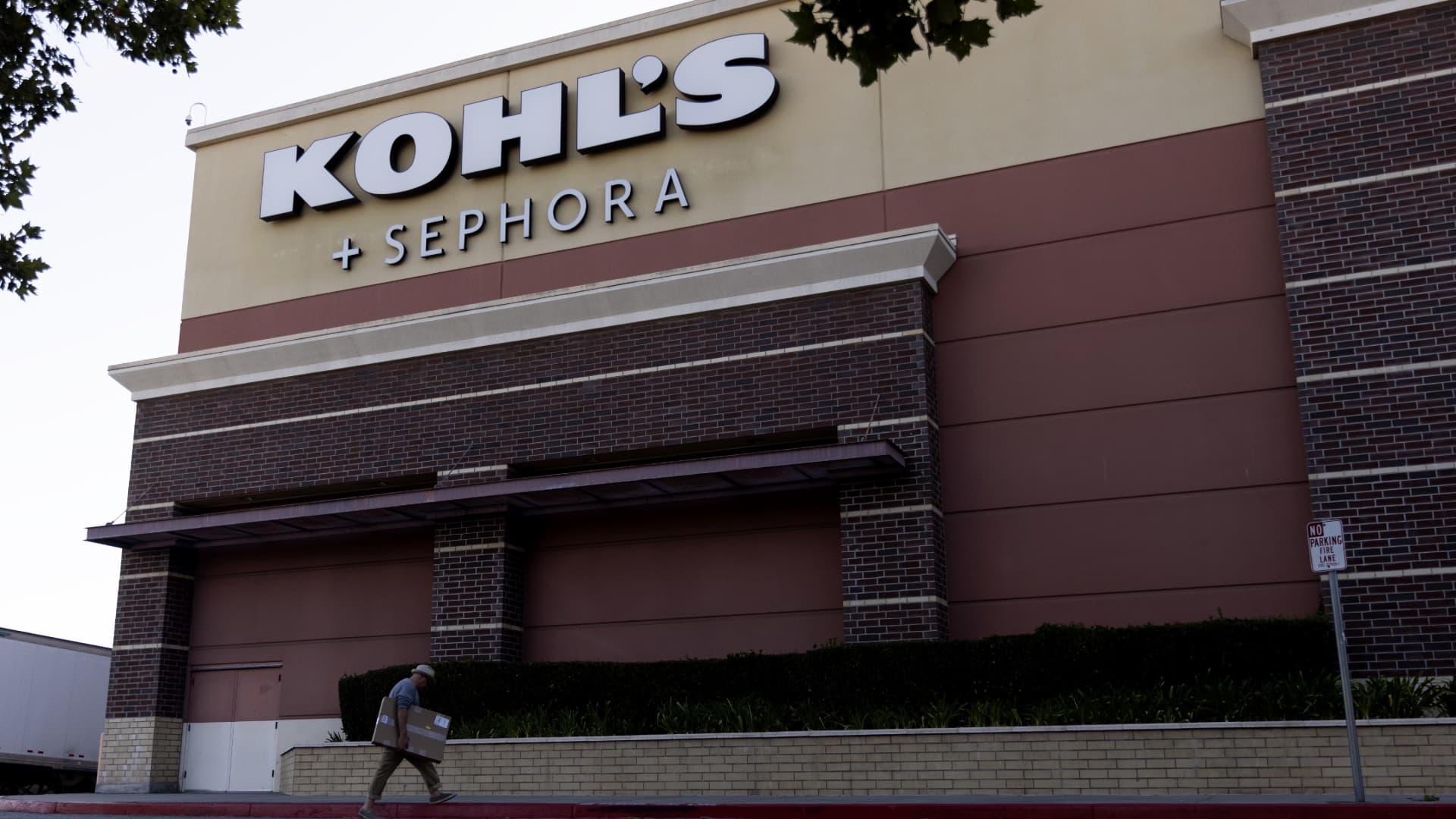
A Kohl’s store in Sun Valley, California on July 22, 2025.
Alisha Jučević | Bloomberg | Getty Images
The company, which went public in 1992, peaked in the early 2000s as department stores gained traction in the United States. Kohl’s was known for its value, exclusive brands, coupons and Kohl’s cash rewards, enjoying success alongside other department store chains like Macy’s and Bloomingdale’s.
At its peak, Kohl’s had significant market share, with its stock reaching an all-time high of $82 per share in late 2018 and the company reporting revenue of $20.23 billion for the fiscal year ended February 2019.

Kohl’s 5-year chart
But soon after, the retailer began to lose ground. While department stores generally struggled during this time, Kohl’s also faced specific issues that contributed to its revenue decline.
“As a department store, they’ve been struggling for several years,” Chuck Grom, an analyst at Gordon Haskett, told CNBC.
Today, the company is striving to stabilize its activity, return to growth and regain a customer base that Bender said Kohl’s never completely lost.
Lose your core
By changing its assortment, limiting the use of coupons and shifting to lower-price retailing rather than exclusive brands, Kohl’s “alienated” its core customers, forcing them to go elsewhere, Grom said.
Grom, who has covered Kohl’s for years, said the retailer made a mistake by switching to an off-price retailer.
“I think businesses need to understand who their customers are and not try to become someone they’re not,” he said. “I think too often retailers want to become what someone else is, and that can often backfire.”
It’s a move that Bender says put Kohl’s on the wrong path, leading to years of stagnant sales, declining foot traffic and “drift” in business strategies. The company has experienced rapid executive turnover and changes in its credit card and promotional offerings, also due to increased competition.
“We’ve made some decisions where we’ve removed categories, for example small and jewelry, we’ve talked about this in previous earnings conference calls and in other public discussions, these are categories, for example, that are not substitutable,” Bender said. “We stopped listening to the customer.”
Kohl paid the price. Wall Street has lost confidence in the retailer, which has recorded declining sales quarter after quarter. At the same time, competitors like Walmart And TJ Maxx were grabbing market share left by Kohl’s, and online retailers such as Amazon were growing up.
It has also become harder to win over cost-conscious consumers hit by high inflation in recent years as more retailers place a premium on value.
“There’s still this concern about the ability of department stores to grow for a significant period of time? There’s a lot of competition in terms of lower-priced, direct-to-consumer specialty brands,” said Blake Anderson, an analyst in charge of Kohl’s at Jefferies. “The industry has really evolved over time, and I think the way Kohl’s has competed has been heavily tied to value, and so it becomes very difficult to win that customer based on value.”
Sonia Lapinsky, managing director of retail at consultancy AlixPartners, said consumer pressure, coupled with the downfall of the traditional department store model, meant the economy as a whole was not on Kohl’s side either.
“They’re looking for options that give them the best value,” she said. “They want value, they want brands, they want the cheapest price possible. And there are a lot of compelling propositions from these other retailers.”
Lapinsky added that priorities at Kohl’s changed several times after the company’s peak, which led in part to its decline.
“Over the years, we’ve seen a lot of changes in strategy at Kohl’s, particularly whether they’re going into athleisure, or they’re doubling down on fashion, or now they’re developing private brands, and it’s kind of a constant shift in what the customer can expect when they walk into the store,” Lapinsky told CNBC. “I think it caused some confusion.”
Turn the page
Since Bender took over as CEO in late 2025, he said he’s focused on returning to what’s always worked for Kohl’s: exclusive brands, value, coupons and ensuring customers will reliably find the products they want at the right prices.
“At that time, Kohl’s was known for taking care of families and making sure there was assurance that what they were looking for, the added value, would be available to them,” Bender said. “We think part of restoring that theme that Kohl’s was famous for back in the day is still relevant today. Customers want convenience.”
In its latest earnings report last month, Kohl’s posted its best comparable sales growth in four years, even as its revenue declined. The retailer reported revenue of $3 billion, beating Wall Street estimates, and forecast full-year net sales and comparable sales to be in a range of down 2% to flat.
At the time, Bender said the quarter marked Kohl’s “knocking on the door of growth.” The stock rose 20% following the report.
Grom, the Gordon Haskett analyst, said he believed that if Kohl’s had not returned to its core identity, it would have been “problematic” for the retailer.
“I think their strategy makes a lot of sense right now,” Grom said. “I think getting back to who they are will be important to their success.”
Kohl’s, which traditionally caters to older shoppers, is also working to capture younger consumers, including through its Sephora shop-in-shops, designed to attract Generation Z to the store.
Although Sephora stores struggled slightly in the retailer’s most recent quarter — Bender saying on a call with analysts that the business was “underperforming” and declined by a low single-digit percentage — it has historically generated billions in sales and growing momentum.
“What’s been a really interesting development for them is a creative use of their square footage and a way to try to generate not only sales but also new, younger customers,” said Anderson, the Jefferies analyst. “There’s often a pushback against department stores because they were created during a different generation and some customers are actually older, so it’s important to make sure they remain relevant to younger consumers.”
Bender said the younger generation is “who we can grow with in the future,” as Kohl’s works to convert this customer to shop deeper into the store after joining Sephora.
Despite Kohl’s progress, Wall Street may not yet be convinced the company is becoming a household name again.
In a June note, TD Cowen analysts wrote that they believed the company was “making the right strategic decisions” but rated the stock on hold due to underperformance in the apparel and footwear sectors.
“Kohl’s remains a ‘show me’ story, but results look better than expected with [comparable sales]”, analysts wrote after the latest earnings report. “We continue to view simplified promotions, inventory rebalancing and leveraging junior success as the keys to the turnaround. On the face of it, product and inventory progress is encouraging, although pressure on the core credit consumer and ‘other income’ remains a key issue. »
Lapinsky said that because of its reputation for deals and promotions, Kohl’s must offer a strong value proposition in addition to a compelling in-store experience, which sets it apart from other retailers.
“They have to have a compelling product offering, they have to have the right prices, they have to have the product that consumers want to go into the store and know that they’re getting the best deal – that’s really what the consumer is looking for, and that’s why they went elsewhere,” she said.
Lapinsky added that while Kohl’s is clearly working to improve its balance sheet and bottom line, the market will have to wait to see how it performs in the face of growing competition as it tries to win back customers.
Nonetheless, Bender said that while the signs of recovery are encouraging, it is only the first step in a longer path toward the “neighborhood” of growth.
“We’re not there yet,” Bender said. “I don’t want anyone to feel like we planted this flag and said, ‘It’s over.’ Honestly, we’re still at the beginning, but we’re moving in a much more positive direction and aligned with a lot more clarity on where we want to take the company. »