


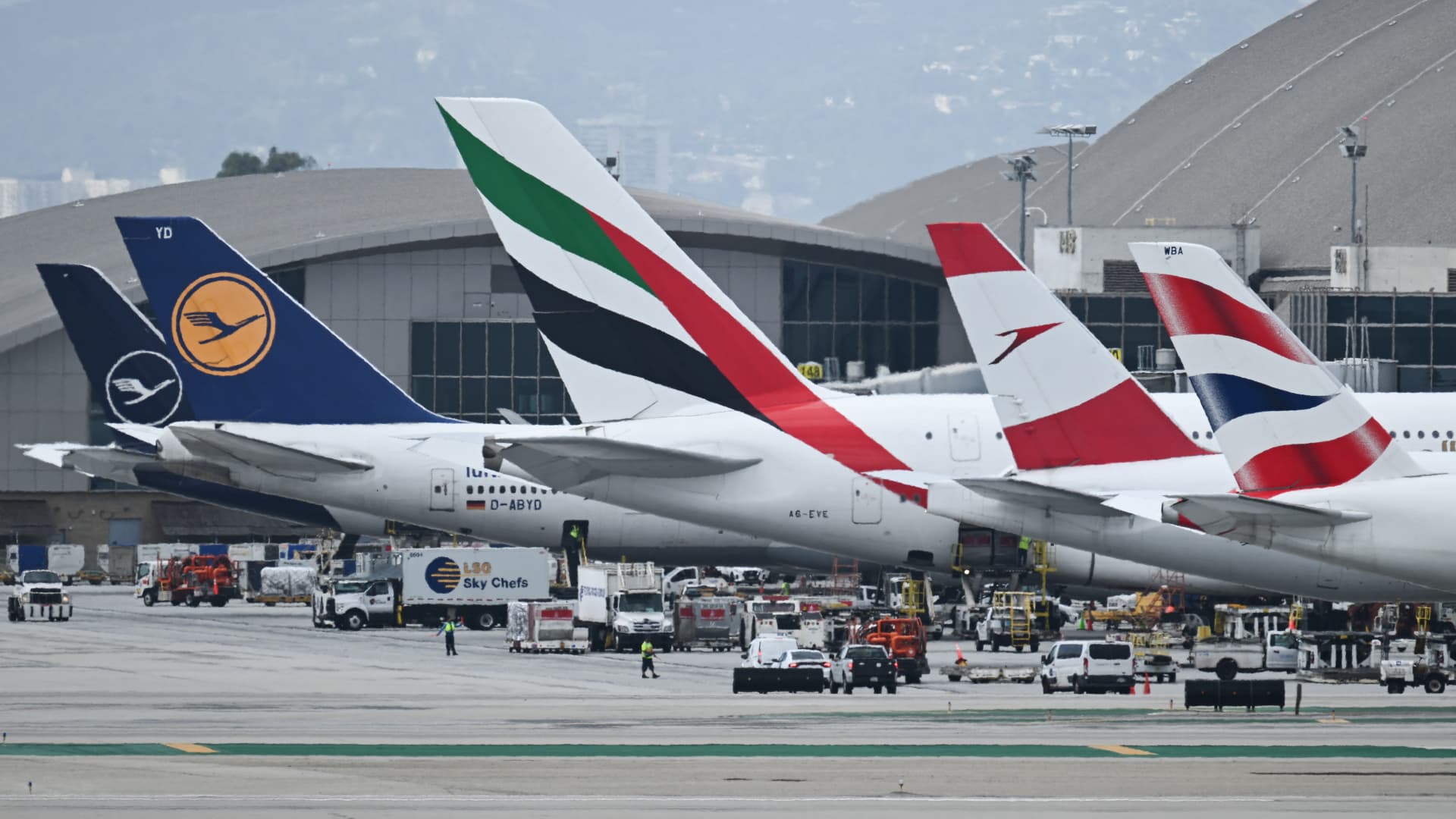
Ground crews load cargo and supplies onto planes from airlines including Lufthansa Group, Emirates, Austrian Airlines and British Airways while parked at the Tom Bradley International Terminal (TBIT) at Los Angeles International Airport (LAX) in El Segundo, California, September 11, 2023.
Patrick T. Fallon | Afp | Getty Images
RIO DE JANEIRO — Hundreds of airline executives gathered in Brazil this week for the annual meeting of the International Air Transport Association to discuss, among other things, high fuel costs, sharp declines in profits, engine reliability problems and elusive emissions reduction targets.
Toward the end of the meeting in Rio de Janeiro, news broke that Iran and Israel exchanged strikes for the first time since a ceasefire took effect in April. For airline executives who have faced ongoing unrest since the first U.S. and Israeli strikes on Iran on Feb. 28, this appears to be just one more incident in the devastating chaos of 2026. The stance of these airline executives thus far has been to wait and see.
Here are some takeaways from the gathering:
Profits falling
Fuel costs have more than doubled in some areas since the start of Iran’s war, with the Strait of Hormuz, a key shipping lane, effectively closed for most of the time.
IATA said airlines around the world will absorb a $100 billion increase in fuel costs this year, which, combined with airspace closures due to attacks in the Middle East reducing travel, will likely cut airline profits in half this year.
Willie Walsh, the organization’s outgoing chief executive, said net profits would fall from $45 billion in 2025 to $23 billion in 2026, and net margins would fall from 4.2% last year to 2% this year.
As fares rise, airlines haven’t been able to cover the entire fuel bill this year, so profits will take a hit.
Travel demand is resilient, but winter is coming
Airline executives told CNBC that customers continue to book.
Etihad Airways, based in Abu Dhabi, United Arab Emirates, first felt the effects of unrest in the Middle East this year with lower demand. But Etihad Aviation Group CEO Antonoaldo Neves said in an interview that the number of tickets was about the same as before the conflict, seasonally adjusted.
United Airlines CEO Scott Kirby, who runs the second-most profitable airline in the United States, said customers continue to book even though fares have risen about 20% and could rise further if fuel costs continue to rise.
He said the resilience of reservations surprised even him. “I think the economy is stronger than people think,” he told CNBC in an interview. The United States is also better protected from oil shocks than other regions due to its large production.
Summer bookings are strong and airlines are also managing capacity better in the face of high fuel prices, cutting more unprofitable routes and reducing frequencies. The big question remains what will happen after the main summer and fall peaks.
“This bodes well for a peak summer season in the North,” Walsh said of current trends. “The big unknown is how long travelers and shippers can tolerate the higher costs of connectivity.”
The other question is where fuel prices go from here.
“If prices stay the same, yes, for sure, fewer people will be able to afford to travel,” said Kamil Al-Awadhi, former CEO of Kuwait Airways and IATA vice president for Africa and the Middle East.
The FOMO plane keeps coming
Airplane makers said they were not seeing a slowdown in orders due to rising fuel prices.
Airbus and Boeing will continue to sell some of their most popular jets into the next decade. Airlines typically plan their fleet growth years in advance, and most of the price of a plane is paid at the time the carrier receives it.
Etihad’s Neves told CNBC it wants to buy even more planes to supplement its existing order book of dozens of planes, although he didn’t give a number, saying only that it was “more than 10.”
A spokesperson for Brazilian aircraft maker Embraer said one of the risks was that customers would not exercise their options to increase their existing orders, but so far the company has not realized this.
Boeing is expected to release its orders and deliveries for May on Tuesday morning.
High fuel prices could kill other airlines
U.S. low-cost airline Spirit Airlines succumbed in May to years of problems. The company had faced an engine recall, a failed merger and changing consumer tastes, all while managing a mountain of debt. But rising fuel prices were the straw that broke the camel’s back for the discounter, he told the U.S. Bankruptcy Court this spring.
IATA’s Walsh told the conference that high fuel costs could also push other airlines out of business.
This means that more profitable, cash-rich carriers, which have been more successful in capitalizing on the K-shaped economy and the shift in demand toward high-priced luxury travel, are in better shape than some more price-sensitive carriers.
“Engineering marvels” at what cost?
Airline CEOs are frustrated with engine manufacturers who have promised increased fuel efficiency in next-generation engines. The fuel savings are there, but they are being swallowed up by disappointing reliability that is forcing airlines to have engines serviced sooner than they thought, executives said.
Furthermore, their production is not sufficient to satisfy carriers, because Boeing and Airbus is accelerating its production.
Alexis von Hoensbroech, CEO of Canada’s WestJet, told CNBC in an interview before the IATA meeting that the new engines promising fuel savings of around 15% or more over previous models were “engineering marvels.”
“However, as you push the limits, sometimes it comes at the cost of reliability, and what we’re all seeing is that these engines are having to undergo unscheduled maintenance much more frequently than previous generations of engines,” he said.
Companies like GE Aerospace and Rolls-Royce, which enjoyed a windfall from increased demand, said it had been busy with fixes and increased overhaul capacity.