


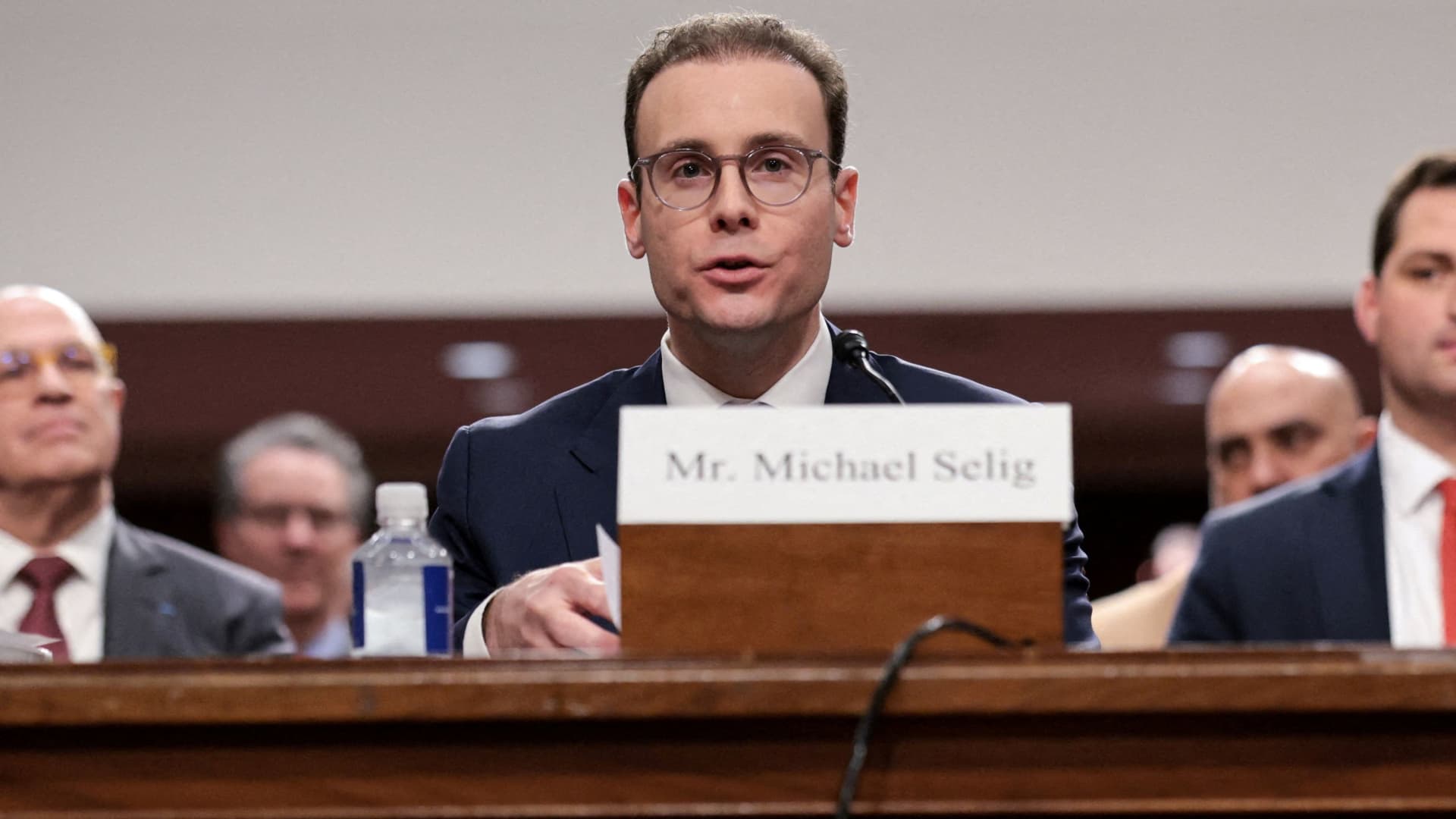
Michael Selig, President Donald Trump’s nominee for chairman of the Commodity Futures Trading Commission, testifies during a Senate Agriculture Committee hearing on his nomination on Capitol Hill, November 19, 2025.
Jonathan Ernst | Reuters
The Commodity Futures Trading Commission filed an amicus brief in federal court Tuesday to assert the agency’s right to enforce prediction markets instead of individual states, according to its new chairman, Michael Selig.
Selig argued in an opinion piece published Monday in the Wall Street Journal that the CFTC has always had authority over prediction markets and determining whether event-driven contracts constitute gambling, as critics claim. Selig noted nearly 50 active lawsuits against prediction markets and said the CFTC would step in to prevent state encroachment.
“The CFTC will no longer stand idly by while overzealous state governments undermine the agency’s exclusive jurisdiction over these markets by seeking to establish statewide bans on these exciting products,” he wrote.
The move comes as prediction markets like Kalshi and Polymarket face legal challenges in several states over event contracts. The platforms allow users to bet on the outcomes of events in pop culture, sports, entertainment and more.
Critics of prediction markets have argued that the offerings amount to little more than gambling, although Kalshi has defended his platform and maintained that it complies with federal regulations. Sports betting on prediction platforms has been compared to legalized sports betting in the United States.
In his first public comments as CFTC chairman in late January, Selig said he was prepared to draft clear new rules to govern prediction markets and review the agency’s rules on participation in federal and circuit court cases.
“When questions of jurisdiction are at stake, the Commission has the expertise and responsibility to defend its exclusive jurisdiction over commodity derivatives,” he said at the time.
In his Monday op-ed, Selig said event contracts “serve legitimate economic functions” and operate under CFTC rules as “exchanges” rather than games of chance. He also said that negotiating event contracts is good for the market and for Americans in general.
“These exchanges are not the Wild West, as some critics claim, but self-regulatory organizations that are reviewed and supervised by experienced CFTC staff,” Selig wrote.
In a video posted Tuesday on X, Selig said his message to those challenging the CFTC’s authority is clear: “We’ll see you in court.”
“Today, the CFTC takes an important step to ensure that these markets have their place here in America and have the integrity, resilience and dynamism that our derivatives markets deserve,” he said.
Selig said the amicus brief would be filed with the Ninth United States Circuit Court of Appeals to support Crypto.com in its dispute with the Nevada Gaming Control Board.
CNBC could not verify that the amicus brief had been filed.
Disclosure: CNBC and Kalshi have a business relationship that includes a minority investment from CNBC.