


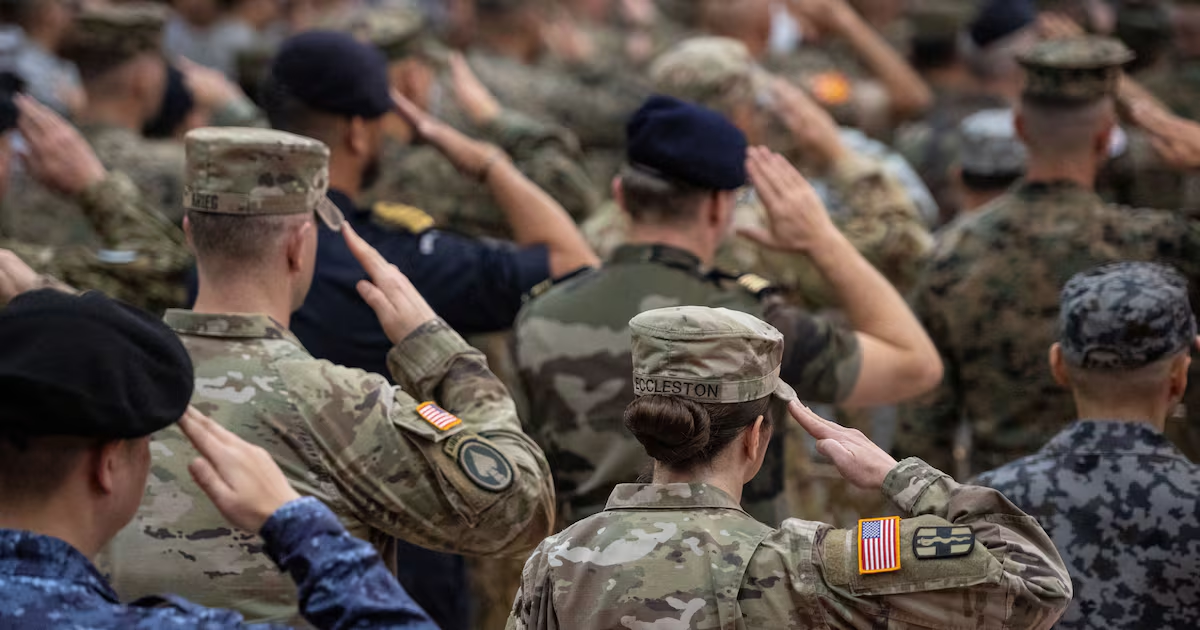
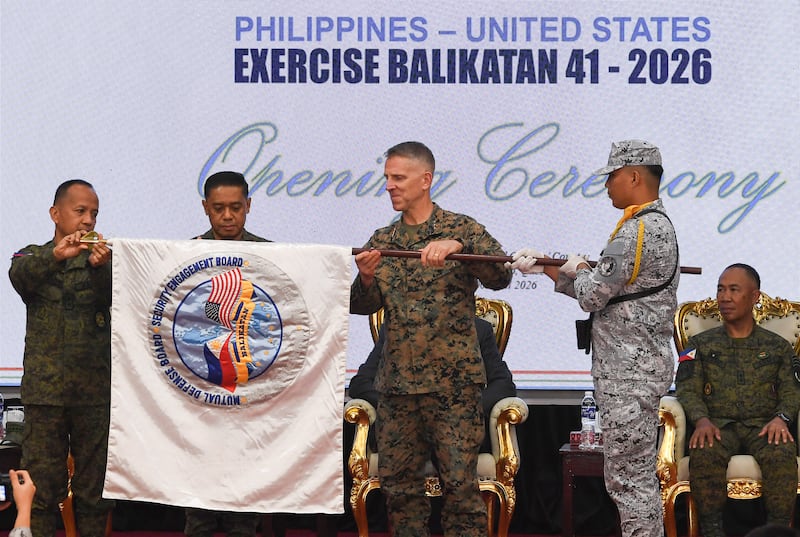
MANILA, Philippines — The Philippines is slowly moving toward a “more active defense posture,” analysts told Radio Free Asia, as Manila and Washington launch the largest iteration of their annual war exercises this week.
The increased scope of the “Balikatan” exercises reflects the Philippines taking a more decisive role in its own defense, while remaining strongly committed to its bilateral alliance with the United States, analysts say.
Although officials behind the “Balikatan” drills do not mention China by name, the war drills are taking place against a backdrop of growing Chinese tensions at sea. Japan, which like the Philippines also faces territorial challenges from China in the East China Sea, is taking a more direct and active role in this year’s drills, reflecting its growing defense ties with Manila.
A total of 17,000 people are participating, including 10,000 from the United States and 7,000 from the Philippines and partner countries Japan, France, Canada and Australia.
Active defense posture
The Philippines’ gradual shift to an “active defense posture” reflects growing defense dynamics in the region, as China sees greater opposition from weaker neighbors seeking to strengthen themselves by uniting, analysts say.
“For years, Manila has operated within a relatively constrained framework, relying heavily on its alliance with the United States,” Arnaud Leveau, president of the Paris-based Asia Center think tank and assistant professor at Paris Dauphine University, told RFA. “What we are seeing today is a progressive effort to assert greater capacity for action while remaining firmly anchored in this alliance. »
Manila’s greater control over its defense is an indication of its adaptation to the current geopolitical climate, he said.
“I see it as a rather calibrated adjustment to changing circumstances. In this context, signaling a determination should not be seen as an escalation, but rather as a form of deterrence,” he said. “Repeated incidents at sea have shown that ambiguity can give rise to more pressure. »
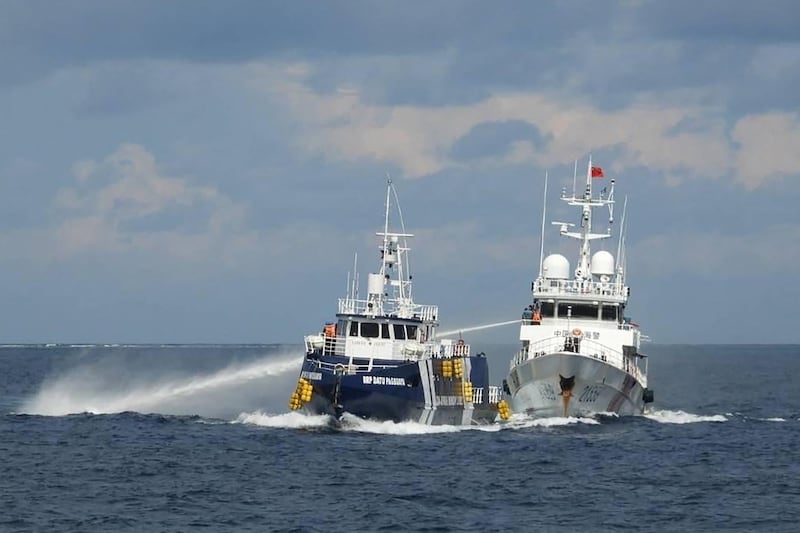
Chinese provocations at sea have become increasingly frequent in recent years. Earlier this month, China erected a floating barrier on the disputed Scarborough Reef to block access to Philippine fishing boats. Around the same time, the Philippine Navy spotted ten Chinese coast guard vessels attempting to impose a blockade.
Previous incidents have included Chinese ships blasting or even ramming Philippine fishing boats with water cannons.
Although Manila can show its resolve through this year’s Balikatan, maintaining efforts to be more active in its own defense will remain a challenge, Leveau said, adding that moving to “more credible capabilities” requires real investments in command structures, improving logistical resilience as well as maritime awareness.
Victor Andres Manhit, president of Manila-based defense think tank Stratbase Institute, told RFA that the Philippines needs to “fully operationalize its active defense posture” to thwart China’s ever-increasing territorial threats.
This year’s Balikatan figures “represent the right path forward” to meet the challenge, Manhit said. This sends a “clear and unambiguous message…that the Philippines and its partners are prepared to defend the rules-based international order against coercion, intimidation and unlawful demands.”
The Philippines in July will mark the 10th anniversary of an international arbitration tribunal’s 2016 ruling that invalidated China’s vast territorial claims in the maritime region. This historic decision is welcomed internationally, even if China continues to reject it.
Increased participation in Balikatan from countries other than the United States highlights the importance of Manila establishing partnerships with its allied neighbors, Manhit said. “It affirms that we are not isolated and that our national security is anchored in strong alliances with nations that respect international law and share our commitment to a free and open Indo-Pacific. »
Evolving Alliance
Philippine Armed Forces Chief Gen. Romeo Brawner, in a ceremony where he declared the war drills open Monday, said the exercises served to amplify the “strength of an alliance” and shared responsibility for securing the region.
“For more than three decades, Balikatan has been a living testament to the partnership between the Philippines and the United States. A partnership that has become stronger, more responsive and more relevant with time,” he said.
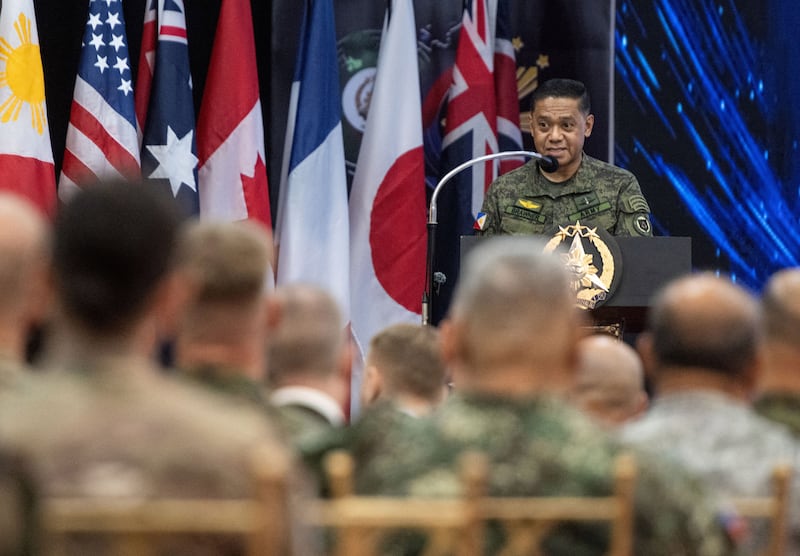
Brawner said participating countries “remain guided by a shared commitment to uphold international law, respect sovereignty, and contribute to a free and open Indo-Pacific where nations can prosper without coercion.”
“We’re building more than capabilities. We’re building systems that think, move and respond as one,” he said. “Let me emphasize this. Balikatan is preparation made real, cooperation put into action and peace preserved through our strength.”
Observers told RFA that the joint exercises have become a forum in which all participants can deploy their combined forces, including Japan, which, before taking on a combat role at Balikatan this year, had participated in an observer or limited capacity in previous iterations.
Japan, for its part, is “aligning its operational posture with the realities of increased friction in the South China Sea and in the Indo-Pacific region as well,” Leveu said, adding that the annual Balikatan exercises have evolved “into a platform for more flexible, mini-lateral forms of cooperation” that complement a U.S.-centered alliance.
Lucio Pitlo, a foreign policy expert at the Philippine Association for Chinese Studies, told RFA that Japan’s growing military commitments in the region reflected its gradual shift from its post-World War II pacifist stance, with Tokyo remaining in step with U.S. defense initiatives in the region.
“Japan has increased its security profile in the region in recent years, driven by changing domestic views and regional and global developments,” Pitlo said. Manila and Washington welcome this development, because “it has expanded our network of defense partners and increased allied access to our territory.”
Edited by Eugene Whong.