


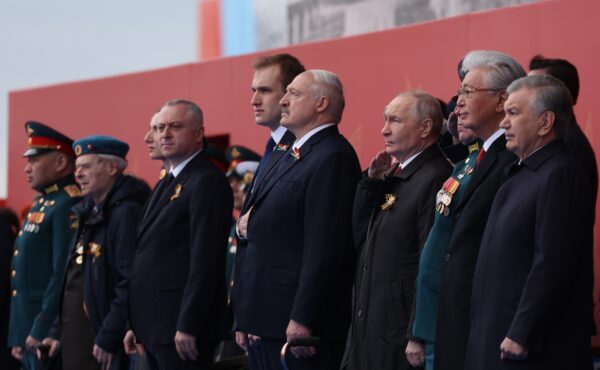
Two Central Asian leaders were among the small group who joined Russian President Vladimir Putin on Red Square to mark the 81st anniversary of the end of World War II in Europe on May 9.
As expectedRussia’s Victory Day military parade has been significantly toned down this year. Lasting only 45 minutes, it included no heavy equipment – neither tanks nor missiles. There were, however, North Korean soldiers participant in the parade.
While all five Central Asian leaders had traveled to Moscow for the parade in 2023, 2024 and 2025, this year only Kazakh President Kassym-Jomart Tokayev and Uzbek President Shavkat Mirziyoyev made the trip. Kyrgyz President Sadyr Japarov was in Moscow to meet Putin in late April, immediately after Kyrgyzstan was imposed secondary sanctions by the European Union.
Last year, on the 80th anniversary of the defeat of Nazi Germany, 27 world leaders attended the parade. This year, only five world leaders – from Belarus, Kazakhstan, Uzbekistan, Malaysia and Laos (in addition to the leaders of South Ossetia and Abkhazia, not internationally recognized) – were present. Slovak Prime Minister Robert Fico was in Moscow and met with Putin, but did not attend the parade.
Before May 9, Russian defense officials said that due to “the current operational situation,” there would be no armored vehicles or missile systems in the parade for the first time in nearly two decades. Concerns about Ukrainian drone strikes may have limited the list of participants.
Nonetheless, Tokayev and Mirziyoev made the trip to Moscow and met with Putin on May 8 before joining him for the toned-down parade.
In the Russian reading Regarding Tokayev’s meeting with Putin, the Russian leader emphasized the symbolism of Tokayev’s visit.
“It is especially nice to see you today and tomorrow because, despite everything that happened around this event, you found the opportunity to come to Moscow and be with us, with Russia, during these days. And this is the best proof of the true level of relations between Kazakhstan and the Russian Federation,” Putin said.
In response, Tokayev waxed poetic in honoring those who fought to defeat fascism and told Putin that Astana was “intensively preparing for his state visit at the end of May.”
In his meeting with MirzioevPutin had much the same tone.
“We recognize that in the current circumstances, our meetings, even on celebratory occasions, are a manifestation and a sign of a special relationship. A relationship that is not just of friendship, I would say, of fraternal interaction,” Putin said. He also personally paid tribute to Mirziyoev for the development of relations between Russia and Uzbekistan in recent years.
These interactions illustrate something of a reversal in Russia’s relations with much of Central Asia. Given Russia’s size and their complex political history, Central Asia is often portrayed (or miscast) as a junior partner. It is Central Asia, in this formulation, which needs Moscow. And Central Asia does, to some extent. But the needs cut both ways today (and perhaps still do): Russia, more than ever, needs friends – or at least partners who don’t mind being presented as friends in public.