


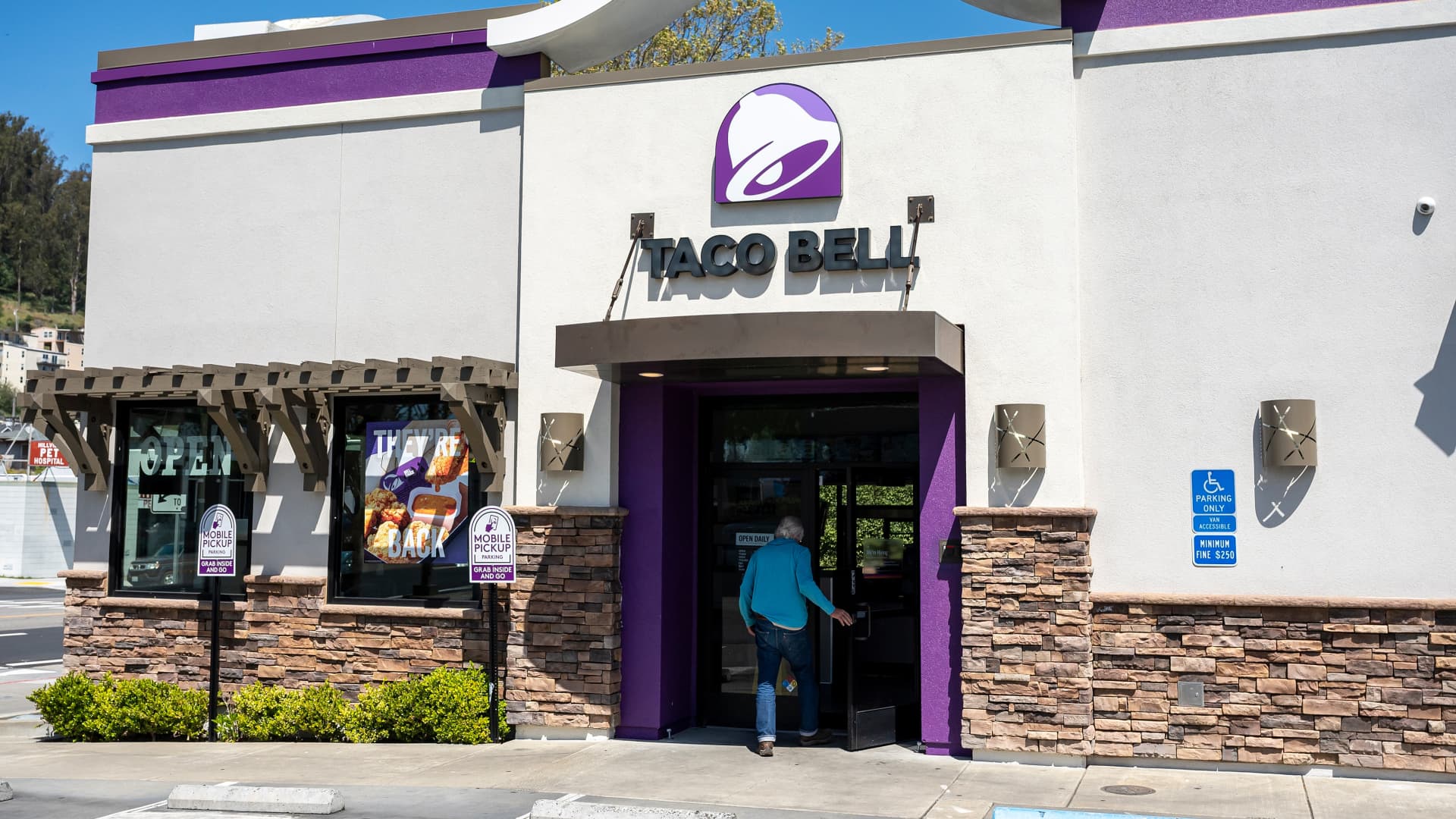
A customer enters a Taco Bell restaurant in El Cerrito, California, United States, Tuesday, April 29, 2025.
David Paul Morris | Bloomberg | Getty Images
Yum Brands Mixed quarterly results were released on Wednesday, despite strong demand for Taco Bell.
Here’s what the company reported for the period ended Dec. 31 versus what Wall Street expected, based on a survey of analysts by LSEG:
- Earnings per share: $1.73 adjusted versus $1.77 expected
- Revenue: $2.51 billion versus $2.45 billion expected
Yum reported fourth-quarter net income of $535 million, or $1.91 per share, compared with $423 million, or $1.49 per share, a year earlier. The company’s tax rate was higher than Wall Street expected, according to Kalinowski Equity Research.
Excluding tax benefits, acquisition costs and other one-time items, the restaurant company earned $1.73 per share.
Net income rose 6% to $2.51 billion.
Yum’s global same-store sales increased 3%, fueled by strong performance at Taco Bell and in KFC’s international markets.
Taco Bell’s same-store sales climbed 7% in the quarter, beating Wall Street expectations of 5.6% growth, according to StreetAccount.
The Mexican-inspired chain is the crown jewel of Yum’s portfolio, consistently outperforming the fast food industry as a whole, thanks to a blend of value offerings and lively menu items. The chain is stealing market share from competitors and consumers ages 18 to 24 are flocking to its restaurants, Chris Turner, Yum’s CEO, said during the company’s conference call.
KFC saw its global same-store sales increase by 3%. The fried chicken chain’s international locations saw same-store sales growth of 3%, while U.S. restaurants saw same-store sales increase 1%.
Wall Street analysts expected KFC to report same-store sales growth of 2.1%, according to StreetAccount.
KFC is experiencing a turnaround in its home market, where it has ceded market share to newcomers like Raising Cane’s in recent years. To win back customers, the company is taking a page from Taco Bell’s successful playbook. The chain plans to unveil new menu items, like sauces and drinks, at a faster pace than before. The chain will also work to offer its customers more affordable options, whether “low-cost, cost-effective products” or targeted individual offers, executives said during the company’s conference call.
And once again, Pizza Hut was a portfolio laggard. The struggling pizza chain reported its same-store sales fell 1%, led by a 3% decline in the U.S. and slightly beating Wall Street estimates of a 1.7% decline in the period.
In November, the company announced it would explore strategic options for Pizza Hut. Yum said Wednesday that the review had begun but did not share further details.
“At this time, we intend to finish reviewing options this year,” Turner said. “Given the current nature of the process, we cannot share further details about the strategic review.”
While Pizza Hut is under review, Yum is also implementing a strategy that will serve as a “bridge to longer-term brand acceleration,” according to CFO Ranjith Roy. As part of the plan, Pizza Hut will close approximately 250 underperforming U.S. locations during the first half of the year.