


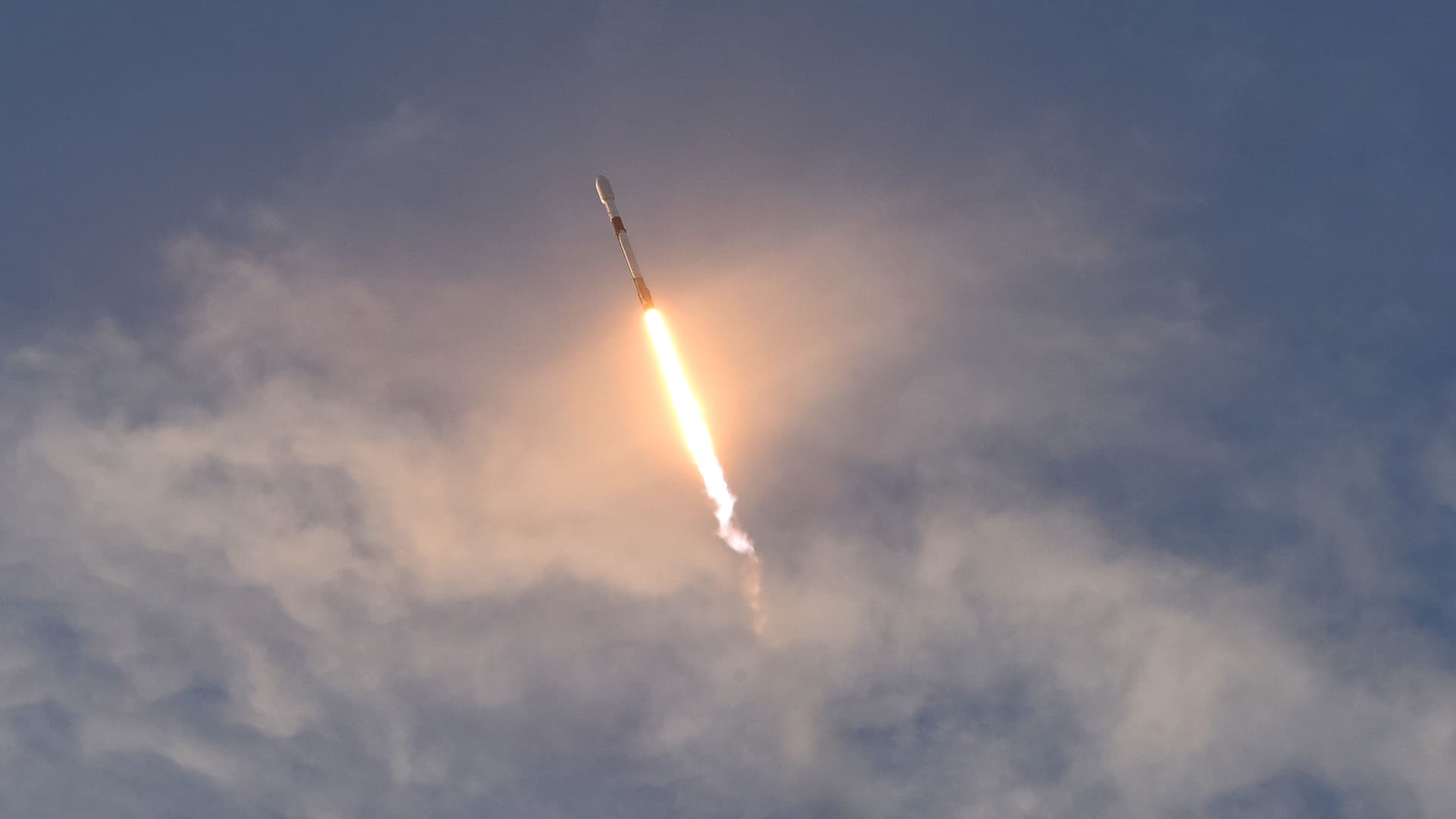
As seen from Canaveral National Seashore, a SpaceX Falcon 9 rocket carrying 60 Starlink satellites launches from Pad 39A at the Kennedy Space Center October 6, 2020 in Cape Canaveral, Florida. This is the 13th batch of satellites put into orbit by SpaceX as part of a constellation designed to provide high-speed internet service around the world. (Photo by Paul Hennessy/NurPhoto via Getty Images)
Nuphoto | Nuphoto | Getty Images
A version of this article first appeared in CNBC’s Inside Wealth newsletter with Robert Frank, a weekly guide for wealthy investors and consumers. Register to receive future editions, straight to your inbox.
Billionaire investment firms, including former eBay Chairman Jeff Skoll and AutoZone’s Pitt Hyde, are expected to reap the rewards of SpaceX’s IPO this Friday.
However, while SpaceX’s profile eclipses that of almost every other private space company, family office investors told CNBC that they see other opportunities in the sector, even for companies without Elon Musk’s name. Additionally, they said they view space-related startups as opportunities to invest in infrastructure and defense rather than flashy bets on space exploration.
Cosmetics heir-turned-venture capitalist Gary Lauder invested in SpaceX through a special purpose vehicle and two venture funds. He told CNBC he was attracted by the strength of its Starlink satellite technology, not the prospect of space tourism.
Much of Lauder’s early investments were in telecommunications, and he attended a seminar on satellite communications in the early 1990s.
“I never dreamed of being an astronaut,” he said. “It’s just an important mode of communication.”
Jason Blanck, an investor who launched his eponymous family office in 2024, said he is interested in the picks and shovels of space, such as critical hardware and data networks.
“I think the public markets focus heavily on debates about rocket launch rates and flight development costs, but from my perspective and one where I manage permanent family capital, the real narrative has actually evolved a lot,” he said.
Robin Lauber’s Infinitas Capital invested in SpaceX in early 2025 via a secondary offering. He cited Musk’s track record and Starlink’s success as reasons to invest money. Lauber also noted that the valuation was “reasonable” compared to the more than $1.75 trillion currently expected.
He told CNBC that Infinitas would have sold some shares before the IPO if it had found a willing buyer at the right valuation. Lauber is willing to sell the blocked shares at a discount to recoup the initial cost of the investment and see how other stocks perform.
Looking ahead, Lauber is considering more investments in European space companies such as Isar Aerospace, a German launch services provider. He also plans to participate in a new fund from Alpine Space Ventures, which counts a SpaceX alumnus as a founding partner.
“European sovereignty is a major topic everywhere,” he said.
Not long ago, investing in space-related companies was unpopular, according to Jon Kutler of Admiralty Partners. He spent 10 years in the US Navy before becoming an investment banker specializing in aerospace and defense in the early 1980s. He left Wasserstein Perella & Co. in 1992 to start his own investment firm to focus more on the sector, much to the dismay of his then-boss, Bruce Wasserstein.
“He told me I was an idiot because the Cold War was over and there would be no more spending on the defense industry,” Kutler said. “People had extrapolated that as the end of the defense industry, but if you look at human history, we’re just not a very peaceful species. To me, it seemed ridiculous to declare an end to defense spending, and I was willing to bet against it with my own capital and time.”
Kutler sold that investment firm in 2002 to focus on his family office, Admiralty Partners. Its investments include Luciole Aerospatialea rocket manufacturer whose customers include Lockheed Martin and the US Space Force.
Investing in aerospace companies pioneering new technologies requires patience, Kutler said. This is where family offices have an advantage over traditional private equity firms, as they are not under pressure to achieve returns within fixed time frames.
Although the prospect of traveling to Mars is exciting, space exploration companies face a more difficult path to financial success because federal government spending is less consistent, he said.
“Defense spending will be a recurring theme. It will ebb and flow depending on the administration’s priorities, but there will always be an end deal,” he said.
Kutler said the excitement around SpaceX’s IPO disguises the considerable risks of investing in aerospace, such as fluctuations in federal spending. He added that he worries that federal cuts in research funding could endanger the pipeline of future startups.
“Because of what’s happening now, it’s tempting to think that commercial space companies are the answer to everything,” Kutler said. “Maybe over time the commercial industry will be able to do it more cheaply, but if you amortize everything, it takes a long time for that to happen, and those early investments from government were critical to making those things happen.”