


Chinese outposts in the South China Sea could be sacrificial lambs – ultimately lost, but formidable enough to bog down foreign forces as Beijing executes a rapid military takeover of Taiwan, a Taiwanese government report reviewed by Radio Free Asia found.
Beijing’s maritime outposts could provide enough distraction during a critical 48- to 72-hour window — just enough time for Beijing to conduct amphibious landings and establish a blockade, said the report, commissioned by the Taipei Mainland Affairs Council, the government body responsible for Chinese policy and cross-strait relations, and produced by the Institute of National Defense and Security Research.
Experts told RFA that although Chinese expansion in the South China Sea is likely linked to Taiwan, a democratic island that Beijing considers its territory, the scenario discussed in the report lacks adequate justification through high-level simulation.
“The report’s main figure of a 48 to 72 hour delay is its own estimate, not something validated by a rigorous test like an open wargame,” Ray Powell, executive director of Stanford University’s SeaLight maritime transparency project, told RFA.
Powell said the report’s logic “makes sense.”
“Distributed and expendable outposts make it more difficult for an adversary to plan,” he said. “But a complication is not necessarily a roadblock, and the routes that matter most to Taiwan are through the Bashi Channel and the Philippine Sea, not the South China Sea.”
Land reclamation
The report focused heavily on Antelope Reef in the Paracel Islands, where China has reclaimed approximately 600 hectares (1,480 acres) of land.
The development is part of Beijing’s broader “active defense” strategy, integrating the reclaimed islands into a regional defense network designed to fragment potential US intervention routes and transform the South China Sea into a protected zone of operations for Chinese submarines, the report said.
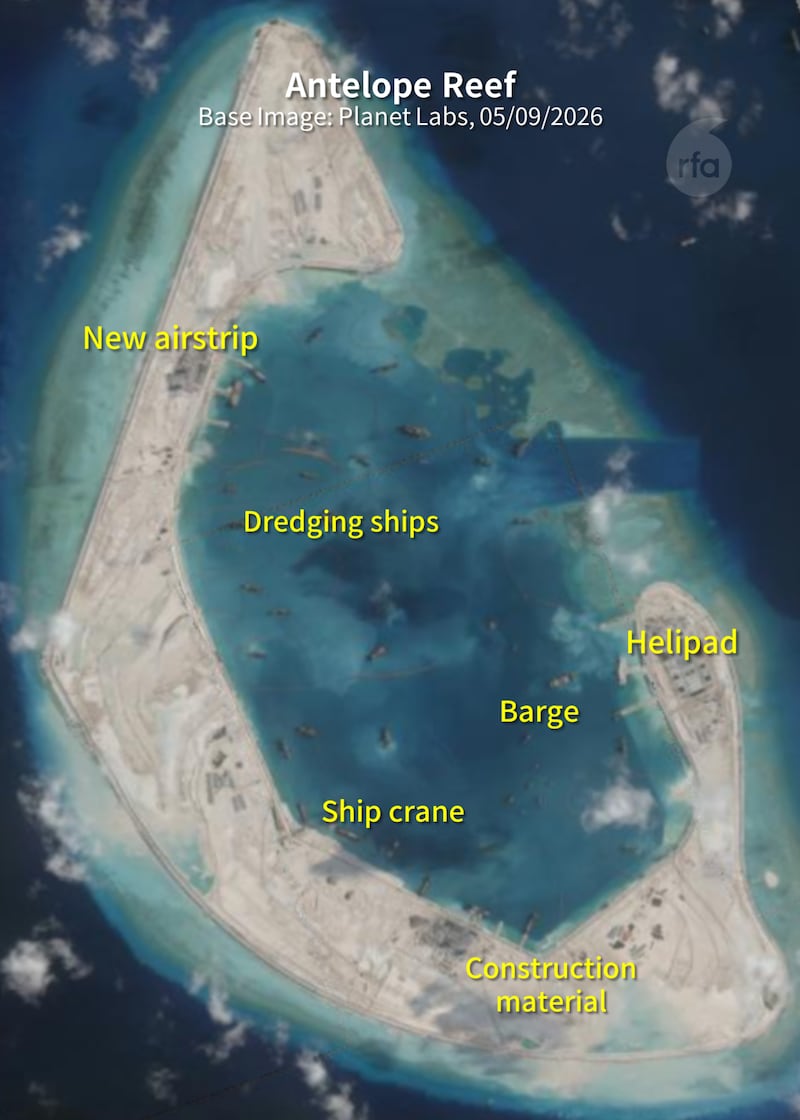
As part of this, facilities such as Antelope Reef could serve as forward operating bases for China’s coast guard, maritime militia and military forces. The report says they could eventually host surveillance systems, electronic warfare capabilities and anti-ship missiles capable of extending China’s anti-access and area-denial network deeper into the South China Sea.
U.S. carrier strike groups and other naval forces approaching Taiwan via the South China Sea could be forced to either face missile, air defense and electronic warfare threats from these Chinese outposts or reroute to alternative approaches such as the Bashi Channel or Miyako Strait, increasing operational costs and travel times, the report said.
Powell also noted that many of the military capabilities outlined in the report have not yet come to fruition at Antelope Reef itself.
“What lies in Antelope today is reclaimed land, berths and canals – not yet the sensor and missile node described in the report,” he said. “This is a forecast based on the Chinese Spratly manual and may prove accurate, but the report analyzes a capacity that is still under construction.”
He added that Antelope Reef’s location in the Western Paracels raises questions about its relative importance in a Taiwan eventuality.
“Antelope is in the Western Paracels, facing Vietnam. Its value in a fight over Taiwan relative to China’s many other operational locations on the mainland and in the South China Sea is not immediately obvious.”
Broader strategy
Other analysts have said that focusing solely on military capabilities risks overlooking the broader strategic effects of Chinese activities in the region.
Sze-Fung Lee, an independent researcher specializing in Chinese hybrid warfare, told RFA that the debate should not be structured as a choice between military utility and signal value.
He said the cognitive effects of China’s growing presence in disputed waters could influence decision-making well before a conflict begins.
“The stories about China’s ability to delay or refuse intervention don’t start with the first shot,” he said. “They are being built now, increasingly visible in the pre-conflict information environment, and will amplify most intensely during the first hours of any operation, when allied decision-making is most fluid and most vulnerable to doubt.”
Lee said the effectiveness of such efforts would depend on a range of political and psychological factors beyond military hardware, including Taiwan’s perceived willingness to resist and the willingness of allied governments and publics to support the intervention.
“The difficulty in quantifying this impact is not accidental, it is the main thing,” he said. “Grey zone and cognitive warfare are designed to be deniable, incremental and invisible until the cumulative effect means the battle is already lost before it officially begins. »
Others see the Taiwan connection as only part of a much larger strategic picture.
China’s strengthening of the South China Sea appears primarily geared toward broader regional goals, Ed Moon, an independent cross-strait analyst and founder of the intelligence site Strait Signal, told RFA.
“From what I’ve read, the rise is more focused on reasons that don’t have much to do with Taiwan,” he said.
Most foreign reinforcements in a Taiwan conflict would likely come from the northeast through Japan, Guam and Hawaii rather than through the South China Sea, he added.
However, Moon said the report also reflected a broader shift in how Taiwan’s security officials view developments in the South China Sea.
“We absolutely see, in official rhetoric and in reports like this, that Taipei is trying to directly link events in the South China Sea to Taiwan’s own security,” he said.
The democratic island has also shown growing interest in military cooperation between the United States and its regional partners, including the Philippines, as well as exercises such as Balikatan, according to Moon.
“So I think Taipei certainly views construction in the South China Sea as linked to the PLA’s plans on Taiwan, and believes that slowing down construction in the region would directly benefit its own security.”
Edited by Eugene Whong.