


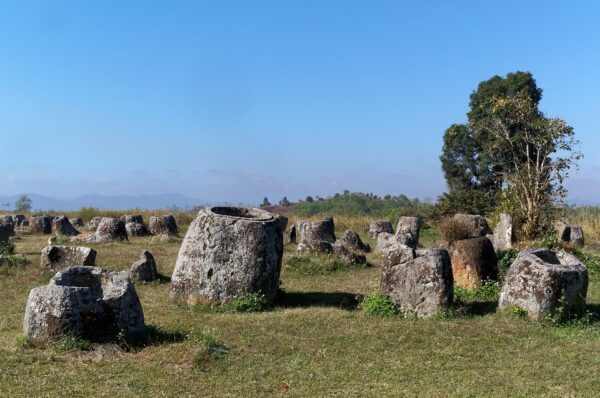
One of my favorite childhood memories is visiting the Plain of Jars with my grandmother, Noy. I come from a long line of artisans who made textiles and shaped gold into jewelry in southern Laos. Grandma Noy wove Lao sins and exchanged with other talented loomers.
She often took me to markets in other provinces like Xieng Khoang. It was then that I first discovered the megalithic jars scattered throughout this famous northern land. These ancient treasures have mystified archaeologists, historians and other experts around the world.
Who made them? And why?
Mesmerized by the jars, I ran among them, placing my small hands on the weathered surfaces, tracing faint carvings and elusive patterns with reverence. Unlike the experts, I did not have to wonder about their origin or their purpose. Grandmother Noy shared the secret with me: “The inhabitants of Laos are descendants of giants. Our ancestors made these beautiful jars to store padeak And Lao Lao.”
I completely believed her. These pots are our heritage.
As a child, I didn’t know at the time that danger lurked beneath my feet. Decades later, I visited the jars again in my capacity as CEO of Legacies of War, a nonprofit advocacy and education organization dedicated to addressing the impacts of war by advocating for U.S. funds for humanitarian mine clearance, survivor assistance, and explosive ordnance risk education. Legacies of War was founded in 2004 after recovering illustrations and testimonials refugees fleeing bombings in this province.
From 1964 to 1973 the United States dropped at least 2.5 million tons of munitions during 580,000 bombing missions over Laos. This equates to a planeload of bombs every eight minutes, 24 hours a day, for nine years, earning Laos the title of the most bombed country per capita in history. The bombings were indiscriminate and the victims were civilians.
The war did not end with the departure of the planes. After 1973, civilians remained the main victims of unexploded ordnance accidents, with more than 60 percent of those injured are children today.
This is not only a story of devastation, but also a story of transformation.
In villages like Ban Naphia, generations of artisans refused to let war have the last word. They gathered pieces of metal, shrapnel, bomb casings, fragments of violence and melted them. The weapons that once destroyed homes became the spoons that fed families. The remains of war became boats, stilts, planters and everyday tools, transformed by human hands.
This creative spirit is deeply rooted in Laos. It resonates in the deep hollows of timeless jars. It rises in the daring menhirs of Hintang Park, where the imposing pillars, engraved with human and animal figures, seem to carry the weight of the hands of giants, testimony to the strength and vision of those who preceded them. He lives in the temple complex of Vat Phouwhere stone and spirit endure, and in the golden presence of This Luangsymbol of faith and continuity. Laos is a country with roots as old as any great civilization, shaped by centuries of memory and by the hands – often women – who continue to move it forward.
In 2008, Elizabeth Sudaan American who researches Laotian textiles, arrived in Laos with questions about craftsmanship and sustainability. Meeting artisans in Ban Naphia, she was struck by their ingenuity and by a history that had never been taught to her.
Moved by their creativity and bold initiative, Suda, along with Laotian artisans, co-created the Peacebomb bracelet with the idea of “redeeming the bombs.” Since then, ARTICLE22 (A22) has grown into a global social enterprise, offering an evolving collection of jewelry to customers in 40 countries, including actress Emma Watson. One of A22’s core commitments is to support nonprofit partners like Mines Advisory Group through financial contributions and meaningful collaborations, such as the HOPE bracelet.
Suda’s work reminds us that repair is something we do with our hands. Each bracelet, each spoon, each transformation from the remains of war is an act of restoration.
This is the profound responsibility we honor on International Women’s Day for Peace and Disarmament. True peace is not simply the absence of bombing; it is the active, daily work of restoring land, livelihoods and dignity. This is work historically and continually championed by women – from the grandmothers who pass on our heritage to the advocates demanding an end to gun proliferation.
The giants my grandmother spoke of may not have roamed the earth as I once imagined, but I eventually understood what she meant.
I know the giants are still there.
It is the artisans of Ban Naphia who transform the fragments of war into new possibilities. These are the women at the loom, powerful weavers who preserve the patterns that pass down our memories across generations. Today, I see exactly the same spirit in the fierce deminers who courageously advance on dangerous lands despite the risks. Thread by thread, inch by inch, they reweave the torn fabric of Laos.
We may never truly understand who built the Plain of Jars or why, but their presence indicates something deeper. On International Women’s Day for Peace and Disarmament, we are called to stand with the giants: ending the cycle of violence, investing in mine clearance and support for survivors, and uplifting women and artisans by transforming destruction into hope. Peace is not given – it is forged, reclaimed and built from the very fragments intended to destroy us.