


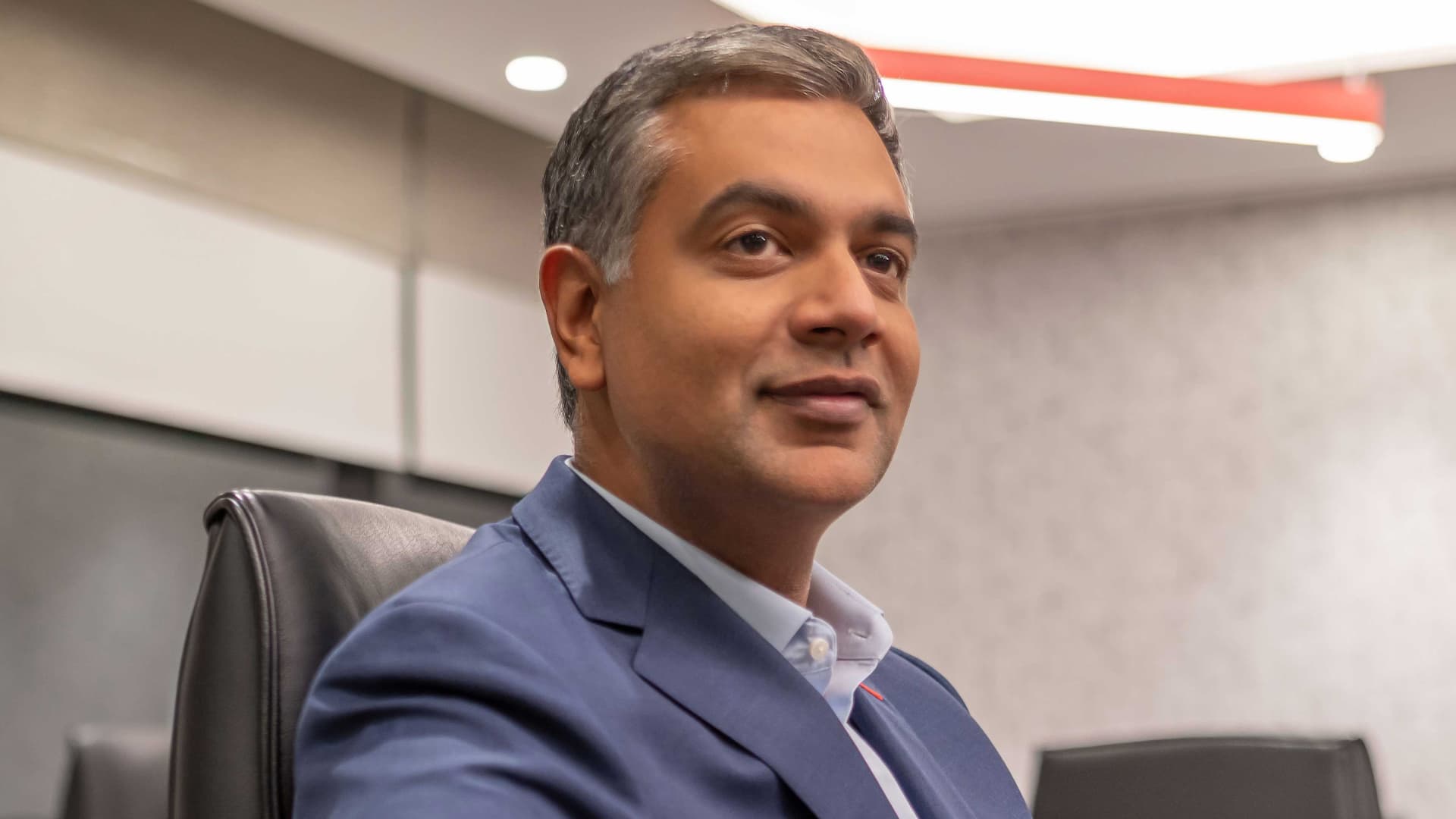
Sam Sidhu, CEO of Customers Bank.
Courtesy of: Customer Bank
Nearly half an hour into a conference call Friday to discuss first-quarter results with analysts, Customer bank CEO Sam Sidhu revealed something unusual: Until then, he hadn’t actually spoken.
“The prepared remarks you heard on my behalf today were delivered by my AI clone, not read by me,” Sidhu said, calling it a potential first for a public company’s earnings call.
The aim of the move, he said, was to highlight a broader shift as Customers Bank, a $25.9 billion asset lender catering to startups and small businesses, embraces artificial intelligence.
Customers Bank has signed a multi-year partnership with OpenAI in which the AI giant will integrate engineers into the company to help automate lending and customer onboarding, CNBC has learned exclusively.
The deal is part of Sidhu’s efforts to leapfrog other banks in the race to transform the industry by using AI agents as the new digital workforce. Its strategy is based on automating core banking processes – reducing loan times from weeks to days, for example – and accelerating growth without adding staff at the same rate.
While many bankers have described AI in general terms like productivity gains, Sidhu ties it directly to financial goals.
Sidhu told CNBC that the project would improve the company’s efficiency ratio from around 49 to 40, thereby increasing the bank’s returns starting next year.
The relationship with OpenAI – which has targeted finance as one of its core lines of business, even going so far as to hire former bankers to train its models – will be a symbiotic relationship for the AI giant, according to the bank’s CEO.
“We will co-create enterprise solutions that they could potentially sell to other banks in the future,” Sidhu said. “The goal here is an automated, end-to-end agent-led workflow” for loans, deposits and payments.
OpenAI said it was proud to help Customers Bank “as they build a smarter operating model that empowers employees, strengthens customer service and sets a new standard for regional banks,” Denise Dresser, chief revenue officer, said in a statement provided to CNBC.
Workers always available
The bank plans to deploy AI agents for loans, deposits and payments over the next six to 12 months.
If they succeed, closing a commercial loan will go from 30 to 45 days, including underwriting, document collection and legal negotiations, to about seven days, Sidhu said.
Opening accounts for complex business clients, which can take more than a day, will be reduced to less than 20 minutes thanks to conversational AI and automated document collection, he said.
“When you have an autonomous agent, you’re essentially creating a digital worker…and they can work 24 hours a day,” Sidhu said.
Customers Bank has been preparing the ground for this announcement for years, first tapping OpenAI in 2023 because Sidhu had what he describes as a tiny investment in the AI giant through his contacts in the venture capital world. The OpenAI deal signed last week expands their relationship, allowing AI engineers to participate in the bank’s processes, he said.
The bank is one of a handful of smaller lenders targeting the startup and venture capital community, and it reportedly made a bid for Silicon Valley Bank in 2023 amid the regional banking crisis that year.
Key advantage
Although it is a relatively small company compared to companies like JPMorgan ChaseWith $4.9 trillion in assets, Customers Bank has a key advantage, according to Sidhu, who started his career at Goldman Sachs in 2004. Megabanks have sprawling global operations and much higher complexity and regulatory standards for implementing AI, he said.
“Small banks will not be expected to have the same level of framework as most large banks,” he said. Regulators want community and regional banks “to be able to compete with big banks.”
The lender already uses AI to write half of the company’s software code and has saved 28,000 work hours so far, the equivalent of not hiring about 15 full-time employees, he said.
“This is an opportunity for us to potentially slow down those hirings … and increase revenue per employee,” he said.
The bank is also considering entering new businesses that would have been prohibitively expensive before AI agents. For these AI-native industries, smaller teams oversee automated systems that handle tasks previously requiring large numbers of humans, he said.
Unlike typical software licensing deals, Sidhu said the two parties are helping create new tools together, with OpenAI getting real-world use cases within a regulated financial institution.
“It will benefit our investors. It will benefit our customers,” Sidhu said. “We hope our regulators will also be more satisfied over time, as they see us reducing risk as well.”