


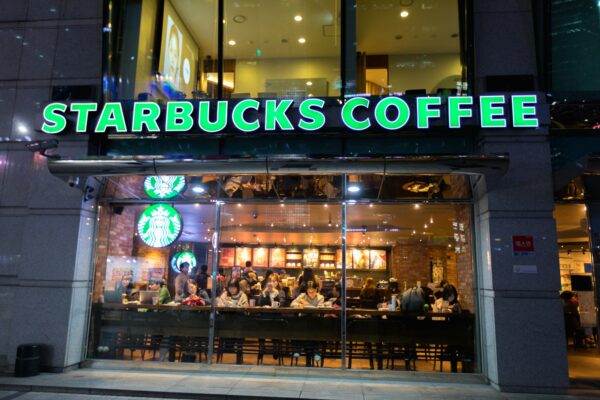
On May 18, the 46th anniversary of the Gwangju Democratization Movement, Starbucks Korea held a cup promotion titled “Tank Day.”
The promotional copy included the phrase “Bang on the Desk” – a phrase instantly recognizable to any Korean adult as an echo of the police cover-up following the 1987 torture and death of democracy activist Park Jong-chul. Park’s interrogators told the public that they slammed the table and he died instantly. Within hours, what the company presented as a routine product launch had become a national scandal.
The May 18 Gwangju democratization movement remains the most politically charged date on the South Korean calendar. In 1980, Chun Doo-hwan, a military strongman who had seized power in a coup the previous year, deployed tanks and paratroopers to the southwestern city of Gwangju to quell a civilian uprising, killing hundreds of people. Official government figures put the death toll at around 200, although survivors and civic groups have long argued that the real number is much higher, with some estimates reaching into the thousands. The exact figure remains disputed to this day. Survivors, bereaved families and much of the Korean population still view these events as a defining wound in the country’s democratic history.
Running a “Tank Day” promotion on this date struck millions as an act of brazen desecration.
Starbucks Korea canceled the event and issued numerous apologies. Shinsegae Group Chairman Chung Yong-jin, whose subsidiary E-Mart holds a 67.5 percent stake in Starbucks Korea, rejected CEO Son Jeong-hyun and a marketing executive issued a personal statement of apology, promising company-wide ethical education. Starbucks headquarters followed with its own statement, calling the incident “unacceptable” and confirming that an internal investigation was underway.
The apology failed to contain the fallout. Chung’s past conduct has made his contrition unconvincing to many. He had on several occasions used the term myulgong, roughly translating to “crush the communists”, as a hashtag on Instagram and had publicly stated that he hated communism, positioning himself as an ideological ally of South Korea’s conservative right. Critics argued that such an organizational culture, established from the top, created conditions under which such an incendiary promotion could pass through four to five levels of internal approval without being reported. Civil society groups filed criminal complaints against Chung and former CEO Son with the Seoul Metropolitan Police Agency, alleging violations of the May 18 Democratization Movement Special Law and criminal defamation. The Seoul Police Serious Crime Investigation Unit has since taken on the case, bringing together the complaints filed in Seoul and Gwangju.
Facing a police investigation triggered by complaints from civil society, Shinsegae announced on May 24 that Chung would make a public apology in person on May 26 at the Josun Palace Hotel in Seoul – which will be his first public appearance since the scandal broke days earlier. His apology is expected to include a full acknowledgment of his personal responsibility and a commitment to corporate social responsibility, alongside the publication of the findings of the group’s internal investigation.
The controversy quickly metastasized into electoral politics. South Korean President Lee Jae-myung wrote on X, formerly Twitter, that he did not understand how such a campaign was possible and called for appropriate moral, administrative, legal and political accountability.
On May 23, Lee further intensified his criticism, linking Tank Day to a separate Starbucks Korea promotion from two years prior. On April 16, 2024, the company had launched a new product called “Siren Classic Mug”. On this day, the country commemorated the 10th anniversary of the Sewol ferry disaster. The mermaid, a mythological creature whose song lured sailors to their deaths, has been Starbucks’ logo since its founding in 1971, but Democratic lawmaker Jung Jin-wook argued that deploying the imagery on this particular date amounted to deliberate provocation. Quoting Jung’s message on X, Lee called the conduct “the depraved behavior of vicious merchants” and said he hoped the link was not intentional. Adding that no one wearing a human face could do such a thing, Lee also warned that the behavior – mocking victims of state violence and national tragedies on their memorial dates – would be subject to public judgment.
As campaigning is underway for the June 3 local elections, Jung Chung-rae, the head of the ruling Democratic Party, exhorted candidates and campaign workers to refrain from entering Starbucks stores, calling the promotion an act that cannot be tolerated. Several campaign headquarters, including that of Seoul mayoral candidate Jung Won-oh, went further and issued internal bans on all Starbucks products. Interior Minister Yun Ho-jung announcement that his department would no longer use Starbucks gift certificates at government events, implicitly inviting other agencies to follow.
The main opposition party, the People Power Party, whose political lineage has its roots in the party that governed under Chun’s junta, has largely looked the other way. Representative Kim Min-jeon job on social networks, that a tank in the promotional context of a drinks company obviously referred to a liquid container, and not to a military vehicle, an argument which immediately aroused ridicule. Furthermore, Representative Han Gi-ho declared that Starbucks would become a gathering place for patriots who cherish conservative values and liberal democracy. For example, some PPP candidates uploaded videos of themselves holding a Starbucks cup, portraying the incident as a battleground between liberals and conservatives.
On May 25, PPP leader Jang Dong-hyeok rejected boycott as election theater, accusing Lee of using the Starbucks controversy to deflect public anger over the so-called “special counsel to withdraw charges” ahead of local elections. He also called it a “people’s court and pitchfork song”, a reference to mob justice, and predicted that once Election Day passed, Lee and his supporters would be back at Starbucks as if nothing had happened. While campaigning for PPP candidates in Incheon, west of Seoul, on May 24, Jang urged the public to bring Starbucks coffee to the voting booths.
What the Starbucks episode reveals goes beyond the misjudgments of a single company or the opportunism of a single party. The timing alone is instructive. Just days before the Tank Day scandal broke, a constitutional amendment bill backed by six parties – which would have enshrined the spirit of the May 18 movement in the preamble to the constitution – failed to clear the National Assembly after the PPP boycotted the session, leaving it short of the required quorum. Minister of Justice Jung Seong-ho note that if the amendment had passed, a stunt like Tank Day would have been unthinkable. The fact that the bill failed despite the support of six parties shows how superficial the political consensus of May 18 remains.
South Korea has laws protecting the memory of May 18. In 2021, she enacted a special law criminalizing the public dissemination of false statements about the movement, with violations carrying up to five years in prison. However, the application was limit: only 21 cases resulted in sanctions in 2025, and the annual number of sanctioned cases has remained below 30 since the introduction of the amendment. The Democratic Party responded to the Tank Day scandal by presentation an amendment that would expand the scope of the law to cover mockery, insult and outright denial. The contrast with Germany, where public trivialization of Nazi-era genocide carries the same maximum penalty and has been applied to offenders abroad, highlights the extent of the gap between law and practice in South Korea.
The Tank Day scandal was not an isolated misstep. Together with the Siren Class Mug promotion, this indicates a trend whereby dates of national mourning have either been ignored or, as critics claim, deliberately exploited.
The Starbucks promotion didn’t come out of nowhere. It arose from an organizational culture operating within a society where, for a significant portion of the population, the events in Gwangju remain open to political reinterpretation. The speed with which fringe voices came forward to defend the promotion, and the eagerness with which elected lawmakers amplified those voices, confirm that the far-right’s rehabilitation of the Chun era is not simply an online phenomenon confined to anonymous comment sections.
The failure of the constitutional amendment, the continuing gap between law and practice, and the reflexive political cover afforded to those who mocked the victims on the anniversary of the massacre all point to the same conclusion: the wounds of May 1980 have never fully healed, and a vocal minority remains determined to ensure that they never are.