


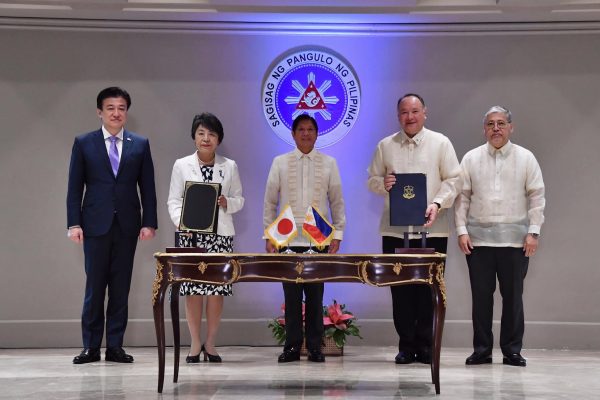
Japan and the Philippines are set to begin formal negotiations to conclude an information security agreement that would allow the exchange of classified security data, marking a new milestone in bilateral security cooperation.
Nikkei Asia reported Friday that the two sides would “agree to launch formal negotiations” on a General Security of Military Information Agreement (GSOMIA) during Philippine President Ferdinand Marcos Jr.’s visit to Japan this week.
Marcos is expected to begin his four-day state visit tomorrow, becoming the first Philippine president to visit Japan in more than a decade. He will meet Prime Minister Takaichi Sanae on Thursday for talks expected to focus on security cooperation and shared concerns over China’s growing maritime influence.
As Nikkei reported, GSOMIA would create a legal framework for the secure exchange of sensitive military intelligence and also facilitate closer cooperation between the Philippines and the United States, which has a similar agreement with Japan. Manila and Tokyo are also ready to upgrade their current strategic partnership to a comprehensive strategic partnership and “affirm their cooperation in a range of areas, including security”, the media outlet said.
Besides the United States, Japan has already signed similar intelligence-sharing agreements with countries like the United Kingdom, India, and South Korea, among others, but GSOMIA would be the first such agreement with a Southeast Asian country. The Philippines also signed an intelligence sharing agreement with the United States in November 2024.
Establishing a similar pact between Manila and Tokyo would strengthen the trilateral relationship between the three countries and enable the creation of a trilateral framework similar to that between the United States, Japan and South Korea. It would also likely allow the Philippines access to more advanced military equipment from both countries.
Over the past decade, the Philippines and Japan have experienced a steady convergence of strategic and security interests, driven by shared concerns over China’s growing military assertiveness, particularly in the East and South China Seas.
In a meeting with Japanese Foreign Minister Motegi Toshimitsu in Manila in January, Foreign Secretary Maria Theresa Lazaro described Japan as “a vital strategic partner of the Philippines” and said the two nations would “continue to be bound by shared values of democracy, respect for the rule of law and commitment to peace, stability and prosperity in our region.”
This gave rise to strong Japanese interest in strengthening the Philippine military capacity to strengthen deterrence in East Asia. In January, Lazaro and Motegi signed an acquisition and cross-services agreement, which will facilitate the tax-free supply of ammunition, fuel, food and other essential goods between the two countries when they undertake joint military exercises. The agreement helps strengthen the Reciprocal Access Agreement (RAA) that the two countries signed in 2024 and which came into force in September last year.
Japan also participated in joint patrols in the South China Sea and provided equipment to the Philippine Coast Guard and the Philippine Navy.
Defense exports are likely to be a major topic at the summit between Marcos and Takaichi, after Japan lifted its ban on lethal weapons exports last month. Earlier this month, the countries’ defense chiefs agreed to establish a new framework to promote cooperation on defense equipment and technology. This should facilitate a “rapid transfer” of Abukuma-class destroyer escorts and TC-90 aircraft, as well as Type 88 anti-ship guided missiles.
As reported in a Japan Times report, Japanese military personnel fired Type 88 missiles during the recent annual Balikatan military exercises in the Philippines, which were attended by approximately 1,400 military personnel, as well as warships and aircraft of the Japan Self-Defense Forces (JSDF). This was the first time the JSDF actively participated in the Balikatan exercises, after years of participating as an observer.
Philippine media also suggested that Takaichi would announce new grants to the Philippines under Japan’s Official Security Assistance (OSA). In January, the two countries announced a $6 million investment in the OSA to fund the construction of facilities to house rigid-hull inflatable boats previously donated by Japan, as well as funds to expand internet access in southern Philippine areas affected by the region’s separatist conflict. Under the OSA, Japan has already exported surveillance radar systems to the Philippines.
Additionally, the Marcos-Takaichi meeting is also expected to finalize an energy cooperation agreement involving POWERR Asia, an energy cooperation framework with Southeast Asia launched last month by the Japanese government. According to Nikkei Asia, Tokyo intends to help establish a fuel storage program run by a state-owned Philippine oil company, in part by helping to build the necessary infrastructure.