


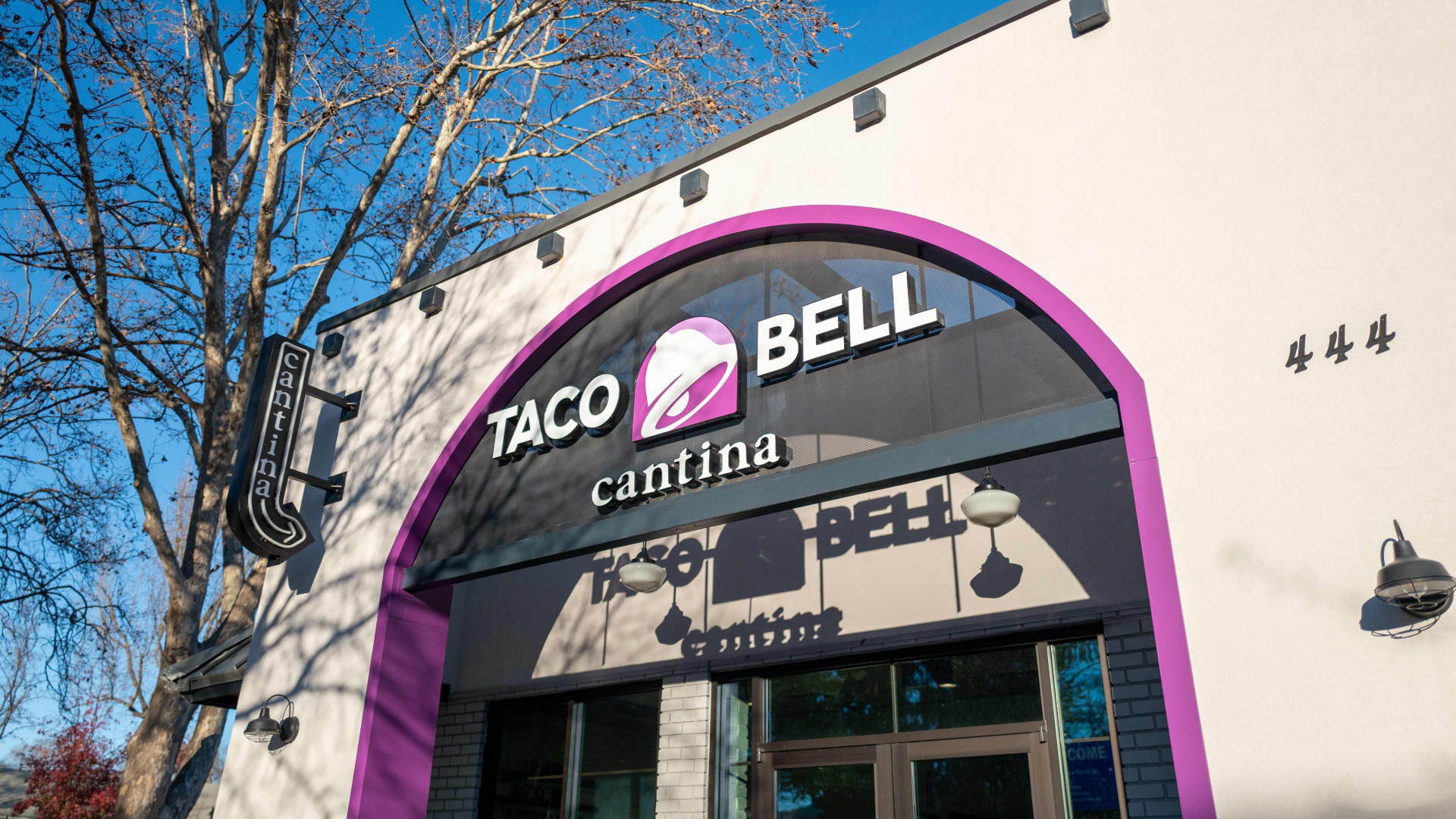
Frontage of a Taco Bell Cantina restaurant in Danville, California on January 8, 2026.
Smith Collection | Gado | Photo archives | Getty Images
Yum Brands On Wednesday, the company reported quarterly earnings and revenue that beat analysts’ expectations, fueled by another strong quarter for Taco Bell.
Here’s what the company reported compared to what Wall Street expected, based on a survey of analysts by LSEG:
- Earnings per share: $1.50 adjusted versus $1.38 expected
- Revenue: $2.06 billion versus $2.04 billion expected
Yum reported first-quarter net income of $432 million, or $1.55 per share, compared with $253 million, or 90 cents per share, a year earlier.
Excluding charges related to its strategic review of Pizza Hut and other items, the company earned $1.50 per share.
Net sales climbed 15% to $2.06 billion, boosted by higher revenue from company-owned restaurants. Last year, the company purchased more than 100 Taco Bell locations across the Southeast in an effort to accelerate its development and profitability.
At Yum, global same-store sales increased 3%, driven by growth at Taco Bell, the crown jewel of the company’s portfolio.
Taco Bell’s same-store sales rose 8%, beating Wall Street estimates of 5.6% growth, according to a StreetAccount survey.
“Taco Bell reported exceptional same-store sales growth of 8%, well ahead of [quick-service restaurant] ” said Chris Turner, CEO of Yum, in a statement.
KFC reported same-store sales growth of 2%, less than the 2.5% increase forecast by StreetAccount. While the fried chicken chain’s international business is considered one of Yum’s “growth engines,” its U.S. business has struggled in recent years, faltering in the face of increased competition and consumer expectations for value. KFC system sales in the United States fell 2% during the first quarter.
To win back its customers, KFC is inspired by the successful Taco Bell model by relying on innovation and affordability.
Similarly, Pizza Hut performed better outside its home market. The struggling pizza chain reported flat same-store sales globally, although its international operations saw same-store sales increase 2% during the quarter. Its same-store sales in the United States fell 4%.
Analysts forecast decline in global same-store sales 0.7% for Pizza Hut, according to StreetAccount.
In November, Yum announced it would explore strategic options for the chain, which has long been a laggard in its portfolio. Several private equity firms, including Apollo Global Management and Sycamore Partners, are among the potential buyers vying for Pizza Hut, Reuters reported earlier this month.
Although Yum did not provide an update on the strategic review Wednesday, its earnings release included an update showing the company’s systems sales, unit count and core operating profit excluding Pizza Hut.