



Gap widens between rival toymakers Hasbro And Mattel — thanks in part to a 30-year-old trading card game.
Toy giants have been flip-flopping in this area for decades, vying for the most coveted master licenses to put new fan favorites — among them Disney princesses and “Star Wars” characters — on store shelves. But as the industry recovers from a period of declining sales, it’s Hasbro that’s winning over Wall Street.
For fiscal 2025, Hasbro reported a 14% revenue increase to $4.7 billion, while Mattel saw net sales fall 1% to $5.3 billion.
Although Mattel’s revenue is higher than Hasbro’s, its growth is stagnating, according to Eric Handler, managing director and senior research analyst at Roth Capital Partners.
“[Mattel’s] revenue has been in a very tight range for five years now, and 2026, on an organic basis, is the same,” he told CNBC.
Mattel shares have fallen more than 20% over the past 12 months, trading at around $17. Meanwhile, Hasbro shares are up about 46% over the same period, with shares trading at around $100.
Of course, Hasbro’s post-pandemic journey hasn’t been without its own headwinds. The company’s revenue took a hit when it sold its film and television business, eOne. Additionally, its entertainment segment, which includes film and television licensing, was deeply impacted by the 2023 Hollywood double strike.
“Despite market volatility and a changing consumer environment, we have returned to growth in this company in a meaningful way,” Hasbro CEO Chris Cocks told investors during an earnings conference call earlier this month.
Throughout these changes, a key part of Hasbro’s business has continued to grow: Wizards of the Coast.
A hint of magic
The Hasbro division includes Dungeons & Dragons, Magic: The Gathering, and the company’s portfolio of digital and video games.
In 2025, Wizards’ revenue grew 45% to $2.1 billion, fueled by sales of Magic’s Universe Beyond tie-in sets and smaller, limited-edition Secret Lair packs, some of which sell for nearly $200.
Although the segment accounts for less than half of the company’s revenue, it accounts for 88% of its adjusted profits.
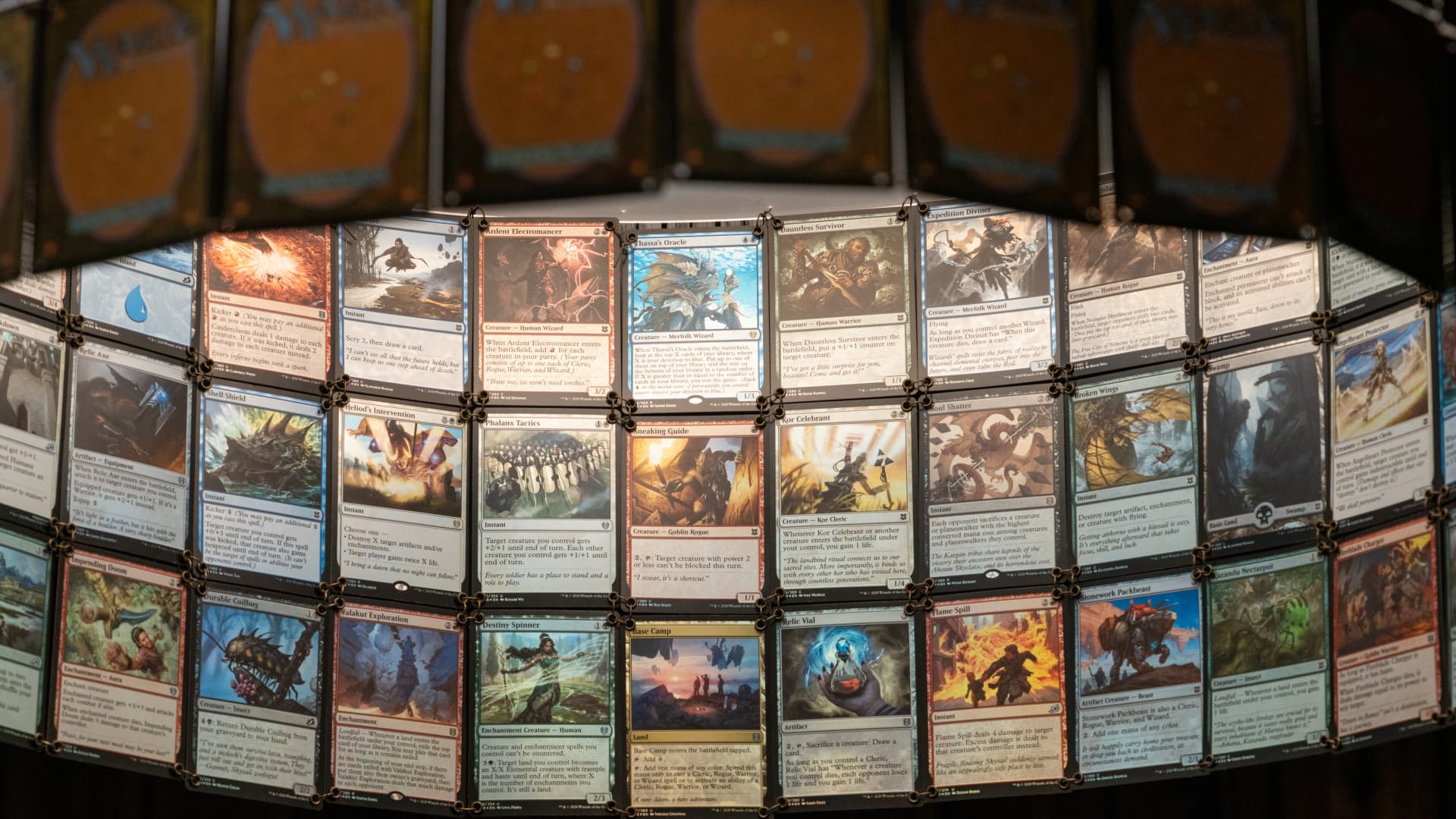
Magic: The Gathering playing cards form a fixture at Wizards of the Coast headquarters in Renton, Washington, on September 11, 2025. While sales of traditional toys and games lag, Hasbro has found a growth engine in role-playing games such as Dungeons and Dragons, collectible card games like Magic: The Gathering and a growing portfolio of digital and video games.
Bloomberg | Bloomberg | Getty Images
The strategic trading card game Magic, created in 1993, typically features two players competing against each other using custom decks of trading cards to cast spells, release creatures, or use artifacts to defeat their opponent.
Over the past five years, Hasbro has expanded beyond the original game story to release card games based on third-party intellectual property, including “Avatar: The Last Airbender,” Marvel’s “Spider-Man” and “The Lord of the Rings.”
These sets are not only popular with longtime Magic fans, but also serve as a gateway for consumers from other fanbases into the world of Magic. In mid-2025, Hasbro released a “Final Fantasy” set that became the best-selling expansion pack in Magic: The Gathering history, generating $200 million in sales in a single day.
“They’ve done a fantastic job expanding the funnel over the last couple of years, and it’s become a multi-generational type product,” Handler said. “The player base is growing. It’s a loyal player base that shows enthusiasm for new products and new ways to play.”
Through the end of 2025, more than 1 million unique players have participated in organized gaming, that is, sanctioned tournaments, according to Cocks. That represents a 22% year-over-year increase, he said.
Additionally, the number of game stores that host events, called Wizards Play Network, has grown to more than 10,000, a 20% increase from 2024.
“Overall, this reinforces our confidence in Magic’s long-term growth,” Cocks said during the company’s earnings conference call. “We are building a gaming system with multiple entry points, product types and engagement pathways, and this system is positioned to continue to drive growth through 2026 and beyond.”
In 2026, Hasbro plans to release new Magic sets based on “The Hobbit,” “Teenage Mutant Ninja Turtles” and “Star Trek.”
The company projects mid-single-digit growth for its Wizards business in 2026, but Keegan Cox, associate vice president and research analyst at DA Davidson, in a research note released shortly after the company’s earnings release, called that estimate “conservative.”
The digital frontier
Hasbro’s Wizards unit also includes the digital and licensed games space, whose revenue jumped 6% in 2025, fueled by the success of “Monopoly Go!”
Cocks has previously noted that modern consumers and modern gaming are increasingly moving to online forums, and the company has launched new games and an in-person video game studio in Montreal to boost gaming.
While Hasbro’s digital gaming division is growing, Mattel has just launched its own digital unit.
Earlier this month, Mattel announced that it would buy out partner NetEase of its 50% stake in their joint venture Mattel163, taking full ownership of the company. Mattel163 develops digital games based on the toy company’s brands and has launched four digital games since 2018: Uno, Uno Wonder, Phase 10 and Skip-Bo.
“In our opinion, [Mattel] is in the early stages of an investment similar to Hasbro’s investment in games over 7 years ago,” wrote DA Davidson’s Cox. “Even though we don’t think [Mattel] we will look to compete with Hasbro…we think [Mattel] can create successful mobile games tied to their intellectual property and are expected to increase profit margins over time.
A changing industry
Mattel’s push into digital comes as two of its flagship brands struggle to make sales.
“Barbie is in significant decline, as is Fisher-Price,” Handler noted. “It kind of undoes a lot of the good news that’s happening with Hot Wheels.”
The vehicles division saw its gross billings jump 11% in 2025, while the doll segment fell 7% and the infant, toddler and preschool space fell 17%.
This younger consumer segment has been in decline for more than a decade, due to slowing population growth and children being introduced to electronics earlier in their development. Changing play habits have forced toy manufacturers to adapt quickly.
But there is hope for Mattel and the toy industry as a whole. In 2025, total annual dollar sales increased 6% in the United States, according to Circana data. And, perhaps most importantly, the number of units sold increased by 3%, allaying fears that price-conscious consumers would forgo their toy purchases.
“I think increasing unit sales is the most important metric we can look at,” said James Zahn, editor-in-chief of The Toy Insider and The Toy Book. “If unit sales were down, that’s when you know people are really buying less, and that hasn’t happened.”
Mattel and Hasbro, alongside other toy companies, are also expected to benefit from a robust theatrical schedule this year.
Mattel has two of its own brands represented at the box office with “Masters of the Universe” in June and “Matchbox” in October. Although Mattel won’t see a major increase in ticket sales, its toy sales could get a boost. After all, the 2023 release of “Barbie” helped fuel a 16% increase in the doll’s gross billings in the quarter following its theatrical release.
Mattel also holds the master toy licenses for “Toy Story” and Disney Princesses, meaning it will handle the bulk of the product for “Toy Story 5” and the live-action “Moana.”
Hasbro will offer toy lines for “The Mandalorian and Grogu,” “Spider-Man: Brand New Day” and “Avengers: Doomsday.”
Together, Mattel and Hasbro also collaborated on the highly anticipated product line for those of Netflix hit animated movie “KPop Demon Hunters”, promising dolls, foam role play items, games and plush items.
“‘KPop Demon Hunters’ is going to be big business for both Hasbro and Mattel,” Zahn said.