


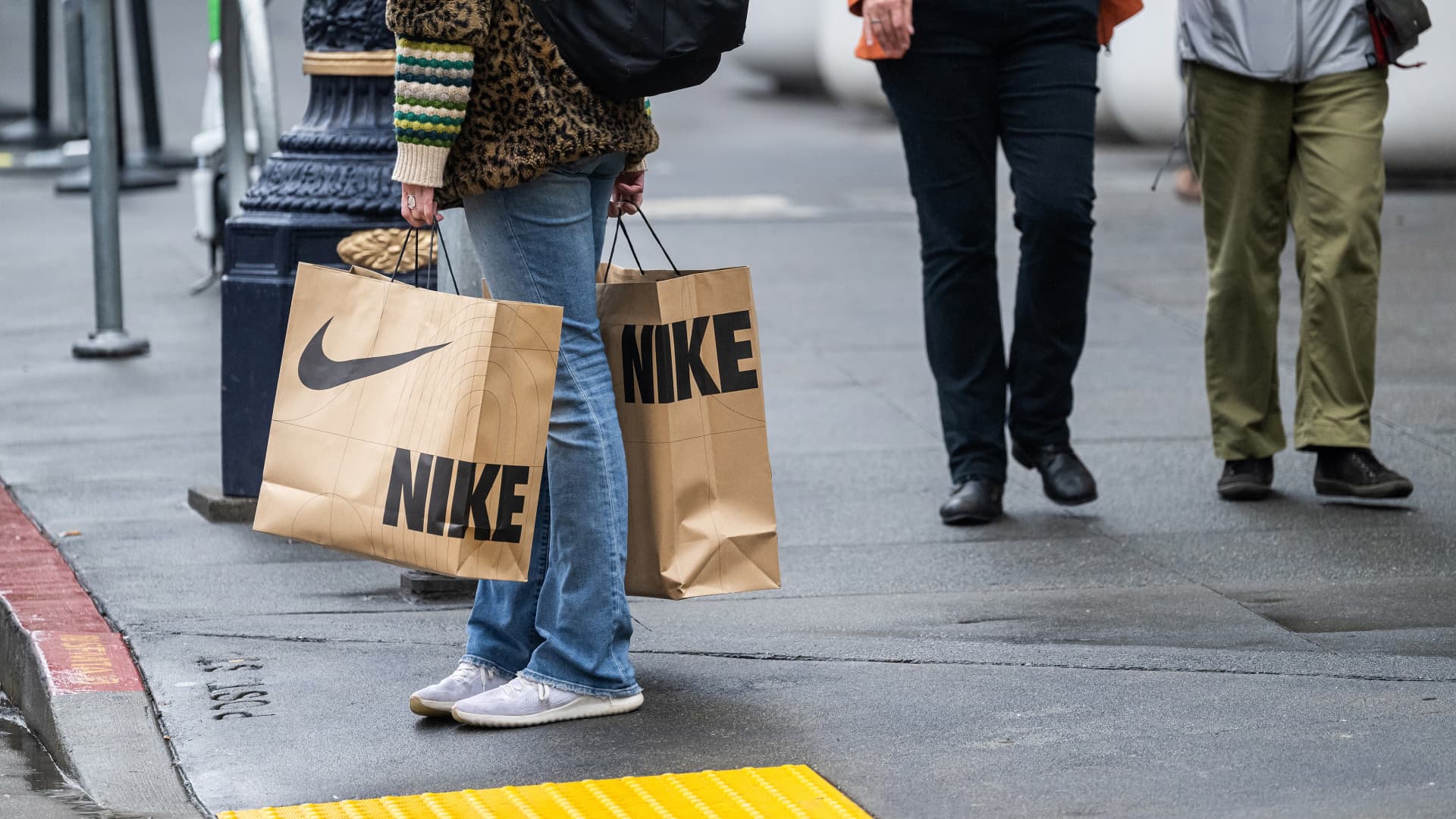
A shopper carries Nike bags in San Francisco, California, United States, Wednesday, December 17, 2025.
David Paul Morris | Bloomberg | Getty Images
Nike reported quarterly earnings and revenue that beat Wall Street estimates on Thursday, as strong North America helped offset falling sales in China.
The company’s shares fell more than 6% during extended trading Thursday as investors digested China’s weakness and the blow Nike is taking from rising tariffs.
Here’s what Nike reported for its fiscal second quarter 2026, according to LSEG consensus estimates:
- Earnings per share: 53 cents against 38 cents expected
- Income: $12.43 billion versus $12.22 billion expected
The sportswear retailer said its North American sales rose 9% to $5.63 billion. But revenue from its Greater China market fell 17%, to $1.42 billion.
The sneaker company has been a little more than a year into CEO Elliott Hill’s turnaround strategy, which focuses on regaining growth and market share, eliminating old inventory and investing in wholesale relationships.
“FY26 continues to be a year of action to right-size our classics business, return Nike to a premium digital experience, diversify our product portfolio, deepen our relationships with consumers, strengthen our relationships with our partners and realign our teams and leadership,” Hill said on a call with analysts. “And I say we’re in the middle of our comeback round.”
“We are far from our potential,” he added.
Hill said Nike’s improvements in its China market are “not happening at the level or pace we need to drive broader change,” while asserting that the country remains one of the most powerful long-term opportunities for the company.
The company said wholesale revenue climbed 8% to $7.5 billion in the quarter. But direct sales – which were a priority for Nike in the years before Hill took over and abandoned the strategy – fell 8%, to $4.6 billion.
Nike has also felt the impact of tariff increases. It said Thursday its gross margin fell 3 percentage points and its inventory fell 3%, mainly due to higher tariffs.

The sneaker company also reported weakness in its Converse brand. During its first fiscal quarter, Nike reported that sales of Converse fell 27% – on Thursday it reported a 30% drop in the sneaker brand’s revenue.
Despite weakness in some areas of Nike’s business, the company highlighted some strengths and new initiatives ahead. CFO Matt Friend said on the call that Nike.com had its best Black Friday ever this year, thanks in part to the launch of its Air Jordan “Black Cat.”
Nike also plans to launch a new footwear platform in January called Nike Mind, which aims to help athletes prepare for performance and competition, Hill said on the call.
Nike made bigger internal changes under Hill.
Earlier this month, Nike underwent management changes to “remove layers,” according to Hill. As part of its “Win Now” strategy, the company announced that Chief Commercial Officer Craig Williams will be leaving the sneaker giant.
Hill called the shakeup a move “about growth and offense.”
“Collectively, these changes amount to peeling back layers and better positioning Nike to continue to make an impact as only Nike can,” Hill said in a statement at the time.
Nike shares have fallen more than 13% this year as of Thursday’s close.