


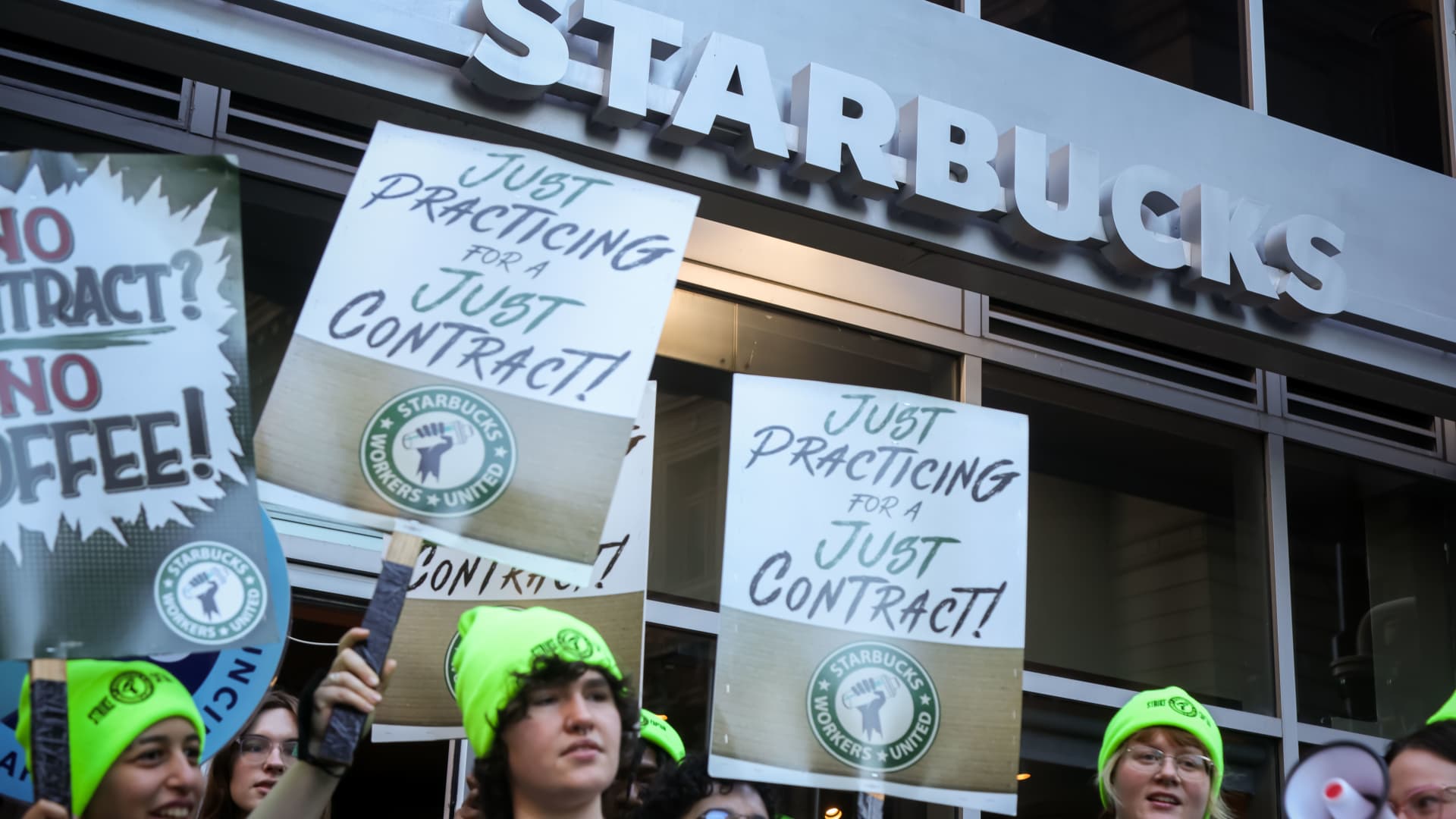
Starbucks employees and supporters picket outside a Starbucks store in New York, United States, Wednesday, October 1, 2025.
Michael Nagle | Bloomberg | Getty Images
More than 100 lawmakers urged Starbucks to resume negotiations with Workers United, the union representing the coffee giant’s baristas, in letters sent Monday to CEO Brian Niccol.
The two letters, from the Congressional Labor Caucus and a group of senators led by Sen. Bernie Sanders, I-Vt., come as the union threatens to go on strike in 25 cities starting Thursday. This coincides with Starbucks’ Red Cup Day, one of the biggest sales days of the holiday season.
“It is clear that Starbucks has the money to reach a fair deal with its workers,” reads the Senate letter, signed by 26 lawmakers. “Starbucks must change course from its current position, resolve its existing labor disputes, and negotiate a fair and good-faith contract with these employees.”
A second letter from the Congressional Labor Caucus is signed by 82 lawmakers.
Lawmakers argued the coffee giant had the resources to increase workers’ wages and benefits, citing the $95 million in compensation paid to Niccol since he was hired. The company said $90 million of the compensation package was in the form of stock awards to cover the equity Niccol left behind at Chipotle during his move to Starbucks to take on the CEO role.
Senator Bernie Sanders (I-VT) speaks to reporters outside the Senate Chamber of the U.S. Capitol on November 8, 2025 in Washington, DC.
Aaron Schwartz | Getty Images
Last week, Workers United said its strike authorization vote had 92 percent approval from its members. If the union decides to strike, it will be indefinite. Workers United is pushing for improved hours, higher wages and resolution of hundreds of unfair labor practice charges against the company.
The two sides are not in active contract talks after talks broke down late last year. Starbucks and the union entered into mediation in February and hundreds of barista delegates voted against the economic package proposed by Starbucks in April.
Both sides blamed the other side for the failure of the negotiation and expressed their readiness to negotiate.
Workers United, which began organizing at Starbucks in 2021, says it now represents more than 12,000 workers in more than 650 stores. The company told CNBC last week that the union represents just 9,500 workers at 550 cafes.
Starbucks Workers United spokeswoman Michelle Eisen said in a statement last week: “We want Starbucks to succeed, but turning the company around and bringing customers back starts with listening to and supporting the baristas who are responsible for the Starbucks experience. If Starbucks continues to be obstructive, they should expect their business to grind to a halt. The ball is in Starbucks’ court.
In response to the results of last week’s strike vote, Starbucks said it would be prepared to serve customers at its nearly 18,000 company-operated and licensed stores during the holiday season.
“As everyone knows, Starbucks offers the best work in retail, averaging more than $30 an hour in pay and benefits for hourly partners. Workers United, which represents only 4 percent of our partners, has chosen to walk away from the bargaining table. We have asked them to come back several times. If they are willing to come back, we are willing to talk. We believe we can reach a reasonable agreement quickly,” Starbucks spokeswoman Jaci said Monday Anderson, at CNBC.
In a letter to workers regarding the strike authorization vote last week, Sara Kelly, a managing partner at Starbucks, echoed the belief that a deal could be reached quickly.
“For months, we were at the negotiating table, working in good faith with Workers United and delegates across the country to reach agreements that made sense for the partners and for the long-term success of Starbucks,” Kelly said. “We have reached more than 30 agreements in principle on complete articles of the contract.”
“Our commitment to negotiate has not changed,” she added. “Workers United walked away from the table, but if they are willing to come back, we are willing to talk. We believe we can reach a reasonable agreement quickly.”
Reuters previously reported on the lawmakers’ letters.
— CNBC’s Amelia Lucas contributed to this report
