



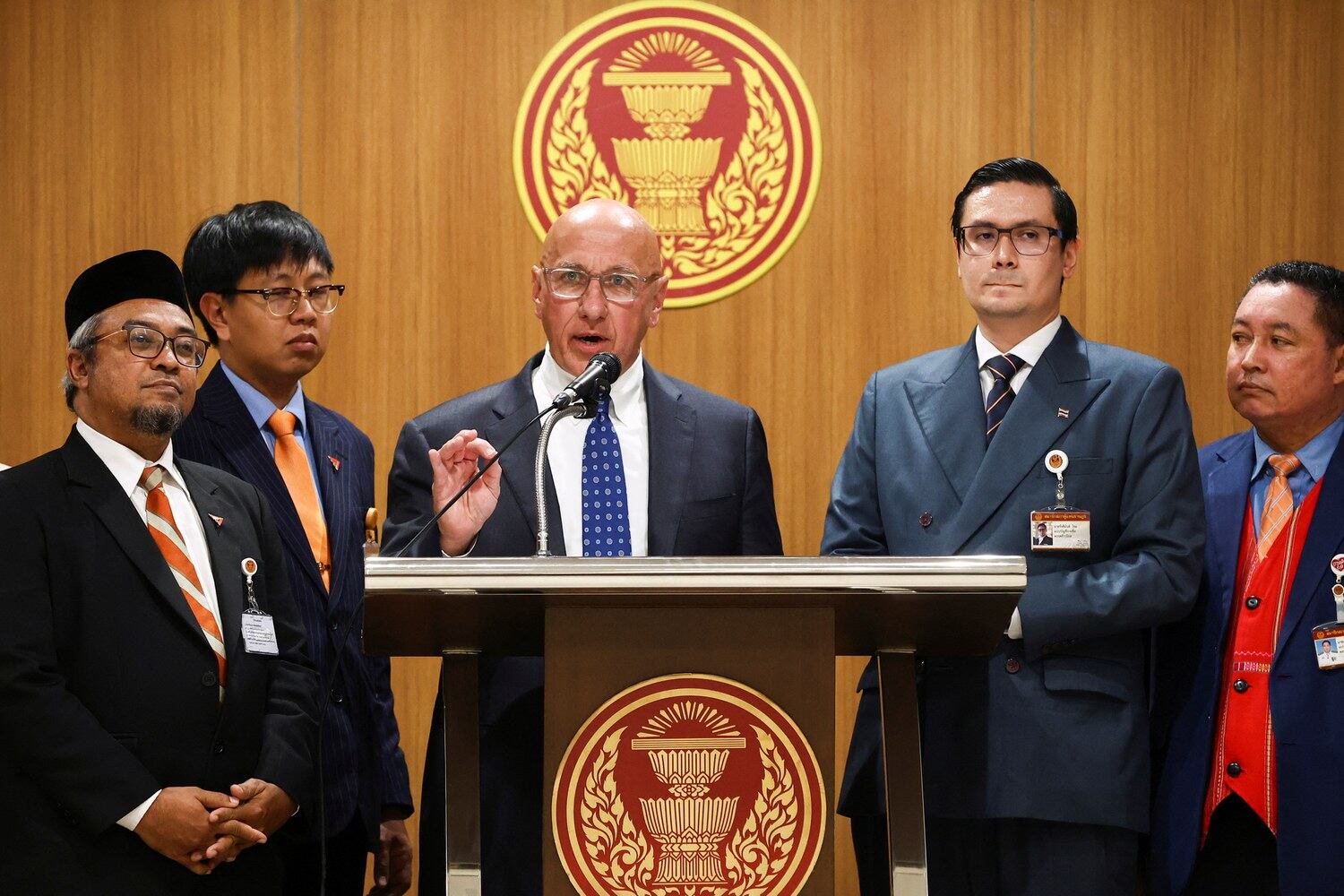
Thai commercial banks, regulators and the anti-money laundering bureau are considering measures to prevent Myanmar from acquiring weapons through Thailand’s banking system, a Thai lawmaker said during a meeting with a U.N. special rapporteur.
Tom Andrews, special rapporteur for human rights in Myanmar, said in a report last month that Thailand had become Myanmar’s main supplier of military equipment through the international banking system, and he called on financial institutions to do more to prevent Myanmar’s junta from acquiring weapons.
Andrews, in Bangkok to address a parliamentary security committee this week, called for steps to cut off arms deliveries to Myanmar’s junta, in line with a plan promoted by the Association of Southeast Asian Nations that frames an end to violence as a first step toward peace.
“I urge this committee and the Thai government to take a clear and strong stance against the transfer of dual-use weapons and technology to Myanmar,” Andrews told a committee hearing.
Andrews, in his report “The Billion Dollar Death Trade”, noted that Singapore had implemented a clear policy against the transfer of arms to Myanmar. As a result, exports of arms and related materials from Singapore-registered entities using the formal banking system increased from almost US$120 million in FY2022 to just over US$10 million in FY2023.
But Thailand, without an explicit public policy position opposing arms transfers to Myanmar, saw exports from Thai-registered entities more than double over the same period, from just over $60 million to almost $130 million, he said. He called on Thailand to conduct as thorough an investigation into the transfers as Singapore had done into its companies’ transactions.
“Singapore has unambiguously adopted this position… which reflects the UN General Assembly resolution of July 2021 which called on all UN member states to prevent the flow of arms into Myanmar,” he said.
Rangsiman Rome, head of the lower house security committee, said lawmakers agreed with the report and would consider taking action.
“We have no argument against the report. Then we will have to have measures, an action plan,” Rome said, adding that the organizations concerned would report to the commission in 30 days.
RELATED STORIES
[ UN rights envoy urges action to stop Myanmar’s access to weapons, fundsOpens in new window ]
[ Myanmar rebels rack up more gains as Operation 1027 enters new phaseOpens in new window ]
[ Junta military preparations point to brutal next phase of Myanmar conflictOpens in new window ]
[ Myanmar still getting jet fuel despite call to cut supply: rights groupOpens in new window ]
Looking towards Singapore
Andrews said five Thai banks and Thailand-based companies facilitated the Burmese junta’s acquisition of weapons, dual-technology items and jet fuel, enabling its armed forces to commit atrocities against the population.
But it said it found no evidence that the Thai government was involved in or aware of the transactions or that Thai banks were aware of the nature of the specific transactions they were facilitating.
“While Thai banks may have been unaware of the nature of these transactions, they are now, and the question now is what can be done and what will be done,” he said.
Representatives from Thailand’s central bank, anti-money laundering bureau and commercial banks cited in the report were present at the three-hour session at parliament in Bangkok.
The Bank of Thailand said it was working with banks and the Anti-Money Laundering Bureau to ensure enhanced due diligence was properly implemented.
“We will look at what Singapore has used to strengthen our criteria, measures and procedures,” a central bank official said.
The Thai Bankers Association said it did not have the means to investigate and monitor such irregularities beyond Thailand’s borders.
“If government security agencies ask us, we will stop transactions,” said Pongsit Chaichatpornsuk, a representative of the Thai Bankers Association.
“We do not support the purchase of weapons by Myanmar or any other military government to violate human rights. »
Thailand, which shares a long border with Myanmar and hosts thousands of refugees fleeing conflict, has tried to promote dialogue between Myanmar’s military rulers and opposition forces, but no progress has been made.
Edited by Mike Firn.