


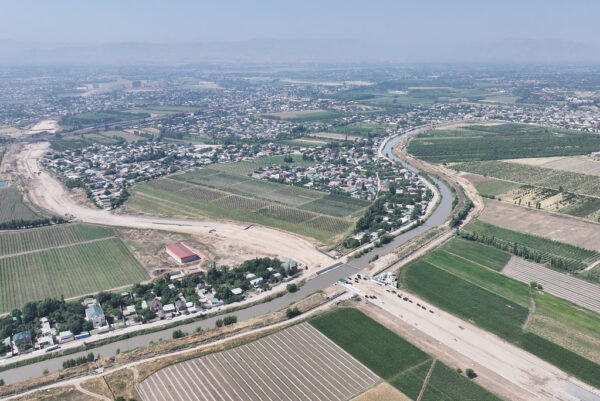
Work has reportedly resumed on a crucial road project linking Tajikistan to China, months after Chinese employees of the China Road and Bridge Corporation were killed in the region in an armed attack.
The Dushanbe-Kulma highway connects the Tajik capital to China via Khorog, the capital of the Gorno-Badakhshan Autonomous Oblast (GBAO), and the Kulma Pass border crossing. In 2022 – shortly after Tajik central government repressed yet another wave of unrest at GBAO – the Tajik Ministry of Transport announcement that China Road and Bridge Corporation would undertake a project to rehabilitate the road.
End of November 2025, five Chinese workers killed in two separate attacks near the border between Afghanistan and Tajikistan. Three Chinese citizens were killed in an attack on a gold mining company complex on November 26 in Shamsiddin Shohin district, Khatlon region. Four days later, on November 30, two more Chinese workers – employees of China Road and Bridge Corporation – were killed in Shodak village, Darvoz district, GBAO. Both attacks took place near the Afghanistan-Tajikistan border.
After the second attack, Guo Zhijun, Chinese Ambassador to Tajikistan “demanded that Tajikistan take all necessary measures to ensure the safety of Chinese businesses and citizens in Tajikistan.”
In a WeChat message, the embassy urged Chinese businesses and citizens to evacuate border areas.
The Chinese specialists having left, construction site stopped on the delicate Qal’ai Khumb-Vanj section of the larger Dushanbe-Kulma highway, which runs between the Darvoz district, where the November 30 attack took place, and the neighboring Rushan district.
In March 2026, Parliament of Tajikistan approved a Chinese-funded project to build nine border facilities along the country’s border with Afghanistanwith a subsidy of 569 million somoni, or approximately $61 million.
And now the highway work appears to be resuming. Quoting the Ministry of Transport, RFE/RL Tajik Service, Ozodireported that Chinese workers returned to work after Dushanbe adopted additional safety measures.
According to the ministry, “after taking necessary measures to ensure the safety of Chinese workers in cooperation with relevant agencies, the Chinese workers returned to the facilities and the remaining work is currently underway.”
Tajik officials, in their comments to Ozodi, acknowledged additional security measures without being specific. But one Journalist RFE/RL at the end of May, Chinese employees were guarded by Tajik special forces.
Chinese workers, typically engaged in Belt and Road Initiative (BRI) infrastructure projects, have been targeted in the Afghanistan-Pakistan border area and Pakistan’s Balochistan province – but the borders with Central Asia have not been the scene of such attacks until recently. In mid-November 2024Chinese workers were attacked for the first time in Tajikistan – in the same district where the first of the November 2025 attacks took place.
Following the 2025 attacks, Taliban authorities in Afghanistan claimed opened an investigation. They also claimed to have arrested two individuals at link to attackswho would both originate from Badakhshan province of Afghanistan. No specific group has claimed responsibility, although Tajik authorities have suggested that criminal groups and drug traffickers are to blame; Taliban officials suggested that unnamed groups wishing to damage relations between Afghanistan and Tajikistan were behind the attacks.
In the months since, there have been no updates on the Taliban investigation, but in January, RFE/RL cited two separate Tajik border agents in GBAO’s Khatlon province said the attack in Shamsiddin Shohin district, targeting the gold mining company, was a result of water-related conflicts. Further details of the attack targeting the road workers have not been released.