


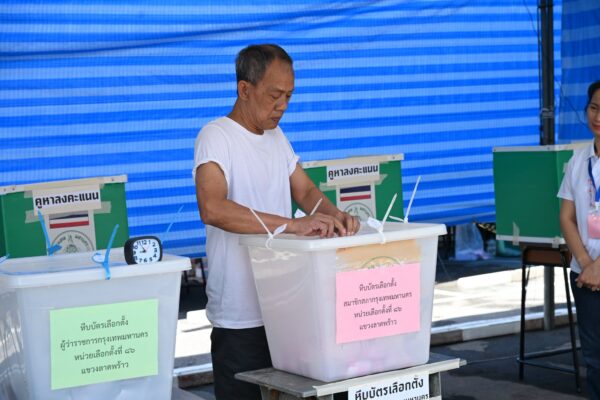
Chadchart Sittipunt, the governor of the Thai capital Bangkok, has been re-elected after the city’s residents overwhelmingly supported him for a second term in yesterday’s election.
According to the vote count reported by Thai PBS, Chadchart won 1.44 million votes, or 68 percent of the vote, with 95 percent of the votes counted. This puts him well ahead of his main rivals, independent Mallika Boonmeetrakul Mahasuk (288,000 votes, or 13 percent of the total), Chaiwat Sathawornwichit of the People’s Party (177,000 votes) and Democratic candidate Anucha Burapachaisri (102,000 votes).
As the Bangkok Post reported, Chadchart’s total set a new record for a winning Bangkok gubernatorial candidate, surpassing his own record of 1.39 million votes, set in his first election in 2022. Just under half of the 4.4 million eligible voters turned out to vote yesterday.
Chadchart, an engineer and former transport minister in the Pheu Thai Party-led government that was toppled in a military coup in 2014, will now return to the governorship for another four years, pending formal confirmation from the Election Commission.
After his victory, the 60-year-old said it was time to “work, work, work”.
“The goal of work over the next four years is not to publish achievements but to succeed in proving to people that their lives will be significantly better,” he said, according to the Bangkok Post.
Bangkok – a far-flung megalopolis of between 5 and 11 million people, depending on how you count it – is the only province in Thailand where the governor is elected rather than appointed by the Interior Ministry. This arrangement has been in place since 1975, when the Bangkok Metropolitan Administration (BMA) was established and the growing city became a special administrative entity headed by a governor elected for a four-year term.
Chadchart’s re-election was widely predicted; in fact, its seemingly inevitability could explain the relatively low voter turnout.
Former governors have often been blamed for Bangkok’s various problems, including traffic, flooding and a worsening smog problem, and Chadchart’s ability to maintain his high level of popularity, especially given the BMA’s limited powers, is no small feat.
A public opinion poll conducted last year found that 48 percent of respondents planned to vote for Chadchart again in the next gubernatorial election. Additionally, 74 percent of respondents said they were either very satisfied or largely satisfied with its performance.
Since taking office, Chadchart has introduced an AI-powered app known as Traffy Fondue, which allows residents and visitors to report urban infrastructure issues, such as potholes, trash, broken streetlights or flooding, to the relevant local authorities. Last month, Traffy Fondue received more than 1.37 million reports, 77% of which were resolved.
Voranai Vanijaka, a prominent political commentator, told the South China Morning Post that Chadchart had managed to cultivate an image as a responsive and kind leader among the city’s population – despite the persistence of his various problems.
“What he did better than most politicians was his ability to relate,” Voranai told the publication. “Chadchart made the office more accessible; he can be found anywhere, even running in the park.”
As Thai political analyst Ken Lohatepanont noted in a June 2 article, Chadchart’s re-election chances were aided by two additional factors. First, he faced a lesser-known field of candidates this year than in 2022, which featured “perhaps the most qualified group of candidates ever fielded for governor of Bangkok.”
Second, the historical tendency of Bangkok voters to “prioritize personality over party” in the gubernatorial election. For example, in February’s national elections, the Progressive People’s Party won all parliamentary seats in Bangkok – the first time in Thailand’s history that a party has achieved such success – but failed to secure more than 8 percent of the vote in yesterday’s gubernatorial elections. The Democratic Party also failed to make a dent in Chadchart’s majority, despite its status as the political home of Bangkok’s sizable middle class. As another observer recently said, all pre-election surveys suggest that Bangkok voters “prioritize administrative competence over political affiliation.”
The fact that Chadchart has become one of Thailand’s most recognizable political figures, despite operating solo and outside the party system, inevitably raises the question of whether he could make an impact at the national level. So far he has expressed no ambition for higher political office and told reporters yesterday that he had no interest in becoming prime minister.
While one cannot take a politician’s statements literally, Chadchart’s seemingly single-minded focus on his current duties in Bangkok most likely explains why he continues to enjoy such a high level of public approval.