


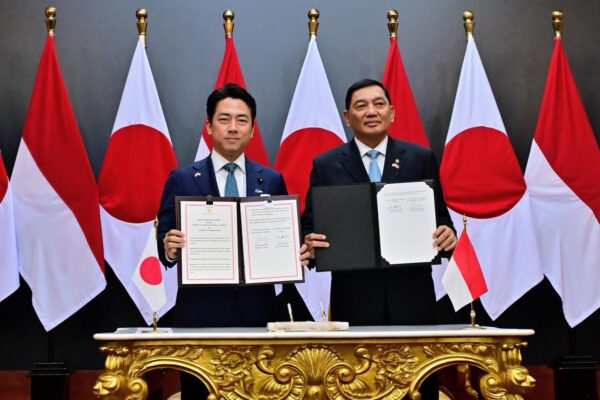
Japanese Defense Minister Koizumi Shinjiro visited Indonesia and the Philippines from May 3 to 6 to meet separately with Indonesian Defense Minister Sjafrie Sjamsoeddin and Philippine National Defense Secretary Gilberto Teodoro. The main takeaway from these visits is that Japan has strengthened security cooperation with Indonesia and the Philippines in an effort to strengthen maritime security in East Asia.
Koizumi and Sjafrie signed the Defense Cooperation Agreement (DCA), expanding cooperation in the areas of people-to-people exchanges, education and research, joint training, maritime security, humanitarian assistance and disaster relief (HA/DR), as well as defense equipment and technology cooperation. Under the agreement, the two countries agreed to launch the “Integrated Defense Dialogue Mechanism” to broaden and deepen their defense partnership through dialogue at ministerial level, vice-ministerial level and among senior military officials. The ministers also agreed to advance discussions on the protection of military information, with a view to strengthening operational cooperation between the two armies. They also agreed to hold operational-level consultations to advance cooperation in the field of defense equipment and technologies that would help strengthen maritime deterrence capabilities.
Meanwhile, in the Philippines, Koizumi and Teodoro reaffirmed their strong opposition to any unilateral attempts to change the status quo through force or coercion in the East China Sea and the South China Sea, and expressed serious concerns over China’s coercive activities in these areas. Furthermore, they confirmed their intention to ensure the integrated functioning of existing and new consultation platforms at the level of Defense Ministers, Deputy Ministers and operational heads of the two defense institutions, covering policy, operations and cooperation in defense equipment and technology. The two ministers also agreed to establish an institutional framework for information sharing to strengthen maritime domain awareness capabilities. They also issued a joint statement on defense equipment and technology transfer. In it, ministers stated that with the transfer of AbukumaWith Class II destroyers in the Philippines in mind, they would establish a working group to discuss education and training, maintenance support, operational cooperation and information sharing, and appropriate post-transfer management.
Considering the contents of the agreements between Japan, Indonesia and the Philippines, we can identify three major priorities that Japan wishes to achieve in maritime security cooperation with each country. The first is Japan’s emphasis on practical and effective security cooperation with the two countries to maintain maritime security in East Asia. By promoting integrated dialogue at the level of defense ministers, vice ministers and operational officials, Japan aims to share strategic awareness on maritime security, while significantly deepening security cooperation by ensuring that political decisions on security cooperation are more easily implemented at the operational level.
The second is Japan’s intensifying information sharing, which is essential for security cooperation. For Japan to share its strategic awareness of the maritime domain with Indonesia and the Philippines and for the self-defense forces and armies of the two countries to operate together, sensitive information held by each side must be exchanged. Japan aims to deepen its information sharing with the two countries by concluding information security agreements, reflecting Japan’s growing emphasis on security cooperation.
The third is promoting the transfer of defense equipment and technology from Japan to Indonesia and the Philippines. If the equipment of the Self-Defense Forces is transferred to the two countries, it will not only strengthen their maritime security capabilities, but also expand the common base supporting cooperation between the Self-Defense Forces and the military forces of the two countries. Two countries operating the same equipment can jointly use command and communications systems, maintenance and supply facilities, and training programs. In the case of Japan, this would significantly expand cooperation between the Self-Defense Forces and Indonesian and Philippine military forces at the operational level.
Before Koizumi’s trip, the Japanese government significantly revised its equipment transfer policy. Previously, it was only possible to transfer equipment in five non-lethal areas, but this limitation was abolished with a revision of the Three Principles on the Transfer of Defense Equipment and Technology, allowing the transfer of all types of equipment. Indonesia and the Philippines have already signed agreements with Japan on the transfer of defense equipment and technology, and serious preparations have taken place to facilitate the transfer of Abukuma-class destroyers in the Philippines. It is likely that the transfer of equipment to Indonesia to improve maritime security will also continue in the future.
Koizumi’s visit to Indonesia and the Philippines clearly demonstrates Japan’s commitment to strengthening cooperation with like-minded countries to ensure maritime security in East Asia. Joint statements from the two countries indicate that they agree to hold consultations as necessary to ensure the security of the two countries as well as regional peace and stability. As the order in East Asia becomes more fluid, Japan appears ready to more actively advance security cooperation with the two countries to maintain maritime stability in the region.