


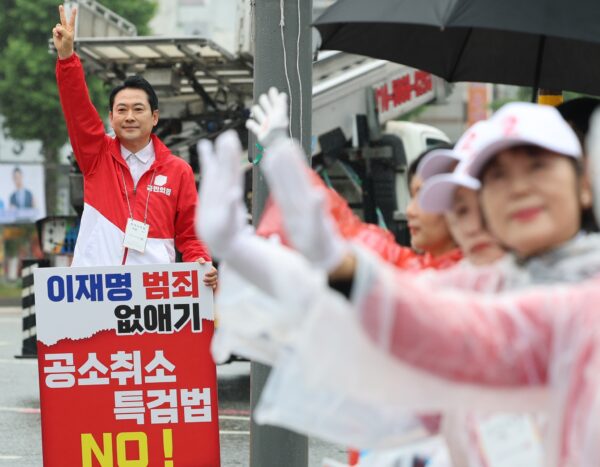
South Koreans will go to the polls on June 3 to elect local councils, municipal authorities, metropolitan mayors and provincial governors. The campaign officially began on May 21. The vote represents the first nationwide political test since President Lee Jae-myung took office, following the impeachment and political collapse of former President Yoon Suk-yeol.
The deeper significance of the election lies not simply in the strong performance of the ruling Democratic Party (DP), but also in whether South Korea’s conservative movement can still function as a credible national alternative after the Yoon era.
For decades, South Korean politics operated within a relatively stable framework. Conservatives and progressives clashed fiercely, but the broader structure of political competition remained intact, reinforced by strong regional loyalties and a resilient two-party system. The conservatives traditionally dominated the southeastern region of Yeongnam, while the liberals maintained their base in the southwest. Governments have changed, but the political geography of the country has rarely changed dramatically.
Yoon’s declaration of martial law last year disrupted that balance. The constitutional crisis and subsequent impeachment seriously dented public trust in the conservative People Power Party (PPP), driving many centrist voters away from the party and consolidating support behind Lee’s newly elected administration.
Yet the PPP’s current crisis extends beyond ordinary electoral unpopularity. The party seems increasingly incapable of defining a coherent post-Yoon identity.
Rather than using impeachment as an opportunity to rebuild a broader conservative coalition, the party leadership has struggled to distance itself from the former president and his most radical supporters. Elements within the party continue to echo allegations of voter fraud and other conspiratorial rhetoric that resonate with part of the conservative base but alienate moderates critical to national competitiveness.
The result is a growing divide between reformists seeking ideological repositioning and pro-Yoon factions determined to preserve organizational control. This conflict increasingly consumes the party itself. Internal conflicts leadership stranglehold, disciplinary measures taken against reform-minded figures, and escalating factional tensions have reinforced the public perception of a party more focused on internal warfare than political reconstruction.
The controversy The hastily arranged visit to Washington in April by PPP leaders further amplified this image. This trip, organized just weeks before crucial national elections, attracted criticism even within conservative circles to appear politically tone deaf and lacking any clear diplomatic or strategic objective. Widely circulated photographs of party leaders posing casually in front of the U.S. Capitol have become a symbol, for many voters, of leadership disconnected from national concerns about inflation and economic stagnation.
This perception has created political openings for the PD well beyond its traditional strongholds. The most obvious symbolic battleground is Daegu, long considered the capital of South Korean conservatism. Even a modest erosion of conservative dominance would have been politically unthinkable just a few years ago. The DP’s growing competitiveness in parts of the Yeongnam region does not necessarily indicate an ideological realignment, but it does suggest a weakening of emotional loyalty to the conservative establishment, particularly among younger, economically frustrated voters.
The broader implications extend well beyond local elections. The PD already controls the presidency and retains overwhelming legislative strength in the National Assembly. A decisive victory in local elections would further consolidate political power around the ruling camp, potentially creating one of the most concentrated distributions of political authority in South Korea’s recent history.
Such dominance would not eliminate democratic competition, nor would it mean the collapse of South Korea’s two-party system. The country has already experienced dramatic political setbacks and conservative parties have repeatedly demonstrated their ability to recover after periods of crisis. Regional loyalties remain influential and the PPP still retains important institutional networks, media influence and support among older voters.
Nonetheless, a severely weakened opposition could reduce significant institutional constraints on the executive while deepening concerns about political imbalance. Local governments play an important role in policy implementation, patronage networks and future leadership pipelines. If conservatives lose ground locally alongside their national defeats, rebuilding organizational capacity ahead of future presidential elections could become significantly more difficult.
Yet a DP landslide is far from inevitable. South Korean politics remains volatile, and history offers clear warnings to the ruling party. After the impeachment of former President Park Geun-hye in 2017, many observers also predicted a long-term gradual realignment. Instead, the Conservatives eventually returned to power after growing public frustration over soaring house prices, political scandals surrounding former Justice Minister Cho Kuk and perceptions of arrogance within the Moon Jae-in administration.
Lee’s government appears fully aware of these lessons. Since taking office, the administration has attempted to present itself as more disciplined when it comes to economic management, particularly regarding housing policy and market stability. Corporate governance reforms and investor-friendly measures have also helped revitalize South Korea’s stock market, helping the government project an image of competence in its first months in office.
At the same time, the conservatives are showing the first signs of partial consolidation in the traditional strongholds of the Yeongnam region. Local elections in South Korea remain heavily dependent on turnout operations, grassroots networks, and regional mobilization. Even in a very unfavorable national environment, these structural advantages can allow conservatives to avoid complete collapse.
The consequences of June 3 will shape South Korea’s political trajectory far beyond local governance itself. A decisive DP victory would likely trigger a new leadership crisis within the PPP, potentially accelerating efforts by reformist conservatives to marginalize pro-Yoon factions and rebuild the party around a more moderate identity. Conversely, a stronger-than-expected conservative performance could stabilize the current leadership and suggest that South Korea’s right retains greater resilience than many observers currently believe.
The election could also boost Lee’s political confidence abroad. A strong domestic mandate would give the administration greater room to pursue its pragmatic diplomatic agenda amid growing competition between the United States and China.
South Korea’s two-party system has already survived repeated crises. But these local elections are important precisely because they can reveal whether the conservative movement is experiencing a temporary setback after impeachment — or whether it is entering a deeper structural decline from which recovery will be much more difficult.