


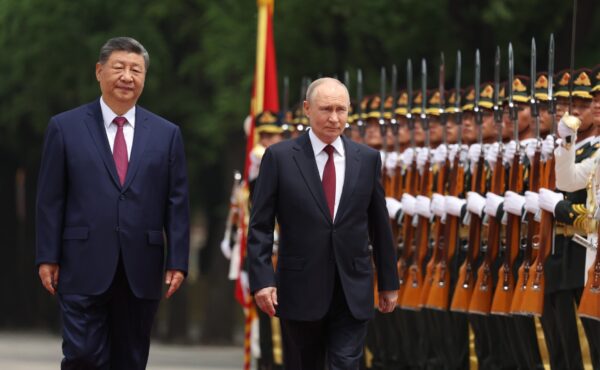
Less than a week after the closely watched summit between Presidents Xi Jinping and Donald Trump, Russian President Vladimir Putin was invited to China. For Beijing, which has always placed great importance on diplomatic protocol and knows how to use timing and ceremonial details to send political signals, the timing is difficult to dismiss as a coincidence. It sounded more like a political message: After the Trump-Xi meeting, two like-minded partners moved quickly to compare notes, coordinate their positions, and assess the direction of U.S. policy and the evolving international landscape.
The symbolism was particularly striking because Beijing had organized the Putin-Xi talks on May 20a date which carries the homophonic meaning of “I love you” in Chinese. This choice necessarily had to be read as a gesture in its own right. The depth of Beijing-Moscow relations and the strength of personal political trust between Xi Jinping and Vladimir Putin now appear to stand in stark contrast to the Trump-Xi summit held just days earlier. The message from the Putin-Xi meeting could force Washington to confront an uncomfortable reality: The idea of befriending China and Russia is likely just wishful thinking.
An empty Trump-Xi summit, a substantial Putin-Xi meeting
The Trump-Xi summit was grandiose on the surface. China offered a high-level welcome and gave Trump all the face he could have wanted. But judging by the concrete results, the meeting was more thunder than rain. As many commentators have pointed outit produced few substantive results and mainly served to create the political atmosphere of two powers seeking to reduce conflict and stabilize relations.
After the negotiations, the two sides did not hold any joint press conferences or issue any joint statements. Even their official readings were published at different times and emphasized distinctly different points. American reading stressed the denuclearization of Iran and North Korea, while the Chinese side has paid relatively little attention to this issue and instead focused on Taiwan. The gap between the two sides on fundamental issues has clearly not narrowed significantly.
In contrast, the Putin-Xi meeting was not only just as ceremonial, but also much more concrete in its results. During their meeting, Xi and Putin signed a joint declaration on deepening the comprehensive strategic partnership of coordination, friendship and good neighborly cooperation, and they jointly witnessed the signing of 20 important bilateral cooperation documents. These covered trade and economic ties, cultural exchanges, science and technology, education, infrastructure and other areas. The two leaders also met the press together and attended and spoke at the opening ceremony of the Years of China-Russia education.
In its official language, Beijing praised Sino-Russian relationsnoting that 2025 marks the 30th anniversary of the establishment of the China-Russia strategic coordination partnership and the 25th anniversary of the signing of the Treaty of Good Neighborhood and Friendly Cooperation between the People’s Republic of China and the Russian Federation. He described the relationship as having reached its highest level in history as a comprehensive strategic partnership of coordination for a new era and as a model for a new type of major country relations. The two sides also agreed to extend the Treaty of Good Neighborhood and Friendly Cooperation between the People’s Republic of China and the Russian Federation. These arrangements and formulations clearly carried more political weight than the symbolic choreography of the Trump-Xi summit.
Beyond the official announcements, it is reasonable to assume that Putin’s visit also touched on the political signals transmitted by Washington during the Trump-Xi negotiations. In other words, the Putin-Xi meeting was not simply a bilateral diplomatic event. It also looked like a rapid post-summit alignment exercise, in which the two leaders coordinated how to jointly respond to the United States. The agenda could well have included how to ease US pressure on Iran and continue supporting Russia. as it suffered its first sustained net territorial loss in Ukraine since October 2023and how to strengthen each other’s diplomatic narratives on the broader international stage.
Washington is isolated, while China and Russia are heading in the same direction
Since the start of Trump’s second term, Washington has tried to bring Putin closer, even at the expense of Ukrainian interests and the alienation of traditional European allies, hoping to drive a wedge between Beijing and Moscow. This strategy failed. The reason is not complicated. Russia, stuck in the war in Ukraine, depends heavily on China. economic support and supplies dual-use goods. More fundamentally, Beijing and Moscow share the same long-term strategic goal: to weaken the US-centered Western international order and erode US global influence.
Trump’s trade war against China in the second term was intended to continue the tough approach of his first term. Yet he underestimated how much Beijing had preparedafter the first cycle of trade conflict, for a new confrontation with Washington. At the same time, Trump’s indiscriminate tariff war against his allies has deepened their resentment and given China more confidence to stand firm against the United States. The result was that Beijing’s countermeasures caught Washington off guard. Trump finally had to to move back of the tough posture towards China that he had cultivated for a long time and sought a thaw with Beijing. In a sense, this amounted to an implicit recognition that China now possesses the international status and influence to deal with Washington on an equal footing.
Unlike Washington, which insulted and alienated its allies and found itself increasingly fight alone In the war against Iran, Beijing and Moscow have remained clear-eyed about who is their enemy and who is their friend. They remained firmly united against the United States and constantly sought to weaken the US-led international order. The unilateral foreign policy of Trump’s second term gave Xi and Putin a moral standing they had never enjoyed before.
During the Xi-Putin meeting, both sides also released a “common declaration in favor of a multipolar world and a new type of international relations”.” Although the statement does not name the United States, it clearly criticizes “unilateralism” and “hegemonism” for pushing the world toward the law of the jungle. He also stressed that China and Russia will firmly shoulder their responsibilities as major powers and uphold the authority of the United Nations and international fairness and justice.
This language is obviously strategic propaganda, but its political effect should not be underestimated. When the United States weakens the credibility of its own alliances and undermines multilateral mechanisms, China and Russia find it much easier to present themselves as defenders of the international order.
Conclusion
The failure of Trump’s strategies in China and Russia reveals Washington’s most serious error in strategic judgment: it no longer seems capable of distinguishing friends from enemies. On the one hand, the United States is exhausting, humiliating and even abandoning its so-called friends – its traditional network of alliances, which constitutes perhaps its most important strategic asset against China or Russia. On the other hand, the Trump administration harbors unrealistic illusions about its strategic rivals, imagining that personal diplomacy and short-term deals can alter the deeper strategic convergence between China and Russia.
Compared to Beijing and Moscow, Washington’s greatest advantage should be its vast network of alliances. For decades, U.S. allies have provided military bases, shared intelligence and provided diplomatic support, while aligning with Washington’s security policies to constrain Beijing and Moscow. Yet Trump’s foreign policy is undermining allies’ trust and putting the U.S. alliance system at risk of fracturing. At the same time, Beijing and Moscow remain determined, aligned and clear in their treatment of the United States as their common adversary. Faced with an increasingly isolated Washington, China and Russia will naturally become more confident and willing to work together to challenge the US-led international order.