


This is part two of a four-part series on “The first hermetic empire» – analyzing the historically unprecedented shutdown that the Chinese Communist Party (CCP) is building in 2026, and how this shutdown has rendered American policy assumptions obsolete. Part I documented the two substitutions of slogans through which Beijing has rewritten its history and pre-written its future. This episode returns to the conditioning sequence which prepared the population to accept the closure that these slogans authorized. Subsequent installments will examine the four-dimensional architecture by which the closure was mechanically designed (Part III), as well as the long historical framework and resulting policy implications (Part IV).
The COVID-19 lockdowns of 2020 to 2022 were not what they seemed.
These were not isolated public health interventions. It was, in fact, a three-step conditioning sequence by which the population of the world’s second-largest economy was made to accept what followed: a hermetic seal that, to those living in China, is no longer visible as a closure. It’s just accepted as a fact of life.
The first confinement: the test
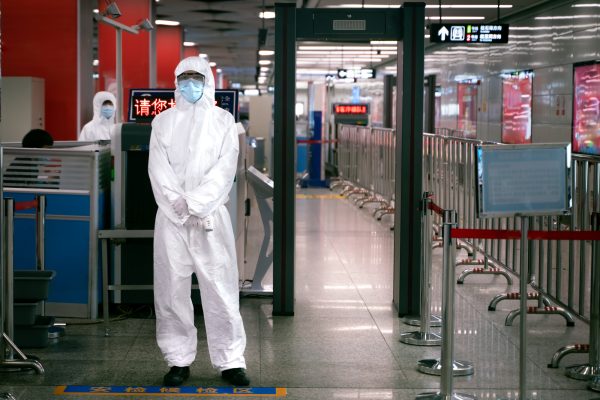
In late January 2020, the Wuhan municipal government announced the closure of a city of 11 million people – the largest metropolitan-scale shutdown in human history. It was extended until April. International coverage at the time treated it as an extraordinary measure justified by the unusual nature of the COVID-19 outbreak; Chinese national media coverage treated it as a mobilizing triumph of the centralized state.
Both framings missed what the Wuhan shutdown also worked for, in retrospect: an operational test of whether a Chinese city of this scale could be physically and informationally sealed off at administrative speed without producing the kind of disorder—looting, mass flight, breakdown of essential services, regime-threatening protest—that would have made the shutdown impossible to maintain.
The test produced an unambiguous answer. With centralized food distribution across neighborhood network units, with movement controlled by cell phone-based health codes, with lockdown information managed by the state media apparatus, the population complied. There was discontent – the death of doctor Li Wenliang, who had been censored for trying to tell his friends about the new virus – caused the first real wave of anger online – but the discontent did not result in anything the regime could not absorb.
On April 8, 2020, the Chinese government knew that a Chinese city of 11 million inhabitants could be confined, against the will of its own population, for 76 days, without a significant break in either the closure or the regime’s authority.
The second confinement: the repetition
In spring 2022, the same operational model was applied in Shanghai. The stakes were even higher: Shanghai is not only home to 25 million people, but it is also the country’s commercial and financial capital – the Chinese city most integrated into the global economy. The Shanghai lockdown lasted two months.
The public health arguments were then less convincing than those of Wuhan. The Omicron variant of COVID-19 was now considered, in most of the world, a respiratory pathogen against which population shutdowns were disproportionate. The cost of closing Shanghai was considerably higher than that of Wuhan. International companies have relocated their regional operations to Singapore, Tokyo and Hong Kong; The city’s position as a global financial center, painstakingly built over three decades, has not recovered.
The Chinese regime has accepted these costs. This is the important operational fact.
A government primarily motivated by public health concerns would have weighed the marginal epidemiological benefit against the structural damage to China’s international reputation and opted for a less aggressive intervention. The CCP did not do this. She carried out the closure for its entire duration, with all its rigor and at a high price. This is because the closure was not calibrated primarily on public health grounds. Instead, a political purpose was served – and that purpose was important enough to accept the loss of Shanghai as an international financial center as a tolerable price.
That the political objective was sufficiently important is confirmed by the personnel file. Li Qiang, the Shanghai party secretary who enforced the lockdown, was elevated within months to premier of the State Council – the same office from which, in March 2026, he would deliver the report on government work whose vocabulary substitutions examined in the first part of this series. Shanghai’s lockdown enforcer has been richly rewarded for his efforts.
The Shanghai lockdown took the Wuhan experiment even further. It was now clear that even a city whose closure carried serious international and economic costs could still be closed when the regime deemed it justified.
The third confinement: conditioning
From spring 2022 until December of the same year, the policy of “dynamic compensation to zero” was implemented nationwide. Cities were gradually closed. Apartment buildings were locked from the outside. Travel was restricted not only at the international border but also at the boundary of each administrative district.
The application of the health code, initially presented as a public health instrument, has become the universal system of authorization for participation in ordinary life: travel, employment, access to commercial establishments, participation in public events. A scan that returned a non-green code made the holder, in effect, a non-person within his or her own city.
As dynamic authorization entered its 10th and 11th months, it no longer tested the population’s willingness to comply with public health measures. This had been established in Wuhan. Instead, the regime reshaped the population’s relationship to the very concept of closure.
By the fall of 2022, the average Chinese citizen had spent most of the year within an administrative regime that treated physical travel, social engagement, and economic participation as conditional on state authorization in real time, via an app from which no one could opt out. The closure is no longer an emergency measure. It had become the ordinary condition of life.
In November 2022, a movement briefly visible in half a dozen Chinese cities – the so-called “White Paper” protests, during which young people held up blank sheets of paper in a sign of refusal to accept the dynamic customs clearance apparatus – appeared to threaten this conditioning.
The central symbol of the protest carried a linguistic subtext that escaped most foreign coverage. The dynamic reset policy aimed to reduce the number of COVID-19 cases, in the regime’s own parlance, to “zero.” A blank sheet of paper is what “nothing” looks like. The demonstrators were literally brandishing what politics wanted for China.
Within days, the Chinese regime identified the participants, dispersed the rallies and quietly arrested or disappeared the most visible organizers. At the same time, the policy of dynamic disengagement was abruptly abandoned, in something resembling a directed withdrawal.
International observers tended to interpret this abandonment as a concession by the regime to popular pressure. This reading missed the most important fact: the conditioning was complete. The Chinese population was subjected, for 33 months, to a sequence of highly publicized confinements. First, a shutdown of 11 million people became normal as an ordinary capacity of the state, then a shutdown of 25 million people became an acceptable economic cost, and finally a shutdown of the entire country became the daily texture of ordinary life. The dynamic compensation device could be removed because the conditioning it had done was complete – and that conditioning did not disappear after the policy change.
After the three confinements: airtightness
From 2023, China was no longer confined. Instead, it remains under a hermetic seal that the previous three lockdowns have conditioned the population to accept – and the difference between the seal and the lockdowns is so complete that its closing character has, for those within it, become invisible.
The three confinements have been named, dated and delimited. They had beginnings and endings. They had officially declared public health reasons. They were, despite their oppression, legible to the people inside them as something that was happening to them – an extraordinary state of being that could in principle be expected to end.
The airtight seal has none of these properties. It was not accompanied by any announcement or explanation. There is no defined beginning, no projected end. It’s not just physical. Confinements operated on bodies in space. The seal operates simultaneously on bodies, on information and on the political imagination.
Its mechanisms – the no-exit regime extended to four major laws, the firewall improvements that resulted in the Great Unplug of April 2026, the cybersecurity law revisions of January 2026 that placed private communications under surveillance, and the extension of the eight provisions of mid-2025 that requires every executive to report any social engagement – were each introduced individually, through different administrative channels, with different stated justifications, over a period of several years.
No moment marked the transition from the third confinement to confinement. Instead, this discrete accumulation of restrictions – each individually defendable on narrow technical terrain – constituted the most complete peacetime shutdown of a great power society in modern history.
It is the conditioning of the three previous confinements which made the seal invisible. A population that had been brought, over the course of three iterations, to the point where closure was the condition of ordinary life, did not register current closure at all. What an outside observer would describe as the country’s shutdown, an inside observer experienced as the banal continuation of conditions that had been in place, in different forms, for years.
The model in packaging
Three iterations of state-administered lockdowns between 2020 and 2022 have produced a population for whom closure is no longer, at the level of language and at the level of expectations, a reality.
This is the deepest achievement of conditioning. Not that the population accepts closure – acceptance presupposes recognition of the thing accepted. The population no longer recognizes the closure as a closure. It simply became the world.
The Chinese regime locked down Wuhan, then Shanghai, then the country. Today, the country is supposed to be reopened – and the population no longer notices that it remains closed.
The seal was mechanically designed to do what no previous Chinese shutdown has achieved: seal the country at the level of physical possibility rather than legal prohibition. The actual mechanisms that created this hermetic empire are the subject of Part Three.