


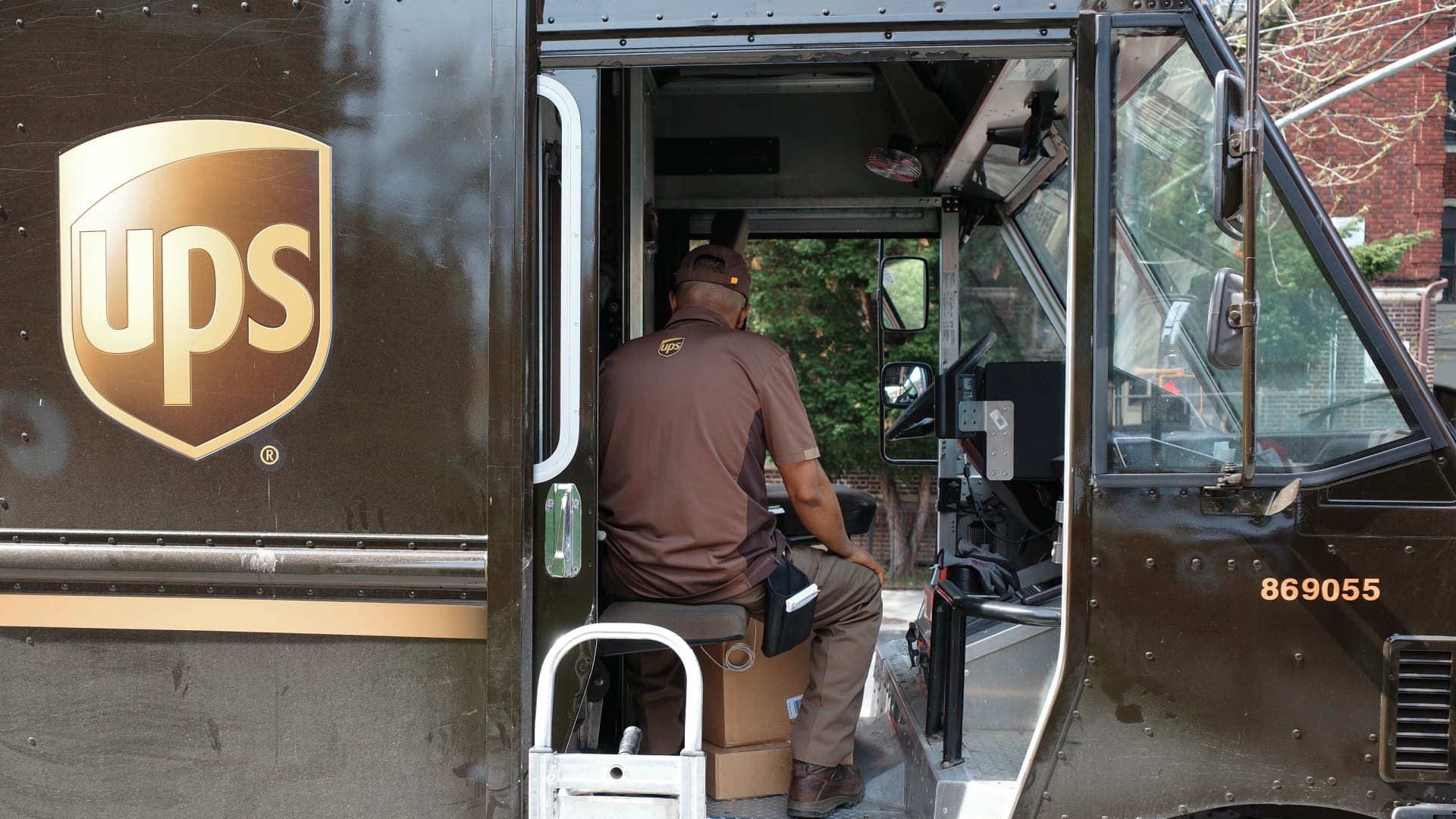
A UPS driver sits in his truck on April 15, 2026 in the Flatbush neighborhood of the Brooklyn borough of New York.
Michael M. Santiago | Getty Images
United Parcel Service on Tuesday reported top and bottom line first quarter results.
Shares of the delivery giant fell about 5% in premarket trading.
Here’s how the company performed in the first quarter, compared to what Wall Street expected, based on a survey of analysts by LSEG:
- Earnings per share: $1.07 adjusted vs. $1.02 expected
- Income: $21.2 billion versus $20.99 billion expected
For the quarter ended March 31, UPS reported net income of $864 million, or $1.02 per share, compared with $1.19 billion, or $1.40 per share, a year earlier. Including one-time items, the company reported earnings of $906 million, or $1.07 per share. Revenue fell to $21.2 billion from $21.5 billion a year ago.
“The first quarter of 2026 marked a critical transition period for UPS during which we had to perfectly execute several major strategic actions and we delivered on our promises,” CEO Carol Tomé said in a statement. “With this behind us, we expect to return to consolidated revenue and operating profit growth, as well as adjusted operating margin expansion in the second quarter of this year.”
For its full-year 2026 outlook, the company reaffirmed its consolidated financial estimate of revenue of $89.7 billion and a non-GAAP adjusted operating margin of 9.6%.
“It’s early in the year to raise [guidance]” Tomé said on a call with analysts Tuesday, adding that there was no indication of concern about the health of the company.
In its domestic segment, UPS said its revenue fell 2.3%, mainly due to an expected decline in volumes.
UPS is also in the midst of a turnaround plan and improvements to the automation of its network. In the first three months of the year, UPS said it achieved $600 million in savings through its network efficiency program, with hopes of reaching $3 billion in year-over-year savings in 2026.
Company executives added during the conference call with analysts that the fuel surcharges have not had a material impact on UPS’s business and that it is still too early to determine the exact impacts of the war in the Middle East.