


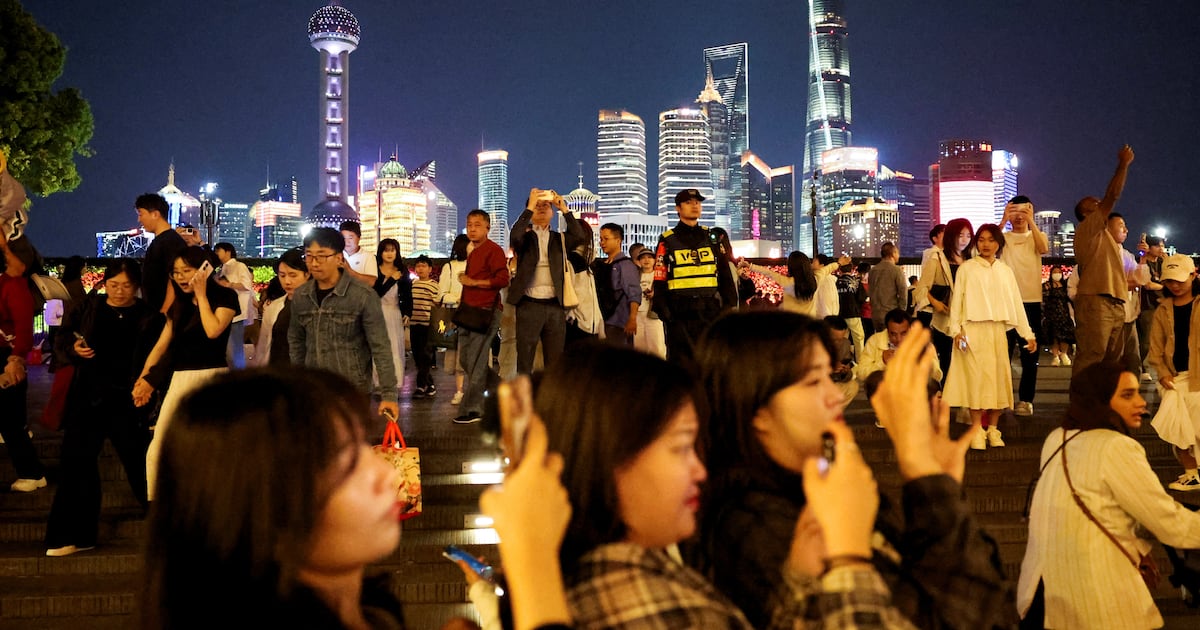

China has reported an increase in the number of tourists and strong consumption activities during the five -day holidays, but Internet users went to Chinese social media to question the accuracy of the data, citing multiple economic pressures and a drop in exports.
Chinese data from the Ministry of Transport has shown that total interregional passenger traffic was on average 293 million trips per day, up 8% compared to a year ago, while sales of large retail and catering companies increased by 6.3% during the holidays, reported the Global Times.
“The twin boom in travel and consumption not only triggered the holiday economy, but also revealed the depth and the great potential for China’s economic development,” said a Global Times editorial on May 5.
Unlike the Chinese state media reports, the sources of the region said that the global feeling of consumers and the market environment during the May holidays of this year were much worse than before.
Once the shopping sites have been devoid of their usual volume of eager buyers, while travelers aware of the costs opted for cheaper alternatives to get around, they added.
For example, Baidu’s research index has shown that the popularity of the search for “green train” has increased considerably during the May holidays, because many passengers have sought the cheap but long way of travel, instead of the more expensive but much faster high -speed rail option.
The reality of average and low -income groups “having a vacation but no budget” is very different from the reports of the Chinese state media of “consumption boom”, say Internet users.
Wuhan resident Zhang said buyers were rare when he visited the Wangfujing popular sales complex on Zhongshan avenue.
“(It was) empty and there were not many people … The atmosphere is certainly not as good as before. Prices have increased; even the price of medicine has increased,” said Zhang.
Last month, the FRG indicated that companies in the main export centers in south -eastern China announced “holidays” in the factory – interrupting production and reduced salaries and hours of work of employees – with more than 50% of the Zhejiang export companies that take “long vacation” after the holidays on May 1.
“Even if we receive orders (from the United States) now, we have to transfer them to Vietnamese factories,” head of a foreign trade company in the city of Shenzhen, in Guangdong province.
“Many factory production lines in Guangdong have stopped. What do you think we should do? ” She asked.
Published by Tenzin Pema and Mat Pennington.