


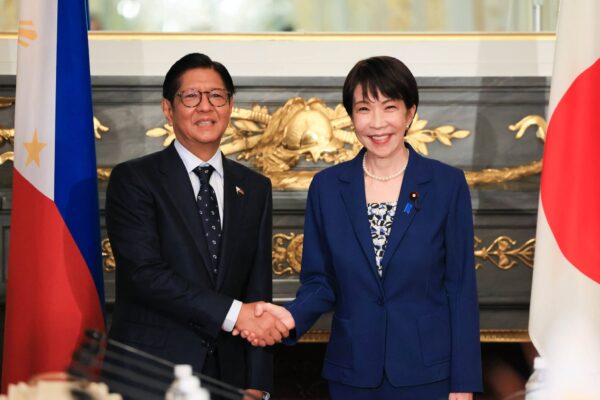
Following their May 28 summit, Philippine President Ferdinand Marcos Jr., who was visiting Japan as a state guest, and Japanese Prime Minister Takaichi Sanae issued a joint statement in which they agreed to elevate bilateral relations to the level of comprehensive strategic partnership. The upgrade marks the 70th anniversary of the normalization of diplomatic relations and reflects the growing cooperation between the two countries in recent years, particularly in maritime and security areas, exemplified by Japan’s first export of completed defense equipment to the Philippines in 2023 and the Philippines becoming the first recipient of Japan’s official security assistance, announced in January.
As part of the comprehensive strategic partnership, the two leaders agreed to begin negotiations on the General Security of Military Information Agreement (GSOMIA), a step toward future intelligence sharing, and to explore the possibility of transferring a military ship from Japan to the Philippines. They also agreed to strengthen cooperation on energy security through Japan’s support for the Philippines in developing a national oil reserves system.
The two countries also reconfirmed their partnership for infrastructure development and trade and investment promotion through existing economic agreements, including the Japan-Philippines Economic Partnership Agreement (JPEPA), the ASEAN-Japan Comprehensive Economic Partnership (AJCEP) and the Regional Comprehensive Economic Partnership (RCEP). The Philippines reiterated its interest in joining the Comprehensive and Progressive Agreement for Trans-Pacific Partnership (CPTPP), and Japan expressed its support. Together, these elements reflect the two fundamental components of international relations: power and economic interest.
Some may question the durability of close ties, given the contentious political environment within the Philippine Senate and its reflection of great power rivalry in Philippine domestic politics; that is, Marcos’ alignment with the United States, with Vice President Sara Duterte’s continued distance from Marcos.
As I have already explained, bilateral relations between Japan and the Philippines are institutionalized beyond politics and have remained stable. It is telling that the ratification of the Reciprocal Access Agreement (RAA) was unanimous in the Philippine Senate, despite the political impasse in which the House found itself. Even senators like Imee Marcos, Bong Go, Bato de la Rosa, Robin Padilla, Alan Peter Cayetano and Rodante Marcoleta, who did not join the Senate resolution condemning China’s comments against a Filipino official, and who are close to the Dutertes, voted in favor of the RAA.
Given the strength of bilateral ties anchored in common strategic objectives, future challenges are likely to be regional or global rather than bilateral. Without this broader context, even historical firsts risk becoming historical footnotes.
The joint declaration also reaffirmed the guiding principle that the two countries have long defended, namely promoting “a regional architecture based on rules respecting international laws”, and announced the start of negotiations on maritime delimitation. This introduces the third fundamental component of international relations: norms.
The Chinese and Taiwanese authorities reacted immediately, in clearly contrasting tones. China says negotiations to demarcate a border between Japan and the Philippines are “illegal, null and void”; Taiwan’s Foreign Ministry said it “commended” the initiative and even suggested possible future collaboration to promote regional stability and environmental protection. Great power rivalry makes it tempting to draw a sharp line between China and U.S. allies in the Indo-Pacific region.
The quest for a rules-based order, however, is universal. The wording of the United Nations Convention on the Law of the Sea (UNCLOS) is instructive: UNCLOS was not an American initiative imposed on the Global South but rather an expression of the newly independent states, now often counted among the countries of the South. Arturo Tolentino, who led the Philippine delegation to UNCLOS, recorded in his autobiography, Decent voice (Phoenix Pub. House, 1990), that Manila maintained its position in favor of a 12 nautical mile territorial sea under UNCLOS despite American opposition. Notably, the Philippines maintained this position even as a close ally of the United States during the Cold War.
The Philippines, as chair of ASEAN this year, would do well not to miss the opportunity to promote a rules-based maritime order supported by UNCLOS. Given the divergent views on the South China Sea, Manila cannot advance its interests alone. It is worth remembering, however, that the Philippines obtained its arbitral award not to protect a sovereign claim over specific islands, but to clarify what constitutes a valid claim under UNCLOS.
The Permanent Court of Arbitration’s award in favor of the Philippines has become part of international law, recognized and approved by many countries. Malaysia, often characterized as a speculative country in the context of great power rivalry, followed the logic of arbitration in rejecting China’s claim to its historic rights at the United Nations.
ASEAN has supported the rule of law as a dispute resolution mechanism since its founding in 1967, and reaffirmed this position when member states adopted the ASEAN Outlook on the Indo-Pacific in 2019. As ASEAN Chair, the Philippines could display this commitment, citing the arbitral award and member states’ maritime delimitation efforts as tangible evidence.
Japan is not a claimant state but, along with other like-minded countries, a player in the rules-based order in the South China Sea. If Japan and the Philippines step up efforts to demarcate a maritime border between the two countries, while pursuing their energy and economic interests, their comprehensive strategic partnership could serve as a beacon in troubled waters.