


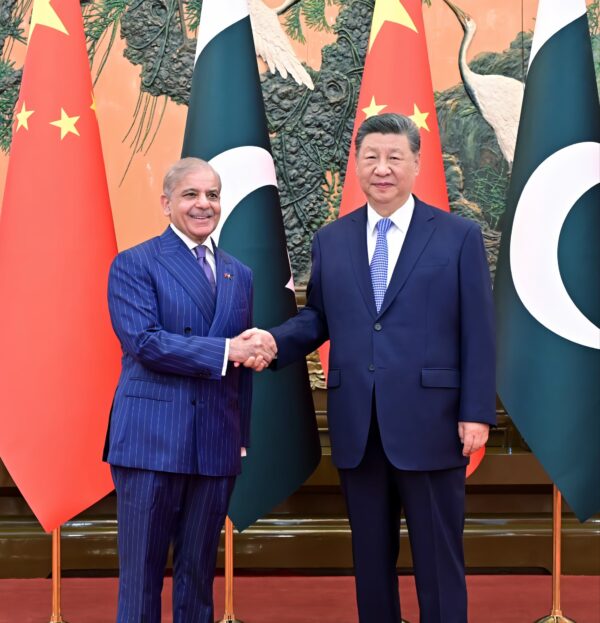
The recent visit of Pakistani leaders to Beijing has injected new energy and solidity into the China-Pakistan bilateral partnership.
During their visit, Pakistani Prime Minister Shehbaz Sharif and Field Marshal Syed Asim Munir held numerous meetings with Chinese leaders, including Chinese President Xi Jinping, Prime Minister Li Qiang and Foreign Minister Wang Yi. Wang also held separate discussions with Marshal Munir.
These interactions, ranging from formal sessions to candid exchanges, highlight a partnership that adapts to the evolving global order. These interactions suggest a deliberate alignment of core interests amid complex regional dynamics and highlight how defense and diplomacy remain closely intertwined when it comes to Pakistan-China ties. From Pakistan’s perspective, the Sharif-Munir visit to Beijing demonstrated to China coordinated civil and military engagement and clear institutional synergy in shaping Pakistan’s regional policy, as the country’s powerful army chief flew directly from Tehran to join Prime Minister Shehbaz Sharif in China.
This high-level synergy also translated into tangible policy outcomes during the visit. A series of memorandums of understanding (MoUs) signed during the visit aim to expand development cooperation. These agreements focus on new phases of the China-Pakistan Economic Corridor (CPEC), improving trade, technology sharing, agriculture and renewable energy. Additional projects in the areas of connectivity and industrial zones appear to be under discussion. This activity demonstrates a continued desire to transform policy understanding into practical results.
It is worth noting that Chinese leaders paid special attention to the Pakistani delegation, demonstrating their clear intention to take their relations from a long-term perspective. During his meeting with Sharif, Xi called Beijing’s partnership with Pakistan “unbreakable.” “No matter how the international situation develops, China always prioritizes the development of China-Pakistan relations in its neighborhood diplomacy,” he said.
It does indeed appear that the Chinese view the partnership as relatively immune to external geopolitical changes. Sometimes, even in the face of diplomatic pressure from the United States, this dynamic provides a degree of predictability for both sides.
Beyond the bilateral sphere, developments indicate that China values Pakistan’s role in broader regional stability. In joint meetings with Sharif and Munir, Xi explicitly appreciated Pakistan’s “constructive role” in the US-Iran negotiations.
“I know you have just returned from Iran and have made positive efforts for the current peace,” Xi noted, adding his gratitude for Pakistan’s contributions. This recognition shows that China is not bothered by Pakistan working with the United States in situations that benefit Chinese interests. Such validation could likely further strengthen bilateral relations in the future.
China and Pakistan appear to have developed a broader consensus on promoting their strategic partnership through these interactions. A joint statement issued Monday reflects efforts to more closely link economic, military, diplomatic and other dimensions.
For example, the statement noted that Pakistan attaches “great importance to and supports” President Xi’s visions, including the Global Development Initiative (GDI), the Global Security Initiative (GSI), the Global Civilization Initiative (GCI) and the Global Governance Initiative (GGI). This alignment suggests that Pakistan is adhering to Beijing’s broader international vision, which could strengthen coordination between the two countries on global issues.
Furthermore, the two sides also reaffirmed their unwavering mutual support on issues concerning their respective core interests. Importantly for Islamabad, China reiterated that the Jammu and Kashmir dispute is a historic issue that must be resolved peacefully in accordance with the United Nations Charter, relevant Security Council resolutions and bilateral agreements. This is an endorsement of the Pakistani position.
Furthermore, the joint statement also included subtle criticism of countries and actors who prefer coercive diplomacy to resolve disputes. “Both sides agreed that it is essential to firmly uphold the victorious outcome of the Second World War and oppose any attempts to revive fascism and militarism,” the joint statement said.
Furthermore, the statement also highlighted CPEC’s expanded development plans, counter-terrorism cooperation to protect projects and personnel and efforts to coordinate approaches on regional issues. These elements show that both sides are determined to create a more integrated framework to protect their interests.
The practical results of these meetings are clearly rooted in a deep historical foundation. As Pakistan and China celebrate 75 years of diplomatic relations, this recent diplomatic activity is part of a broader trajectory. Over the past seven decades, ties between Pakistan and China have gradually strengthened. This partnership, which began with early diplomatic recognition in 1951, has evolved into one of the most cohesive strategic relationships in the region.
Overall, the Pakistani leaders’ visit to China reflects the adaptive nature of China-Pakistan relations at a pivotal moment. Clearly, the reaffirmed commitments demonstrate continuity. But their long-term importance will depend on how the two countries manage the implementation phase in the face of evolving regional pressures.