


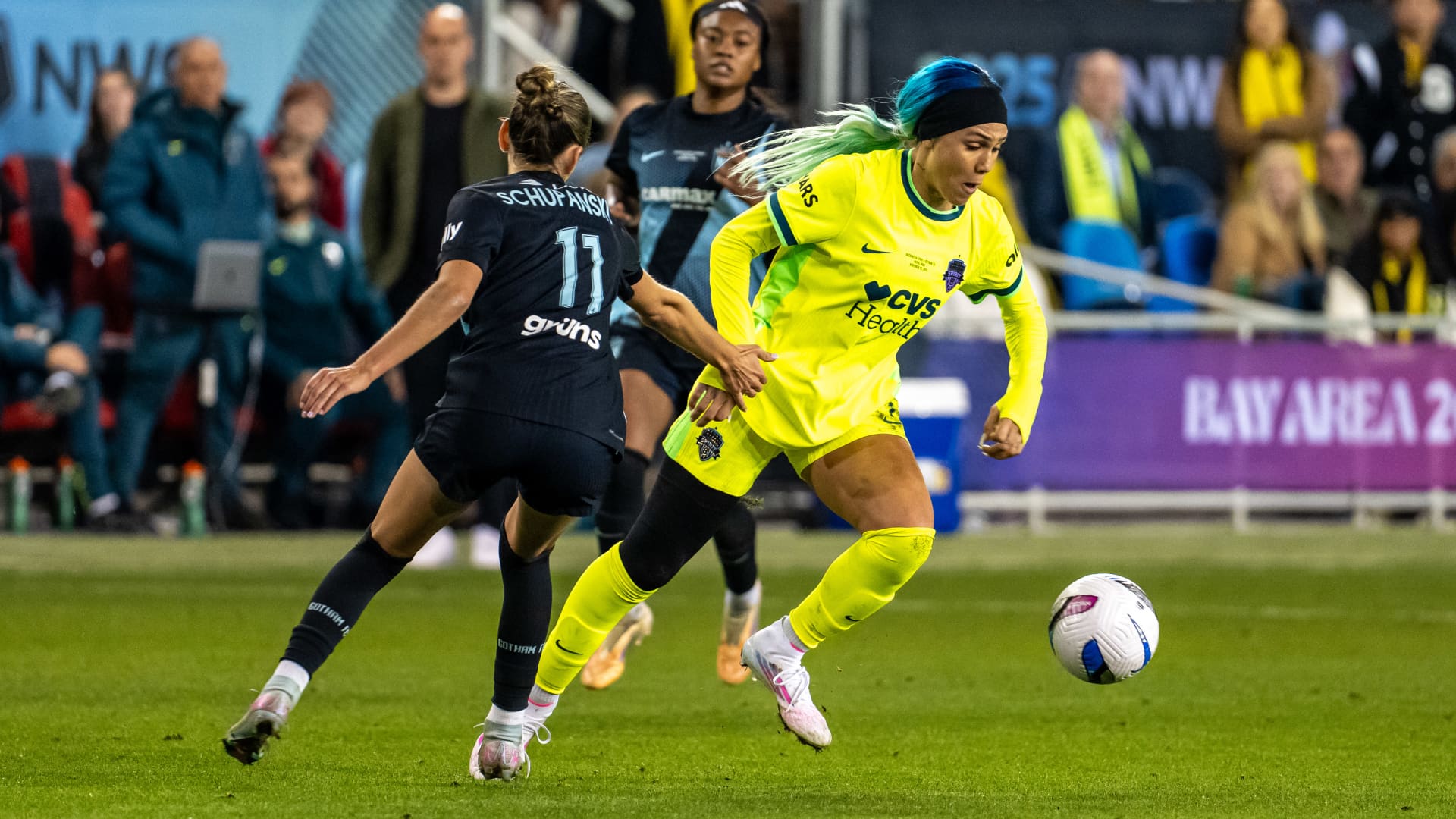
Trinity Rodman #2 of the Washington Spirit avoids Sarah Schupansky #11 of Gotham FC during the 2025 NWSL Championship final between Washington Spirit and NJ/NY Gotham FC at PayPal Park on November 22, 2025 in San Jose, California.
Lyndsay Radnedge/isi Photos | Isi Photos | Getty Images
A version of this article first appeared in the CNBC Sport newsletter with Alex Sherman, bringing you the biggest news and exclusive interviews from the world of sports and media. Register to receive future editions, straight to your inbox.
Last week, the National Women’s Soccer League awarded a new expansion franchise — in Columbus, Ohio — to an ownership group led by Haslam Sports Group for a reported $205 million.
That’s a $40 million increase from the $165 million billionaire Arthur Blank reportedly paid for the league’s franchise in Atlanta in November. And that $165 million itself was a $55 million increase from the $110 million Denver paid in January of last year.
Fast forward to 2022, and the expansion fee for a new NWSL club was just $2 million.
On the surface, this appears to be an NWSL growth story. Playoff attendance increased 11% last season, according to the league. Nearly 1.2 million people watched the NWSL Finals, up 22% from last year, including a whopping 70% increase among 18-34 year olds, the NWSL said.
It makes sense that investors would want to get in on it now given the league’s growth trajectory.
But, according to investors and bankers, there’s something else going on that’s affecting NWSL valuations that has absolutely nothing to do with soccer. This is a spinoff investing thesis driven by the outsized businesses of the NFL and NBA.
Wealthy investors have long been interested in sports ownership, trophy assets that have also produced outsized investment returns. The introduction of private equity, first adopted in the NFL in 2024, has expanded the pool of possible buyers.
This dynamic is good news for the entire professional sports industry, which is also benefiting from another strategic investment: the anti-artificial intelligence trade. Betting on live events is a counter-strategy for those who want less exposure to technology in a market driven by AI investments.
This has helped boost the valuations of the most valuable sports teams in the United States. According to CNBC Sport, the average NFL team is now valued at $7.65 billion. In 2010, NFL teams were worth an average of about $1 billion.
The average value of an NBA team now stands at $5.52 billion, 18% more than a year ago. Fifteen years ago, the average NBA team was worth $369 million. This represents an increase of 1,396%. THE S&P500 is up about 422% over the same period.
Stakes in the NBA and NFL are becoming too expensive for a class of buyers who have an active interest in becoming a sports team owner – even at the minority stake level. Former New York Giants quarterback Eli Manning said this in an interview with CNBC Sport last year.
“It’s too expensive for me,” Manning said of a possible minority stake in his longtime team. “A 1% stake valued at $10 billion becomes a very big number.”
Equity research firm Bernstein wrote in a recent note to clients that NFL team valuations have increased about 17 times in 25 years, “the kind of returns enough to give any portfolio manager legendary status and easily outperform the S&P or any emerging market index on the planet.”
The main cause of the valuation growth comes from the enormous size of the league’s media rights. The NFL signed an 11-year, $111 billion media rights deal in 2021 — and now wants even more money. The NBA followed with a $77 billion deal over 11 years, starting with the 2025 season.
Dividing national television dollars among teams allows even the lowest-revenue teams — the NFL’s Arizona Cardinals and the NBA’s Memphis Grizzlies — to be valued at $5.9 billion and $3.75 billion, respectively, according to CNBC estimates.
There are concerns that “second-tier” sports, including MLB and the NHL, stand to lose media rights dollars as the NFL flexes its muscles and demands more from its media partners. The more money that goes to the NFL, the less there is for everyone.
One might expect this dynamic to negatively affect the valuations of these sports. But according to these bankers and investors, this is not the case.
As the NBA and NFL have kept buyers away, there is now increased demand for sports teams with more affordable valuations. This has contributed to the NWSL’s recent surge, they say. There is more liquidity at the price levels of NWSL teams, which has led to bidding wars and soaring valuations.
While the most recent winning buyers — Blank and the Haslams — already own the NFL and other sports teams, they have had to pay increasingly higher prices to fend off other offers. There are far more buying groups willing to write a $200 million consortium check than pay $1 billion or more for minority stakes in the biggest leagues.
“There’s a lot of demand to get into the sports business, but people can’t write checks to get into the big four anymore. So what they’re doing is substituting,” said veteran sports banker Sal Galatioto, president of Galatioto Sports Partners. “When supply is fixed and demand increases, people bid more to win. The underlying economic factors are not as important.”
The San Diego Padres are finalizing a sale for $3.9 billion, an MLB record, despite the collapse of the team’s regional sports network a few years ago. While nearly $4 billion is a lot of money, it’s still well below the average value of an NFL or NBA team.
“I’ve had investors come to me and say, ‘I can’t afford the NFL and the NBA, what do you have for me in MLB, in the NHL?'” said one prominent sports banker, who asked to speak anonymously because the discussions were private.
The success of the NBA and NFL has trickled down to the bottom of the sports food chain, said Rick Horrow, CEO of Horrow Sports Ventures.
“Major League Cricket was worth $5 million. Now the value is $30. [million] and go higher. Two years ago, Major League Pickleball cost $5 million. Today the value is $15 million or more,” Horrow said.
It’s a bit like an investment bubble in sports, where valuations are decoupled from the underlying financials of the leagues themselves.
That’s a real concern for smaller, less established leagues, said Jasmine Robinson, managing partner of Monarch Collective, the largest investment fund in women’s sports, with $250 million to invest. That’s why Monarch has focused most of its funds on the WNBA and NWSL, rather than more emerging leagues, Robinson said.
“Sports has always been a great investment, but that’s really only in the bigger leagues. It’s not really like you can do a sports deal and make money,” Robinson said. “There has been a real shortage. You have to be part of the leagues that are really going to be leaders to make money. We wouldn’t bet on all the women’s sports leagues.”
Perhaps the big question is what the threshold is for an established league in the event of an economic downturn that turns off the investment spigot. Monarch is betting the WNBA and NWSL are above the line, but WNBA franchises have historically never made money, and now they have to pay players a lot more money after this year’s new collective bargaining agreement.