


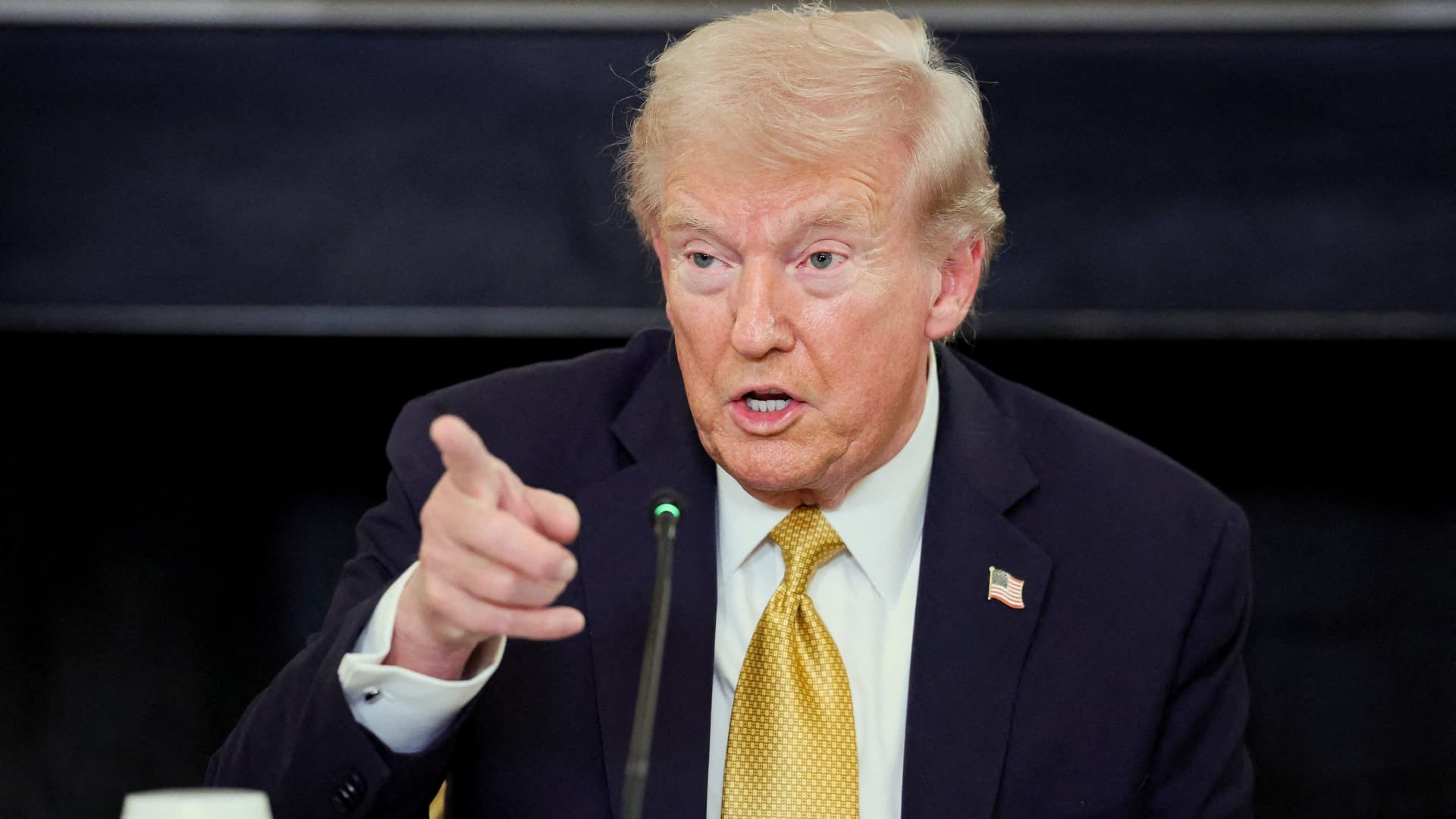
U.S. President Donald Trump gestures during an announcement from the State Dining Room of the White House in Washington, DC, U.S., October 23, 2025.
Jonathan Ernst | Reuters
President Donald Trump on Friday exempted major agricultural imports like coffee, cocoa, bananas and some beef products from his higher tariff rates.
The move comes as Trump faces political setback over high prices at U.S. grocery stores. Some distributors of beef, coffee, chocolate and other common food items raised their prices as Trump’s tariffs took effect this year, adding to the pressure on household budgets created by decades of high inflation in recent years.
Trump’s action Friday also exempts a range of fruits, including tomatoes, avocados, coconuts, oranges and pineapples. In addition to coffee, the price reductions extend to black and green tea, as well as spices such as cinnamon and nutmeg.
The move marks a turnaround for Trump, who insisted the tariffs were necessary to protect American businesses and workers. He said American consumers would not pay the higher tariffs.
The exemptions come just a day after Trump reached trade framework agreements with four Latin American countries – including 10% tariffs on most products from Argentina, Guatemala and El Salvador, and 15% from Ecuador. It also removes tariffs specifically on products that are not grown or produced in the United States in sufficient quantities, such as bananas and coffee.
Rising food prices have been bothering American households for several years. Data from the Consumer Price Index shows that home food prices rose about 2.7% year-on-year in September. (Newer data was delayed due to the government shutdown).
The tariff exemptions are intended to help moderate rising food prices, although experts warn that other factors, such as global supply shortages, also influence prices, particularly for coffee and beef.
Here’s more information on how sectors like beef, coffee and cocoa have responded to tariffs and rising prices.
Beef
A customer purchases meat at a Costco store on November 11, 2025 in Novato, California.
Justin Sullivan | Getty Images
The beef tariff exemption comes after months of rising prices linked in part to Trump’s tariff policies.
Over the past year, the United States has imposed high tariffs on its major suppliers, including Brazil, Australia, New Zealand and Uruguay. Brazil – the world’s second-largest beef producer – is facing effective tariff rates exceeding 75%, leading to a decline in imports to the United States, just as the country’s cattle herd hit its lowest level in nearly 75 years.
Ranchers have struggled to replenish their herds amid drought, higher feed costs and tariffs on fertilizer, steel and aluminum that have made equipment and repairs more expensive.
The supply squeeze has fueled a price spike at grocery stores: Raw beef products rose 12 to 18 percent year over year in September, according to the latest Consumer Price Index report from the Bureau of Labor Statistics.
Producers told CNBC earlier this month that political whiplash, from changing tariff rates to Argentina’s recent beef quota expansion, had further chilled long-term investment, keeping supplies tight and sentiment fragile.
Coffee
Coffee beans are displayed at a grocery store on November 13, 2025 in San Anselmo, California.
Justin Sullivan | Getty Images
Prices for roasted coffee in the United States reached $8.41 per pound in July, a record high and a 33% increase from the previous year, according to data from the Bureau of Labor Statistics.
Trump’s 50% tariffs on Brazilian coffee — which accounts for about a third of U.S. imports — have driven up costs in the roasting and retail supply chains. Vietnam, Colombia and other major exporters have also been affected by the administration’s food tariffs.
Roasters and cafes say they have no way to avoid tariffs because the United States does not produce any of the beans they consume, exposing importers to higher costs regardless of their origin. The September CPI report reveals that coffee prices soared nearly 21% in August compared to the previous year. This is the largest increase since the 1990s.
Retailers warned the impact could have spread if the tariffs had remained in place. The Tax Foundation estimated in August that 74% of U.S. food imports were subject to tariffs, already hitting tea, spices and other products that, like coffee, don’t have a domestic supply chain.
Many of these products that have little or no production in the United States were on Friday’s list of items that Trump exempted from higher tariffs.
Global coffee prices are approaching a 50-year high reached in February.
Cocoa
Cocoa has faced similar price pressures.
Even after a sharp decline this fall, futures prices are still more than double pre-pandemic levels, costing around $5,300 today, following tariffs and three years of weather-driven crop failures in Ivory Coast and Ghana.
In October, Hershey executives said they expected tariff spending of $160 million to $170 million this year, on top of record bean costs that sent retail chocolate prices soaring nearly 30% from a year earlier in the run-up to Halloween, according to research firm Circana.