


Content Warning: This story contains language that readers may find disturbing.
A Tibetan activist died Thursday after setting himself on fire outside the United Nations headquarters in New York.
Lobsang Palden, better known as Lobga Rangzen, a longtime New York-based Tibetan activist, died at Bellevue Hospital after succumbing to his injuries, Jamphel Choesang, president of the New York and New Jersey Regional Tibetan Youth Congress, told Radio Free Asia.
The self-immolation comes a day after China’s new ethnic unity law took effect, with critics warning the law leads to accelerated forced assimilation and cultural erasure of Tibetans and Uyghurs. It also raises fears about Beijing’s growing transnational repression and its ability to stifle dissenting voices abroad.
“The ongoing genocide in Tibet and the implementation of the draconian Ethnic Unity and Progress Law on July 1 are what led Lobga Rangzen to this tragic decision,” Penpa Tsering, head of the Central Tibetan Administration, said in a statement released Friday.
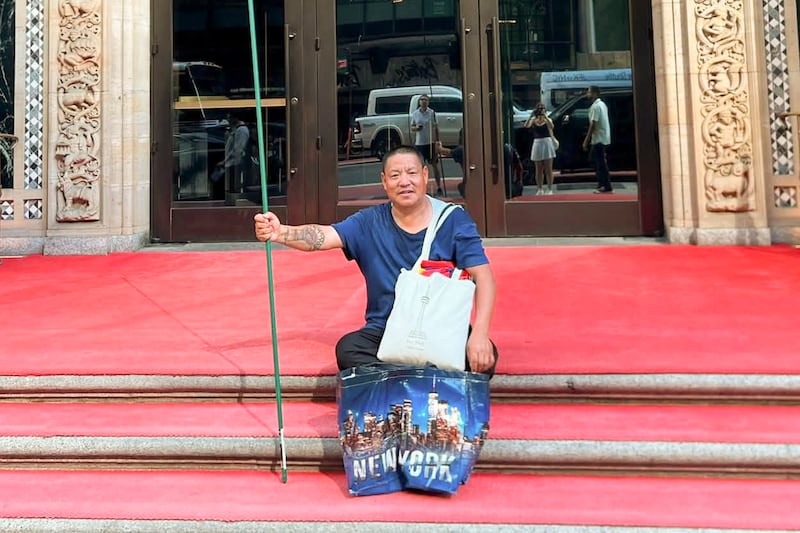
Rangzen was a well-known Tibetan activist who participated in protests and campaigns calling for freedom for Tibetans and raising awareness of human rights issues under Chinese rule.
Before the incident, Rangzen posted a video on Facebook in which he spoke about the situation in Tibet and the importance of efforts to preserve Tibetan language and culture. He also criticized the Chinese government’s policies in Tibet, which he called the “erasure” of Tibetan identity, and urged exiled Tibetans to step up their efforts in their struggle.
Content Warning: Below is language that readers may find disturbing.
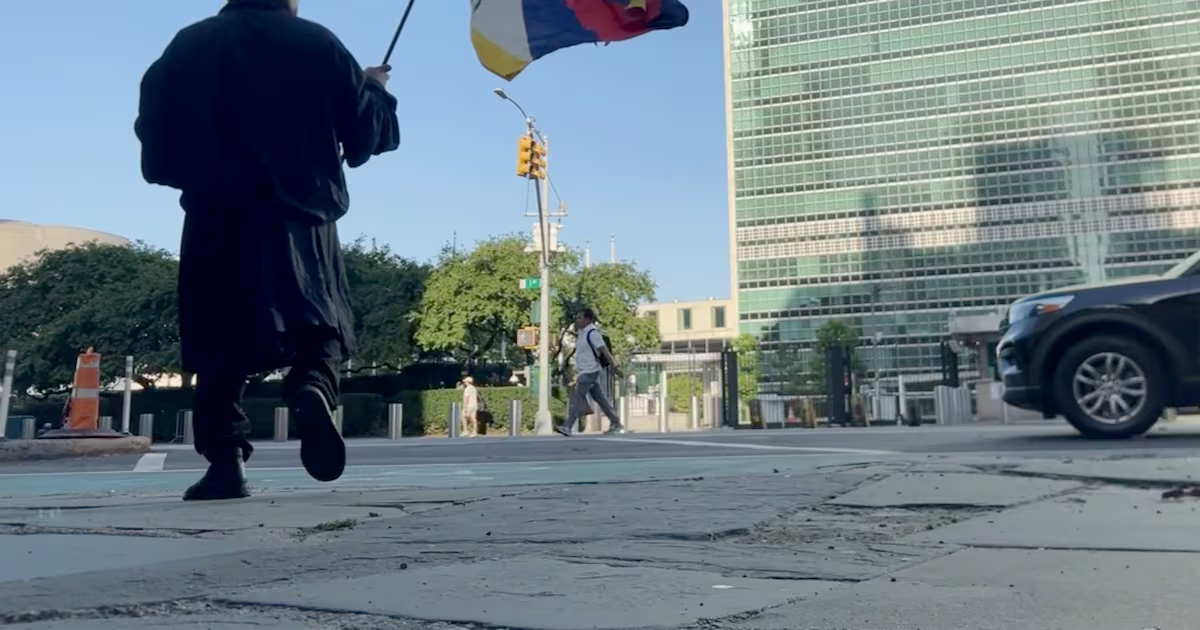
In a subsequent Facebook live post, Rangzen set the camera on the sidewalk and took a few steps to a central reservation in front of the UN building and placed a large Tibetan flag on a signpost. Moments later, he set himself on fire. In the video, cars were seen driving by on First Avenue honking their horns. Rangzen fell to the ground. Two men in security uniforms reached him one minute and ten seconds later with fire extinguishers.
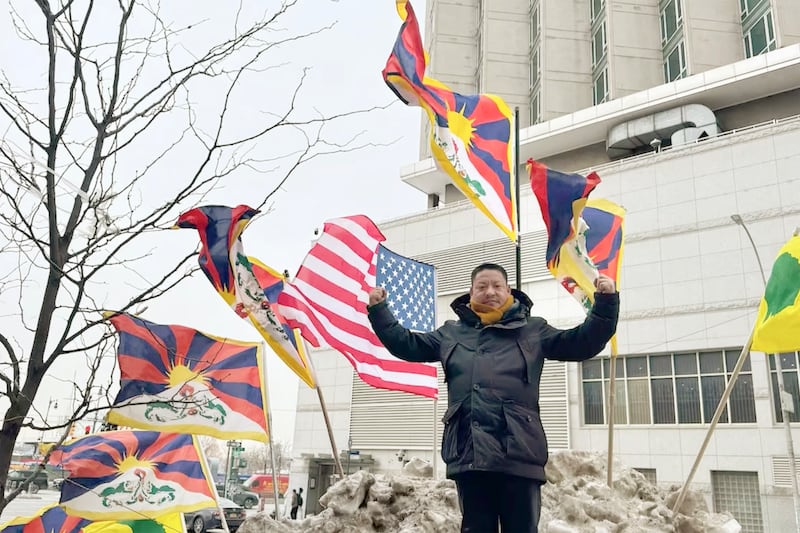
Tibetans have previously committed acts of self-immolation to protest Beijing’s policies in Tibet and in areas with large exile Tibetan populations.
Penpa Tsering said that between approximately 2009 and 2022, around 157 Tibetans self-immolated in Tibet, calling the act an “offering of the body” to the Tibetan cause.
Thupten Choenyi, a friend of Lobga Rangzen, told Radio Free Asia: “About 15 minutes before he set himself on fire, I had a video call with him on WhatsApp. It was around 5:30 p.m. Unlike our previous conversations, he spoke very softly and looked deeply disappointed. He told me, ‘I think China will never listen to us.'”
“He was smoking during the call and I told him not to smoke. He said he didn’t drink, but he did smoke. He was also sipping from a bottle of Coke and his T-shirt was wet. I asked him where he was and he said he was in front of the United Nations.”
“Then he suddenly asked, ‘Can I take a screenshot of our video call?’ I said yes and he sent it to me immediately. Shortly after, he set himself on fire. He also called a few of his close friends before committing the act. I am very sad at the moment.
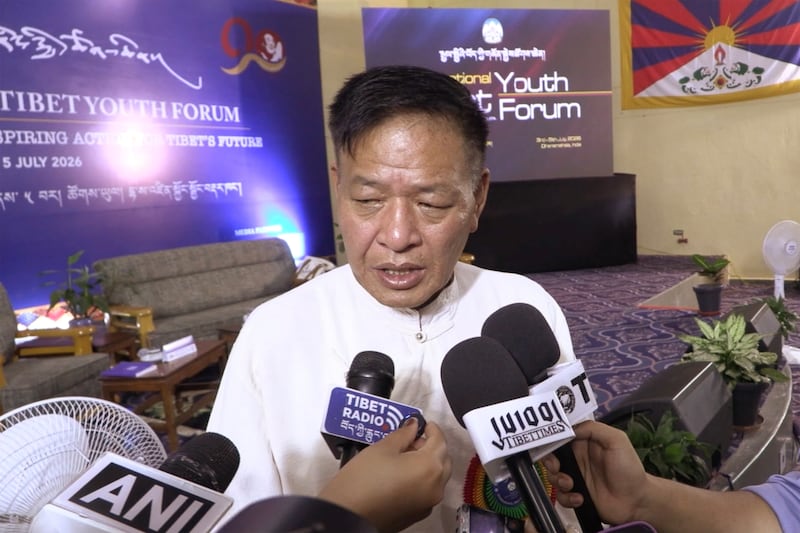
Penpa Tsering, a participant at the International Tibetan Youth Conference in Dharamsala, India, said Rangzen had always carried the Tibetan cause and devoted his time to it in New York. He said that wherever this happens, in Tibet or outside, those who give their lives for the Tibetan cause must be remembered. He announced that the Kashag (Central Tibetan Administration cabinet) had met that morning to hold a day of memorial prayers.
Sonam Tso, who was among more than 100 participants at the conference, told RFA: “It is heartbreaking to learn of his death, but I hope it will help more people around the world learn more about Tibet and the Tibetan cause.” »

Tibetans gathered outside the United Nations headquarters for a candlelight vigil and prayers following Rangzen’s death Thursday evening.
As news of Rangzen’s death spread, Tibetan communities, including groups in Dharamsala, Australia, Taiwan and elsewhere in the United States, began holding prayer gatherings in his memory.
Responding to the immolation at a daily news conference in Beijing on Friday, Chinese Foreign Ministry spokesperson Guo Jiakun said Tibet had been an inalienable part of the country’s territory since ancient times and that Beijing believed “relevant countries would handle this issue in accordance with their national laws.”
Additional reporting by Dickey Kundol, Tenzin Dhonyoe, Tashi Wangchuk and Kalden Lodoe. Contributions from Reuters. Edited by Charlie Dharapak.