


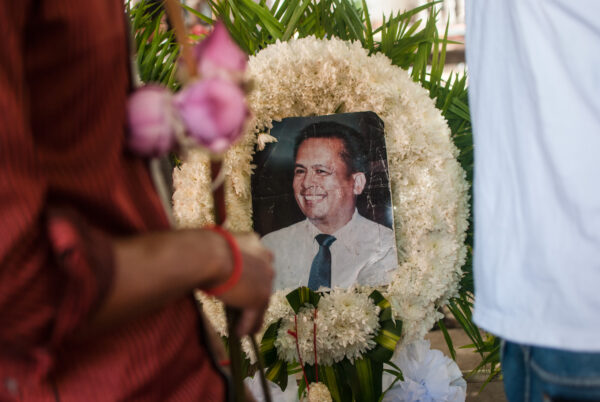
On July 10, 2016, Cambodia’s political landscape was significantly altered by the assassination of popular political organizer Kem Ley. Shot in broad daylight at a gas station in Phnom Penh, his death silenced a prominent supporter of political reform and one of the country’s most ardent defenders of democratic transparency and accountability.
Ten years after his death, the principles he defended seem increasingly distant to most Cambodians. The ruling Cambodia People’s Party (CPP) has tightened its grip on the executive and judiciary, while increasing its dependence on China in a bid to protect the economy from Western tariffs and sanctions. Nevertheless, initiatives both at home and abroad point to a new, potentially democratic, path for Cambodia in the years to come.
Kem Ley was neither a politician, nor a military commander, nor a wealthy businessman. He served as a political analyst, public intellectual and grassroots advocate, speaking out loud on corruption, land rights and the growing divide between Cambodia’s leaders and the general public. In a country where public dissent is tightly limited, Kem Ley possessed a rare ability to engage ordinary citizens in open political dialogue. For many, his assassination marked a watershed in Cambodia’s democratic experiment after the civil war.
The decade following his death was marked by the systematic dismantling of the country’s democratic institutions. Cambodia has moved from an imperfect but competitive electoral system to a de facto one-party state. Before 2016, opposition parties could campaign relatively openly, independent media retained some operational freedom, and civil society organizations had space to criticize government policy. The 2013 elections demonstrated the potential for true political competition, when a unified opposition pushed the ruling CPP, led by former longtime Khmer Rouge commander Hun Sen, to the brink of defeat.
Kem Ley understood the significance of this moment. He frequently warned that systemic corruption, dynastic political ambitions and unchecked patronage networks were hollowing out Cambodia’s institutions. He also acknowledged that growing public frustration, particularly among young Cambodians with no first-hand experience of the Khmer Rouge nightmare of the mid-1970s or the country’s subsequent conflicts, posed a fundamental challenge to existing leaders.
Immediately after his death, the regime moved quickly to suppress public outpourings of support for Ley and his teachings. Independent observers and rights groups quickly labeled the arrested shooter a state “scapegoat,” viewing the assassination as a continuation of Cambodia’s long history of politically motivated killings carried out with institutional impunity. When thousands of mourners gathered in Phnom Penh for his funeral procession, Hun Sen warned that the protests could be exploited to launch a Western-backed “color revolution.” In the years since, the justice system has been used to crack down on those seeking to mark the anniversary of his death or demanding justice in his case. Activists who attempted to gather to commemorate Kem Ley and his work were arrested during commemorations in 2019, and by 2020 the regime had imposed a total ban on all gatherings and public memorial services in his honor.
The regime’s efforts to silence critics have also taken place against a backdrop of shifting regional alignments. Live research published by Action for Democracy, titled Authoritarian Collaboration Index, found that the Hun regime has increased its operational cooperation with anti-democratic partners, collaborating with its authoritarian peers hundreds of times over the past two years, including with China. Beijing’s political, economic and strategic support for the Hun regime, including more than $3.75 billion in foreign direct investment in 2025 (73% of Cambodia’s total FDI), has enabled political elites in Phnom Penh to offset economic sanctions imposed by countries such as the European Union and the United States for political and human rights violations.
In return, Cambodia has consistently aligned itself with Beijing diplomatically, with Cambodian leaders repeatedly describing China as the country’s “most trusted friend and most reliable partner.” This relationship has strengthened the Cambodian government’s confidence in its ability to suppress dissent without significant international consequences.
But foreign influence alone does not explain Cambodia’s democratic decline. Corruption and favoritism remain at the heart of the country’s political system. The transfer of power from Hun Sen to his son Hun Manet in 2023 was presented by the state as a “generational renewal”. In reality, authority remains concentrated within the same leadership networks that have dominated Cambodia for decades. Since Manet’s succession, the V-Dem Institute has recorded significant setbacks in the autonomy of Cambodia’s electoral management bodies. Similarly, other global indices like the Reporters Without Borders World Press Freedom Index saw the country’s score drop sharply between 2024 and 2025, despite the new leadership.
Yet despite these restrictions, the policy environment is not entirely static. Although they often project a sense of permanence, authoritarian systems also evolve under the pressure of demographic shifts, economic frustration, and the shifting calculations of elites. Cambodia’s next local elections in 2027, while still tightly managed, will take place in a society that is more urbanized, more digitally connected, and more internationally aware than at any time in its modern history. Even limited elections in such an environment can become focal points of popular grievances.
Outside the country, political coordination is even more apparent. As it has for many years, the Cambodian diaspora continues to play an important role in the country’s politics. Initiatives such as the Overseas Khmer Citizens’ Assembly have begun to coordinate the civic engagement of Cambodian communities abroad, creating platforms for dialogue, advocacy, and political engagement with international actors.
At the same time, the Kem Ley Freedom Academy has played a formative role in training a new generation of civic actors, providing training in political systems, civil and political rights, and the practical skills of democratic engagement, from public speaking and strategic messaging to organizing events and building coalitions. These exercises are designed to equip participants with the tools necessary to support long-term democratic advocacy for Cambodia in exile.
Ten years later, the assassination of Kem Ley gave birth to a dispersed but lasting political project. While democratic political space in Cambodia remains very restricted, the underlying demand for institutional accountability – a key principle of Kem Ley’s teachings – continues to prevail within Cambodian society as a whole.