


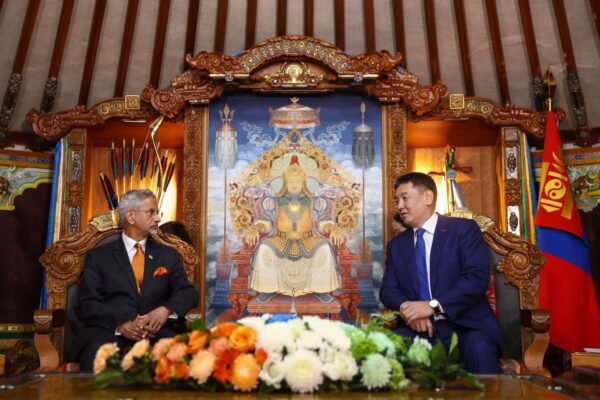
Indian Foreign Minister Subrahmanyam Jaishankar recently completed his tour of East Asia, which included Mongolia. The official visit highlighted the strategic partnership between Mongolia and India, growing bilateral economic engagements and the strong political will of both sides to strengthen cooperation, demonstrating deeper connectivity between Eurasia and the Indo-Pacific.
by Jaishankar official visit to Mongoliafrom June 22 to 23, was part of the 10-year strategic roadmap established in 2025 during the state visit of Mongolian President Khurelsukh Ukhnaa to New Delhi.
During Jaishankar’s visit to Ulaanbaatar, he met Khurelsukh, Foreign Minister Battsetseg Batmunkh and other senior government officials to strengthen bilateral cooperation in several areas, including mining, technology and human resources.
In his press releaseJaishankar called Mongolia and India “strategic partners” and “spiritual brothers and sisters”. The Modi government’s strategic direction – which ranges from global digital and physical connectivity and defense partnerships to economic integration, promoted through cultural diplomacy – aligns with Mongolia’s economic and development goals. Thus, India is and will continue to be a third important partner of Mongolia.
June 22, Jaishankar visit the flagship Mongolian oil refinery in Dornigovi province. India is currently building Mongolia’s very first oil refinery in Dornigovi. The project is financed by a $1.7 billion line of credit. Once completed, the Mongolian refinery will be the second largest foreign investment project after Rio Tinto’s Oyu Tolgoi and has the potential to change Mongolia’s energy sector.
Importantly, the oil refinery is one of the most important investments financed by Mongolia’s third neighbors outside of the mining sector. The successful completion and operation of the refinery will provide a major source of diversification for Mongolia’s limited market. The completion of the project is therefore eagerly awaited by both Mongolia and India.
However, mining remains an important focus of Mongolia’s economic strategy – and India is also a possible third destination for Mongolia’s coking coal industry. Considering India’s growing need for coal for its technological advancement and steel industry, Jaishankar expressed interest in exploring logistical opportunities for Mongolia to export coking coal and other mining products to India.
In addition to their economic engagements, Mongolia and India both use soft power mechanisms to manage international and regional affairs. Cultural diplomacy, religious ties and education have become the pillars of Indo-Mongolian cultural diplomacy.
During Khurelsukh’s reign state visit to India in 2025, the two countries agreed to digitize 1 million ancient Buddhist manuscripts kept in the Gandantegchinlen Monastery in Mongolia, which Jaishankar personally visit during his official visit.
After his visit to the monastery, Jaishankar I called him “a symbol of the special and spiritual bond between India and Mongolia.” He added that he was “excited to see the partnership project for the digitization of one million Buddhist manuscripts in action.”
India’s technological innovation and digital transformation have inspired Mongolia’s ambition to become a digital nation. India and Mongolia have deepened their digital and technological cooperation by signing several Memoranda of Understanding (MoUs) in the areas of cybersecurity, IT, communications and digital education.
Jaishankar’s official visit to Mongolia highlighted several important foreign policy developments for India and Mongolia.
For India, East Asia has become increasingly important in terms of technology, trade, supply chain resilience and soft power. This creates a new window of opportunity for Ulaanbaatar’s landlocked economic environment. Moreover, India and Mongolia’s non-bloc approach aligns with their economic and growth strategies.
Just days before Jaishankar’s official visit, Mongolia hosted Khaan Quest, the annual multinational peacekeeping exercise Or India actively participated since 2006. Mongolia also participates in the Indian military exercise Nomadic Elephant, which develops counter-terrorism capacity. To elevate the defense relations of Mongolia and India, in 2025, New Delhi established a defense attached in Ulaanbaatar.
At the leadership level, both Mongolia and India demonstrate the political will to strengthen cooperation mechanisms. Chairman of the State Great Khural of Mongolia, Byambatsogt Sandag, received Jaishankar to strengthen cooperation in governance and legislation.
The Ministry of Foreign Affairs of Mongolia summarized Jaishankar’s stay: “This visit is of great significance for strengthening the ‘strategic partnership’ between the two countries, enriching trade and economic cooperation with new ideas and ties, and determining the direction of future cooperation.” As Mongolia continues to seek investment from its third-party neighbors, India will become an increasingly important partner for Ulaanbaatar. Mongolia has also become an important partner in New Delhi’s Act East policy.
Today, we hope that Mongolia will have stable governments which can successfully implement large projects crucial to the country’s development – such as the Indian-backed oil refinery.