


Two state-owned banks in Kyrgyzstan have ended their partnerships with more than 130 companies due to sanctions risks, the Kyrgyz government announced this week.
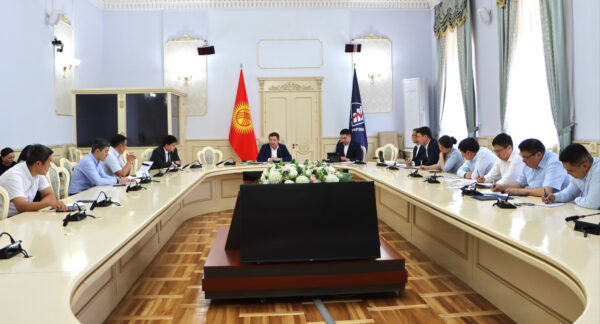
During a work meeting on sanctions policy, chaired by Bakyt Sydykov, Minister of Economy and Trade – and also recently named the Kyrgyz president’s special representative for sanctions policy – the government shared what he called the “results of ongoing work.”
Two state-owned banks, Eldik Bank and ABank, have terminated relationships with around 131 companies and are investigating another 80 companies. These figures come just a few weeks after those of Kyrgyzstan. Ministry of Justice announced that it had ordered the closure of 50 locally registered businesses in the country.
All this follows the 20th European Union sanctions package, adopted at the end of April, which targeted the EU’s “anti-circumvention” tool against Kyrgyzstan. The tool has been presented as “an exceptional and last resort measure” to be used against countries that the EU believes have taken insufficient steps to prevent the circumvention of sanctions against Russia, and Kyrgyzstan has become the target of its first deployment. Concretely, the tool allows the EU to “restrict the sale, supply, transfer or export of specified sanctioned goods and technologies to certain third countries”.
Over the past year, several Kyrgyz banks have been individually sanctioned by the EU, US and UK, including state-owned banks Keremet Bank and Kapital Bank. Additionally, more than 30 companies registered in Kyrgyzstan have been added to the sanctions lists.
In FEBRUARYBrussels dispatched EU sanctions envoy David O’Sullivan to Kyrgyzstan to continue negotiations. As I said at the time:
O’Sullivan told reporters that trade flows suggest some goods “are being imported into Kyrgyzstan for the sole purpose of being re-exported to Russia, in violation of our sanctions.” In particular, he mentioned radio equipment and machine tools produced in Europe and imported to Kyrgyzstan for the exclusive purpose of being re-exported to Russia.
“What concerns us is the fact that there has been a significant and very notable increase in the percentages of imports and re-exports of these products compared to the pre-war period,” O’Sullivan said.
“We are not asking Kyrgyzstan not to have trade relations with Russia. We are only asking that these trade relations do not involve the deliberate circumvention of our sanctions by transporting EU-sanctioned goods through Kyrgyzstan to Russia,” he added.
Despite this commitment, the EU took the decision in April to intensify pressure on Kyrgyzstan.
Kyrgyz officials, including President Sadyr Japarov, continue to deny accusations that the country facilitated the evasion of international sanctions against Russia. However, since the launch of the “anti-circumvention” tool, Bishkek has taken concerted steps to at least appear to be doing something to address this problem.
Economy Minister Sydykov was given exactly this portfolio earlier this month when he was named the president’s special representative for sanctions policy. According to the Ministry of Economy and Trade, state-owned banks carry out daily screening of customers and payments against EU, US and UK sanctions lists and also “apply a risk-based approach that includes an analysis of customers’ ownership structure, nature of their activities, geography of counterparties, product range and other risk factors.”
It is in light of these policies that the two aforementioned state-owned banks have cut more than 130 customers. The specific companies have not been named and it is unclear whether there is any overlap between the two banks or whether the companies involved have relationships with other Kyrgyz banks. The ministry says that between the two banks, around 17,000 transactions were deemed “suspicious” and subject to investigation.