


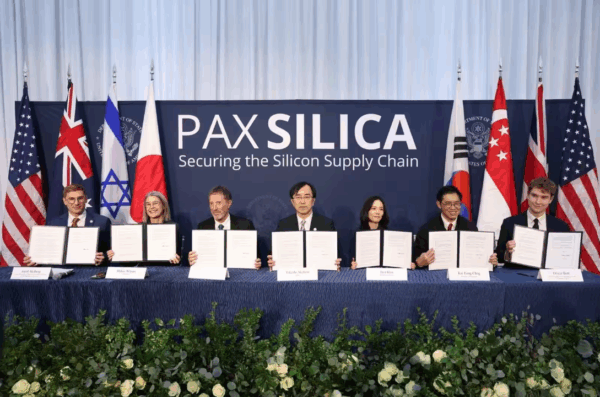
Diplomat author Mercy Kuo regularly engages subject matter experts, policy practitioners, and strategic thinkers from around the world for their diverse perspectives on U.S. Asia policy. This conversation with Akhil Ramesh – director of the Economic Statecraft Initiative at the Pacific Forum – is the 514th in “The Trans-Pacific View Insight Series.”
Explain how the U.S.-led Pax Silica initiative integrates economic security with foreign policy.
Pax Silica can be understood through two complementary lenses. First, it reflects a distinctive Trump administration initiative that utilizes critical technology cooperation. – particularly across the silicon and semiconductor value chain – as a tool to strengthen bilateral relations while advancing broader U.S. economic and trade interests. Second, it can also be seen as a continuation of the industrial policy foundations laid under the Biden administration.
Under President Biden, initiatives such as the Mineral Security Partnership (MSP), the Indo-Pacific Economic Framework (IPEF), and CHIPS4 were designed to complement domestic industrial policies such as the CHIPS and Science Act and the Inflation Reduction Act. Pax Silica appears to build on these efforts, but with a more transactional and deal-oriented Trump approach, focusing on striking strategic agreements with countries around the world to strengthen U.S. leadership in the production of semiconductors, critical minerals and advanced technology supply chains. In this way, economic security becomes a central pillar of foreign policy engagement.
Examine the factors driving Indo-Pacific partners’ decisions to participate in Pax Silica.
The global economy remains deeply interconnected around two major poles: the United States and China. While the United States and its allies dominate the design and manufacturing of advanced semiconductors and high-end technologies, China retains significant control over the processing of rare earth minerals and upstream supply chains.
For Indo-Pacific countries, participation in Pax Silica is driven by strategic pragmatism. These states recognize the importance of being part of any major economic and technological framework providing benefits in security, investment and market access. Joining such initiatives allows them to diversify economic risks, attract industrial investment, strengthen national production capacity and avoid excessive dependence on a single power. Rather than choosing sides outright, many countries view participation as a way to maximize strategic flexibility while benefiting from U.S.-led and China-linked economic ecosystems.
What are the geopolitical factors behind Pax Silica in relation to China’s supply chain dominance?
Early in its second term, the Trump administration recognized that engaging with the People’s Republic of China required a fundamentally different approach than with other major economies. As several countries sought negotiated settlements and conciliatory approaches in response to tariffs and trade disputes, China responded by leveraging its dominant position in rare earth mineral value chains and critical supply chains as a strategic tool.
Beijing’s drive to militarize its control over rare earth elements, processing infrastructure and industrial inputs has highlighted the vulnerability of Western economies and defense industries. This has accelerated the urgency for the United States and its allies to develop alternative supply chains and reduce their dependence on China. Pax Silica emerges from this geopolitical reality: it is designed not only to build industrial resilience, but also to serve as a coordinated strategic response to China’s supply chain dominance and economic coercion.
Analyze the impact of the Iran-US War on Pax Silica.
One of the least studied dimensions of Pax Silica is the effect of the Iran-US conflict on its broader strategic viability. The conflict raises serious questions about the sustainability of building resilient supply chains through partnerships in regions vulnerable to geopolitical instability, particularly in the Middle East.
If Pax Silica aims to create secure and diverse supply chains, reliance on conflict-prone regions could undermine this goal. While partnerships with Gulf states such as the UAE and Qatar offer clear benefits in energy security, capital flows and AI infrastructure development, broader regional instability creates significant long-term risks for industrial planning and supply chain continuity. In this sense, the war highlights a fundamental tension within Pax Silica: finding the balance between strategic economic opportunities and geopolitical risk management.
Evaluate the role of American and Asian industrial players in promoting the Pax Silica program.
Ultimately, Pax Silica’s long-term success will depend less on political leadership and more on whether it gains lasting support from industry stakeholders across the Indo-Pacific. For the initiative to survive beyond the Trump administration, it must be institutionalized through commercially viable frameworks that earn both bipartisan support in the United States and the trust of private sector players across Asia.
Given the frequent shifts in U.S. policy between climate-friendly industrial strategies and administrations skeptical of such programs, industry players need predictability, stable rules, and long-term incentives. Companies are primarily motivated by access to U.S. markets, advanced technologies, and secure supply chains. – no ideological competition. Although Southeast Asian countries may be reluctant to embrace a strict bifurcation between the United States and China, they would strongly support an initiative that would genuinely reduce supply chain bottlenecks and protect against geopolitical disruption.
If Pax Silica is designed around practical supply chain resilience, industry could become its strongest advocate. However, if it becomes primarily a geopolitical instrument to counter China without providing real commercial value, it risks becoming a symbolic initiative with limited strategic impact. – a paper tiger rather than a transformative framework.