


Indian and Chinese civilizations have known each other and been in contact for more than 2,000 years. Any book or article that focuses on India-China relations will usually include mention of their long – and generally peaceful – ties. These include trade and civilizational influence. The export of Buddhism from India to China and its long-term impact on that society are invariably discussed. Moreover, China is India’s largest trading partner today. However, there is little historical evidence of an influence in the other direction: Indian interest in Chinese thought or literature.
Moreover, despite their current rivalry, what is happening in China barely commands the attention of the Indian public, unlike India’s other rival, Pakistan.
According to a recent survey, a plurality of Indian adults ranked China as the biggest threat to their country. According to a Pew survey, released after the India-Pakistan military clashes of May 2025, China was considered the second biggest threat to India after Pakistan. It is clear that Indians are aware of the Chinese threat, but this does not translate into a willingness to learn more about China.
Apart from a few specialist institutes, government organizations and university departments, why has there been little interest in Chinese culture, history, language, philosophy and politics in India, both in the past and today?
India and China have known each other for at least two millennia. The Hindu epic Mahabharata and Kautilya’s Arthashastra, an ancient textbook on statecraft and economics, contain references to cīnapaṭṭa or bundles of Chinese silk. Zhang Qian, an early envoy of the Han dynasty to Central Asia in the 120s BCE, saw bamboo and fabrics from China in the markets of Balkh (Bactria), which he believed were arriving from India.
There is therefore evidence of bilateral trade dating back to ancient times, both by land and sea, through intermediaries or directly. During the time of the Chola dynasty, in the 11th century CE, Tamil envoys and merchants traveled directly to China: there are records of tribute missions and merchant colonies. Land routes from India to China tended to bypass Tibet, due to the high Himalayan barrier, along the northern and southern edges of the Taklamakan Desert in Xinjiang, and enter China through the Gansu Corridor. Sea routes used monsoon patterns to reach the southern coast of China via Southeast Asia, seeding Indian-influenced kingdoms in places like Java, Champa (now in Vietnam), and the early Khmer polities of Funan. In addition to silk, Indians purchased paper and porcelain from China. The first evidence of the use of paper in India is mentioned by Chinese pilgrims in the 7th century CE. At the same time, India exported spices, incense, high-quality steel, and horses from West Asia to China.
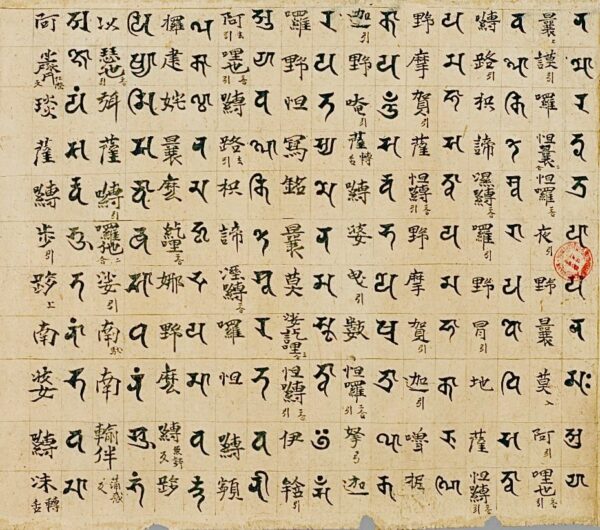
Besides trade, Buddhism spread from India to China after the establishment of the Kushan Empire, which spanned both sides of the Himalayas, in the first century BCE. Buddhism became popular in China after the fall of the Han empire and grew, perhaps to fill the void of poor governance, during the three-century interregnum between the dynasties that ruled a united China, the Han, which ended in 220 CE, and the Sui (581–618 CE). The Sui were succeeded by the Tang (618-907 CE), who presided over the height of Chinese Buddhism, before the rise of Neo-Confucianism during the Song dynasty that followed. It was during this time that many Chinese scholars researched Buddhist manuscripts, made translations from Sanskrit into Chinese, and even traveled to India, often with state sponsorship, facilitating the transfer of much Indian knowledge to China. In addition to Buddhist manuscripts, the Chinese acquired works on various subjects.
In his book India, China and the World: A Connected History, Tansen Sen writes that in 1924, when Chinese intellectual Liang Qichao delivered a series of lectures to welcome the famous Indian author and poet Rabindranath Tagore to China, he “explained the various ways in which Chinese culture was indebted to India in the fields of philosophy, literature, music, architecture, art, astronomy and medicine. Calling India an “elder brother”, Liang stressed that what China received were “gifts of singular and precious value, which we can never forget”.
But why hasn’t India received similar intellectual gifts from China? To begin with, it was easier for Indian culture to exert influence on China because Indian literature, ideas, and knowledge arrived with Buddhism, and for centuries China continued to seek out Buddhist texts in India. There was no similar channel for texts and knowledge from China to India. This may be because Confucianism and Chinese literary culture in general are not ideal for export: they require immersion in a highly developed, particularly Chinese, worldview as well as mastery of a complex writing system.
It is telling that even when cultures had the choice of adapting Indian or Chinese traditions to their needs, most of China’s immediate neighbors in the Eurasian steppe, the Himalayas, and Southeast Asia chose Buddhism or Hinduism, as well as Indian-derived writing and political systems. The few exceptions, Korea, Vietnam and Japan, are telling: these societies did not have direct access to Indian civilization itself during their formative periods, except via China. It is therefore not surprising that Indians themselves, with their own intellectual and literary traditions, generally did not seek Chinese knowledge, given the complexities of travel and translation. There is, however, a singular and tantalizing reference to a lost Sanskrit translation of Daodejinga Taoist work, requested by the king of Kamarupa, in modern Assam.
However, none of this prevented the exchange of useful trade goods or even technology. It is reported that during the reign of Emperor Harshavardhana of Kannauj (606-647), Chinese and Indian monks met at the Mahabodhi Monastery in Bihar and exchanged knowledge on silk and sugar production.
More than a thousand years later, in the 20th century, under very different geopolitical and civilizational circumstances, the modern nation-states of India and China emerged in the 1940s. A persistent territorial conflict in the Himalayas led to a brief war in 1962, which China won, thus shaping modern Indian security policy. Indian policymakers are aware of China’s support for Pakistan, its composure in the face of India’s rise as an Asian power, and the increased geopolitical competition between the two countries, and have started planning accordingly. The vast majority of the Indian population believes that China constitutes the greatest threat to India. According to a 2024 survey of Indian youth by the Observer Research Foundation (ORF), an Indian think tank, 89% of respondents view the border conflict with China as India’s biggest foreign policy challenge.
Yet other countries occupy a much larger place in the Indian imagination: Pakistan, Afghanistan, Israel, the United States, Russia, the Arab states and Japan. In the case of Pakistan, it feels like a sibling conflict between two siblings who eat, dress and speak the same way. The recent success of “Dhurandhar” films in India – the highest-grossing Hindi-language films of all time in India – is a function of India’s familiarity and obsession with Pakistan. The films feature a secret Indian agency infiltrating a gang in Karachi in order to prevent the movement of terrorists and weapons against India. It is inconceivable that a similar film set in China would be so successful.
India’s rivalry with China has not translated into broader interest in China and what China has to say, either among the population or the political class: suggestions that India has something to learn from China, or about China, even in the service of strengthening India, are often met with retaliation from Indians. There are extremely few Chinese studies programs in India, and even among those, few teach Chinese or encourage students to conduct research using primary sources in Chinese. This is partly due to the lack of teachers, funding and research opportunities in China itself. According to Madhavi Thampi, honorary fellow of the Institute of Chinese Studies, New Delhi, due to the emphasis in India on the study of China either from the angle of its foreign policy or from the angle of its trade with India, interest in the study of Chinese civilization as a whole has few takers and, therefore:
…[A] a holistic understanding of China and the Chinese people still eludes us. Even when departments and think tanks engaged in China studies claim to be “multidisciplinary,” in practice the focus is on China’s foreign relations and their impact on India. This myopic approach to the study of China – a neighboring country with a deep and complex society and culture and a growing impact on all spheres of life in the world today – is certainly one of the major obstacles to the development of a holistic and informed understanding of China in India.
My own anecdotal experience, through discussions with For many Indians, it is because Indians would find it difficult to talk, even in general terms, about China’s recent history, its stance towards Taiwan, Japan or Russia, or its economic and technological progress, and what that means for India. Even fewer people would have been interested in Chinese philosophy or its ancient history.
Besides government policy and the emphasis on geopolitics or commerce in universities, another explanation for this lack of interest among Indians in China could simply be the significant distance that separates the two countries in terms of customs, norms, language, food, music, clothing, and even radically different approaches to politics, ideas and religion. Various contemporary observers of China and India have generalized the Chinese as more pragmatic, practical, and materialistic, while disinterested in grand abstract theories, while the Indians are seen as more argumentative, traditional, and interested in religion and abstract ideas. These are stereotypes of course, but the fact is that Indians and Chinese, taken as a whole, have very different worldviews and approaches to life.
It is therefore clear why China has never entered the Indian imagination as deeply as other countries, although this may seem surprising at first, given contemporary geopolitical tensions and ancient cultural ties. Commerce is one thing; interest in another society or country is another, a phenomenon dependent on various contingent circumstances such as the quality of academic programs, government priorities, and, most importantly, cultural interest and similarities.