


North Korea’s strategic posture has visibly changed since the signing of the Australia-UK-US (AUKUS) agreement in 2021. Pyongyang has “irreversibly“inscribed nuclear weapons in its constitution, formalized a”Global strategic partnership» with Russia which contains a mutual defense clause, sent 14,000 soldiers on the battlefield in Ukraine, reunification abandoned with South Korea and committed to modernize its outdated navy.
North Korea constantly reminds its citizens of the perception of threat posed by AUKUS. The official state media mouthpiece, the Korean Central News Agency (KCNA), recently described AUKUS as “seriously threatens regional peace and security” after Australia transferred the first $500 million payment in the United States. It is clear that Pyongyang is closely following new developments regarding AUKUS, but to what extent can the change in North Korean grand strategy be attributed to this?
AUKUS in a dangerous mosaic of “tripartite nuclear alliances”
North Korean media comments on AUKUS primarily focus on the perceived role it plays in spread of nuclear weapons in Asia-Pacific. Shortly after the agreement was announced in September 2021, Pyongyang slammed AUKUS as “an irresponsible act posing a danger of nuclear proliferation and triggering an arms race”. THE KCNA official report described AUKUS as the symbol of “double-dealing” and “Janus-faced” foreign policy of the United States. Washington has been portrayed as the central aggressor seeking to undermine the global proliferation regime under the guise of protecting a rules-based international order.
From North Korea’s perspective, AUKUS is not the only “tripartite nuclear alliance” to emerge in recent years. Pyongyang is tied more critical of the Japan-South Korea-United States Trilateral which first met in August 2023. Although the summit was largely focused on bringing Japan and South Korea together to balance China’s growing maritime power in Northeast Asia, a Pyongyang Times commentary viewed the trilateral as evidence of a “Asian triangular NATO“emerging. Considered together, AUKUS and the Japan-South Korea-US trilateral are, for North Korea, interconnected parts in a “multilayer nuclear encirclement ring» directed against him.
Although Pyongyang’s accusations of nuclear proliferation may seem puzzling, contradictory, and even amusing, its rhetoric toward AUKUS reflects a deep and persistent fear of regime change imposed from the outside and led by the United States and its allies. Pyongyang’s strategic thinking is guided by the conviction that it is surrounded by larger, hostile powers who seek to dominate it. THE representation and projection of AUKUS as a threat legitimizes the necessity to develop a nuclear deterrent to equalize the imbalance of power for the benefit of the North Korean people, who had to tighten your belt repeatedly to ensure the success of the program.
North Korean representations of AUKUS also have racial and colonial dimensions. Successive articles in North Korean media have described AUKUS as a “Anglo-Saxon nuclear submarine alliance” which aims to subordinate the Korean race. However, what arouses even greater indignation against AUKUS is the policies of Japan. deepen military cooperation with its three members. Tokyo is traditionally described by North Korean sources as a dormant but inherently militaristic power. the intention to recover the Korean peninsula if its expansionist tendencies are not controlled. According to Pyongyang, this further justifies its nuclear weapons program.
AUKUS and the naval reinforcement of North Korea
While it is hard to deny that North Korea views AUKUS as just one threat in an emerging nuclear alliance structure, what remains unclear in media commentary is whether AUKUS has directly affected Pyongyang’s increasingly active military posture. Closer threats – like South Koreakill chain strategy», the semi-annual report South Korea-United States Ssang Yong exerciseand the Japan-South Korea-US trilateral partnership – visibly occupy more of North Korea’s strategic attention than AUKUS.
However, the most plausible link between AUKUS’s actions and North Korea lies in Pyongyang’s ambitions to build a blue water navy. In August 2023, Supreme Leader Kim Jong Un warned that the “waters off the Korean Peninsula” had become “thethe most unstable” on land. Although Kim’s remarks were largely directed at the United States, Japan and South Korea, Pyongyang’s strategists are likely aware of Australia’s role. participation in the application of multilateral sanctions in the Yellow Sea. Australia’s Virginia-class SSNs should get under AUKUS will allow Canberra to observe North Korean ships over long distances while the Korean Peninsula is firmly entrenched in their territory. operational range.
Australia’s ban on North Korean ships has been a major sticking point in their non-existent diplomatic relations. In 2017, Pyongyang threatened Canberra with a nuclear strike for “zealously toeing the US line” after then-Australian Foreign Minister Julie Bishop said: “all options were on the table» to curb its nuclear weapons program.
Two months after the AUKUS announcement, North Korea’s foreign ministry accused Australia of “commit hostile acts» by “regularly deploying war equipment, including maritime patrol aircraft and warships around the Korean Peninsula, under the control of the United States”.
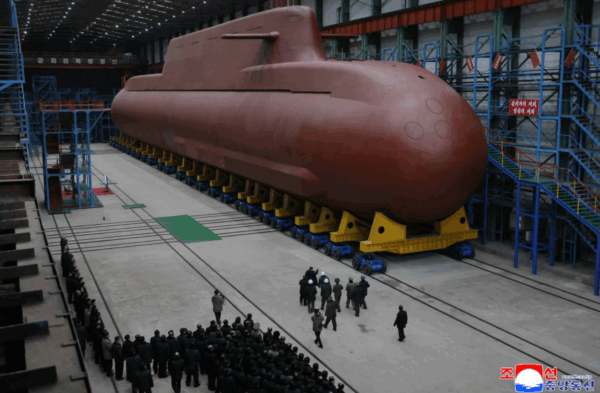
Therefore, the possibility of Australia deploying nuclear submarines in the waters around the Korean Peninsula likely motivated North Korea to begin developing its own. In December 2025, KCNA released images of Kim Jong Un and his daughter, Kim Ju Ae, inspecting a building. Unnamed 8,700-ton nuclear submarine equal to the displacement of Australia’s proposed Virginia-class SSNs. In 2023 and 2024, Pyongyang launched the Hero Kim Kun-ok’s Submarinedesigned to carry tactical nuclear charges intended for “basic submarine offensive means” and a new Amnok-class corvette armed with RBU-1 200 anti-submarine rocket launchers.
The development of nuclear submarines will allow the Korean People’s Navy (KPN) to escort North Korean ships in the Yellow Sea and beyond, which would help deter interdictions. North Korea’s protection of its warships in maritime East Asia could be further facilitated by its ally China, which has previously disrupted Australia’s sanctions enforcement operations by deploying helicopters and naval destroyers in the Yellow and East China Seas.
AUKUS and the “comprehensive strategic partnership” between North Korea and Russia
Before 2025, it was unclear whether North Korea had the technology to develop nuclear propulsion. However, rapid progress in the development of the unnamed 8,700-ton nuclear submarine suggests that Pyongyang could receive outside help. Naval experts noted the likelihood that Russia carried out undisclosed technology transfers as part of the 2024 Comprehensive Strategic Partnership (CSP) agreement, which would allow North Korea to reverse engineer reactor components to power the submarine.
The North Korea-Russia CSP differs from traditional strategic partnership agreements by including a mutual defense clause and provisions relating to military technology transfers, bringing them closer to a formal alliance. Article 4 of the CSP states that if “either party falls into a state of war, the other party shall provide military and other assistance using all means at its disposal.” The “other aid” category clearly encompasses any transfer of technology by Russia to North Korea to help it develop a deep-sea navy.
North Korea’s stated fear of a “multi-layered nuclear encirclement ring” provides a strong reason for Pyongyang to enter into an alliance with Russia. Although state media amplify the nuclear dimension of cooperation between the United States and its allies and partners to justify its nuclear deterrence, North Korea’s rhetoric reflects a real shift in the US “hub and spoke” alliance system toward a more decentralized approach. lattice-like structure who gives priority sharing the burden. That of American President Donald Trump mistreatment The efforts of allies and partners in the Indo-Pacific, however, have compromised this situation, to the great benefit of Pyongyang.
North Korean leaders have stressed the imminence of war also provoked by the change in American alliances and partnerships. Before signing the North Korea-Russia CSP, Kim warned at the ruling Korean Workers’ Party plenum in December 2023 that “war approaches us as a realistic entity and not as an abstract concept.” Therefore, Kim’s decision to send the Korean People’s Army (KPA) to the front lines in Ukraine was not just for financial gain, but also to establish reciprocity with Russia while providing the KPA with modern battlefield experience to prepare for what Pyongyang sees as a impending war around the Korean peninsula.
The verdict
Both Pyongyang’s rhetoric and actions suggest that AUKUS has partially influenced its changing grand strategy. This is particularly evident in the modernization of the KPN and in military cooperation with Russia. Given North Korea’s increased activity, AUKUS should be seen as operating in tandem with the Japan-South Korea-US trilateral cooperation and the bilateral cooperation between Japan and the United States, Japan and South Korea, and Japan and Australia. These minilateral agreements, alliances and deep strategic partnerships are seen by Pyongyang as proof of the emergence of an Asian NATOwhich differs significantly from the perspective of the United States and its Indo-Pacific allies and partners.
North Korea’s view of AUKUS should also remind Australian strategists that Pyongyang pays attention to Canberra’s decisions. Even though North Korean propaganda describes Australia as the “deputy sheriff” of the United States. the fact that Canberra is now more taken into account in Pyongyang’s calculations demonstrates the capacity for action that Australia has in shaping the strategic environment in the Western Pacific.
However, as deterrence increases on both sides, the margin for engagement between Pyongyang and Canberra has narrowed, increasing the risk of miscalculation if their nuclear submarines come into increased contact on the high seas.