


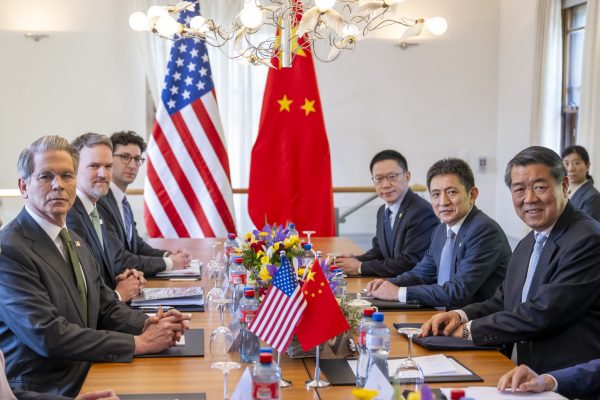
As US President Donald Trump’s planned visit approaches, Washington and Beijing are discussing a new China-US Trade Council. US Treasury Secretary Scott Bessent and US Trade Representative Jamieson Greer have suggested the creation of a body that would define what the two countries can trade without crossing national security red lines.
This seems reasonable, but it is dangerously incomplete. The real problem is the lack of procedures to prevent ordinary trade conflicts from escalating into geopolitical clashes.
A board that merely approves some transactions and prohibits others would quickly become another arena for political theater. Its real goal should be to prevent everyday commerce from being dragged into every diplomatic crisis and to prevent minor frictions from triggering tariffs, sanctions, export controls and retaliation.
The difficulty is that while the U.S. and Chinese economies remain closely intertwined, the rules that govern them are based on fundamentally different assumptions about state power, market discipline, ownership, data control, and national security. These differences appear in disputes over subsidies, state-owned enterprises, industrial policy, regulatory discretion, digital governance and security controls. No amount of trade advice will make these differences disappear. He shouldn’t try either. The test is whether two rival systems can create procedures that allow companies, banks, shippers and investors to understand the rules before acting, check their compliance after disputes arise, and adjust course without turning each disagreement into a test of national resolve.
The Manus-Meta dispute shows why this procedural architecture is essential. According to Reuters, Chinese regulators have ordered US tech giant Meta to unwind its more than $2 billion acquisition of Manus, a China-founded artificial intelligence company that had moved its operations to Singapore after US-led funding. China’s National Development and Reform Commission reportedly demanded that the transaction be withdrawn under China’s foreign investment security review mechanism.
Manus had reorganized overseas, attracted foreign capital, and become the target of a major U.S. technology acquisition. However, relocation and incorporation abroad have not resolved the question of jurisdiction. Regulators considered the company’s ties to China in terms of technology, talent, data, past operations and strategic industrial capacity as relevant for review.
The lesson is not limited to a single transaction. A cross-border agreement may be commercially consistent and yet fail because the parties do not know in advance which facts will trigger security processing. Headquarters, ownership structure, founder location, prior operations, cloud systems, data feeds, investors, employees, and code can all become relevant after the fact. By then, staff may have already moved, investors may have been paid, and code, data, intellectual property, due diligence records, and engineering knowledge may have been integrated into new systems. A government can order that a transaction be reversed, but it cannot easily remove what has already been learned, copied, adapted or integrated. The certainty of a deal depends less on incorporation formalities or summit diplomacy than on predictable scrutiny before committing capital, people and knowledge.
Previous Sino-US dialogues have shown the danger of an incomplete structure. The Joint Commission on Commerce and Trade, established in 1983, provided a useful venue for complaints and sectoral negotiations. The China-US Strategic Economic Dialogue, founded in 2006, was renamed not once but twice: as the China-US Strategic and Economic Dialogue in 2009 and finally as the China-US Comprehensive Economic Dialogue, announced in 2017 but which met only once before being abandoned. These executives have elevated commitment to the Cabinet level. But consultation is not governance. Without a limited mandate, fixed deadlines, standards of proof, escalation rules, and solutions announced in advance, no forum can stabilize expectations once the political weather changes.
A serious chamber of commerce should start with a written charter that defines its jurisdiction. It should specify which sectors are covered, what measures must be notified, what constitutes non-compliance, when a matter can move from consultation to judicial decision and how a temporary restriction is reduced or lifted. Vague boundaries do not equal flexibility; they are invitations to rewrite the terms of a deal once companies have already invested.
The board should also separate business governance from security oversight without pretending they are independent. One of them should manage market access, customs, standards, subsidies, state-owned enterprises, payments and supply chain continuity. Another is expected to address export controls, sanctions compliance, technology restrictions, investment reviews and other security-sensitive measures. A formal notification must link the two. Otherwise, the security exception will engulf the trading system.
Technical work must be ongoing and not improvised before the summits. A permanent secretariat should monitor implementation, receive complaints, organize regular sector reviews and publish reports. Businesses should be able to request clarification without taking every issue to Cabinet level.
All this may seem bureaucratic. It’s not. Bureaucracy becomes dangerous when it hides its discretionary power. The objective here is to make discretionary power visible, comparable and reviewable. Dispute resolution must be designed before a violation. Panel formation, deadlines, confidentiality rules, review standards, compliance deadlines, and permitted countermeasures must be established in advance. Enforcement should progress in stages, from consultation and formal findings to compliance plans and proportionate countermeasures within agreed limits. If enforcement rules are left hanging until a violation occurs, negotiation will fill the void just when the procedure is most needed.
Payments deserve special attention. Legal commerce cannot function if settlement cannot be achieved through predictable channels. The board should define approved settlement channels, documentation rules, bank verification tasks and fallback routes. Disputes relating to private contracts may remain subject to arbitration or the courts. The council should address systemic failures such as regulatory blocking, customs obstructions, discriminatory licensing and measures that make legal trade virtually impossible.
Finally, the board of directors must not become an instrument for legitimizing permanent emergencies. Any restrictive measures must have a clear trigger, a review date and an exit route. The goal is to isolate what is sensitive so that the rest of commerce can remain rule-based.
Both governments have many tools to punish, but too few to correct. When a dispute arises, companies are often unsure which rule applies, which authority can clarify it, what evidence will be important, how long the review will take, or what recourse is available without escalation. In this environment, each party assumes that the other is exploiting ambiguity. Precaution becomes retaliation, and retaliation becomes normal practice.
A serious Board of Trade would not eliminate distrust; this would make distrust governable. It would require both governments to define their obligations before companies invest, make their compliance observable after disputes arise, and create a path for review that does not depend on personal access, political timing, or unilateral pressure. The institutional burden of Sino-US economic governance today is not reconciliation but disciplined coexistence.
The danger is not simply that the next crisis will disrupt trade. This is because every interruption will be seen as proof that the rules no longer matter. If Washington and Beijing create a Board of Trade, they should build one that does more than just announce what can be traded. It must prevent a dispute from becoming a doctrine, an exception from becoming a policy and a crisis from becoming the operational system of the relationship.