


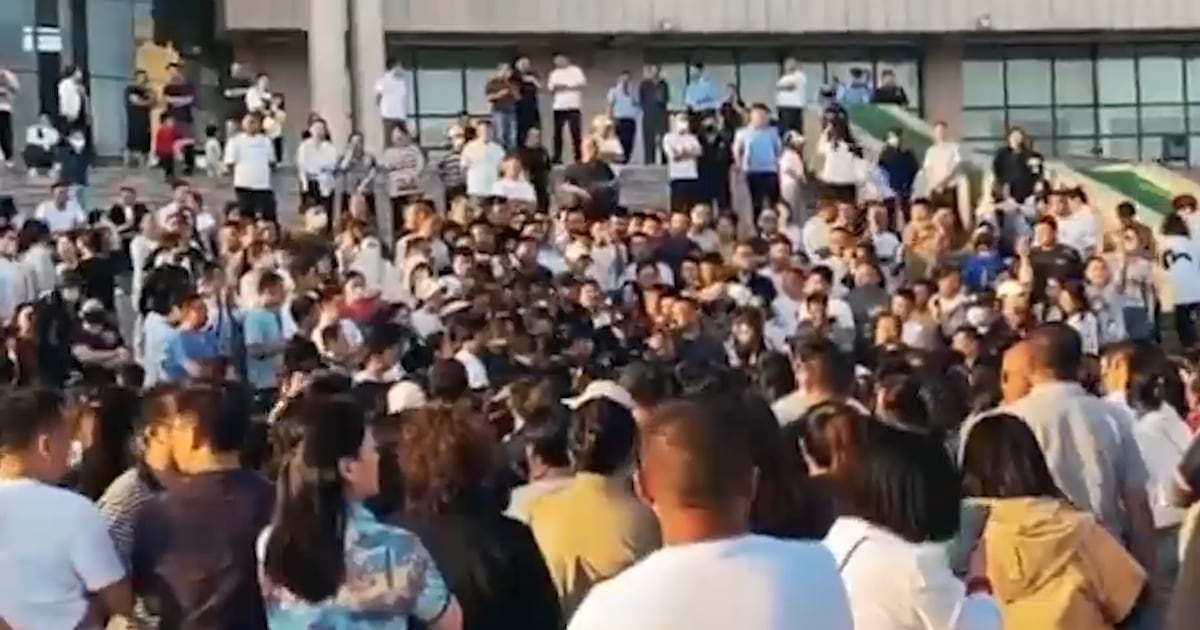

A mass demonstration of parents this week against the planned closure of a private school in northern China caused a rare reversal of the authorities, officials and parents said.
The video published on social networks showed hundreds of parents outside the building of the municipal government of Nangong in the province of Hebei on Sunday, demanding that the primary school of Fengyi remains open after learning that it should close its doors.
The planned fence seems to be part of a broader government effort that started several years ago to reduce private education and stimulate public schools.
In the video, published on X by yesterday, a project that documents mass demonstrations in China, the demonstrators could be heard shouting “in disagreement!” And “The leaders go out!”
Witnesses told RFA that the demonstration had continued overnight and that the police had been sent to maintain order.
A parent who did not want to be appointed for security reasons declared Thursday at Radio Free Asia that the school was well considered and that the parents would compete for investments for their children thanks to a public lottery.
With the closure of the school, the children were going to be sent instead in public schools with a reputation for chaotic management and a high teachers' turnover, he said.
“They (the government) saw that the school had a high educational quality and that the parents with financial means sent their children to the Legyi primary school, so they wanted to close it,” said the parent.
In addition to being informed that the school would close, the parents were invited to choose a public school for their children. The video published on X has shown a form to be completed to list the priority of their school choices.
But after the demonstration, the authorities reversed the course.
An official of the Office of the Government of the City of Nangong confirmed a “protest by thousands of parents a few days ago”, but said that “the problem has been resolved” and that “the Fengyi primary school will not be closed”. The official said he was unable to provide more details and that the case was addressed by the Education Office.
In recent years, the Chinese Communist Party has sought to reduce private education and put private schools under the control of the State with the justification that it would promote equity in education and reduce costs for parents. However, he recently attenuated restrictions on private tutoring.
According to statistics published by the Ministry of Education last October, the total number of private schools in the country has decreased by more than 20,000 in the past four years and by more than 11,000 in 2023 only. Data has also shown that the current number of students enrolled in private schools amounted to less than 50 million, down more than 3 million 2023. In total, this represents almost 17% of the total student population nationally.
But private schools remain a first choice for many parents in China, even if local governments have implemented policies in order to restrict private education and reduce the quality gap with education offered in the public sector.
Jia Lingmin, a retired teacher of Zhengzhou, Henan, told FRG that, as birth rate rates in China continue to lower, the number of children entering school also decreases from year to year and that many public schools are faced with the problem of inscriptions and insufficient closure.
“Private schools have a high quality of education and a good teaching environment, and many parents are ready to send their children to private schools,” she said.
Yao Li, a parent of Handan, Hebei, said that although public schools offer free tuition fees for centuries to which education is compulsory – from 6 to 15 years – parents always generally prefer private schools in terms of education, quality of teachers and management methods.
The Office of the Nangong City Education Office did not answer the RFA call to request comments.
Edited by Mat Pennington.