


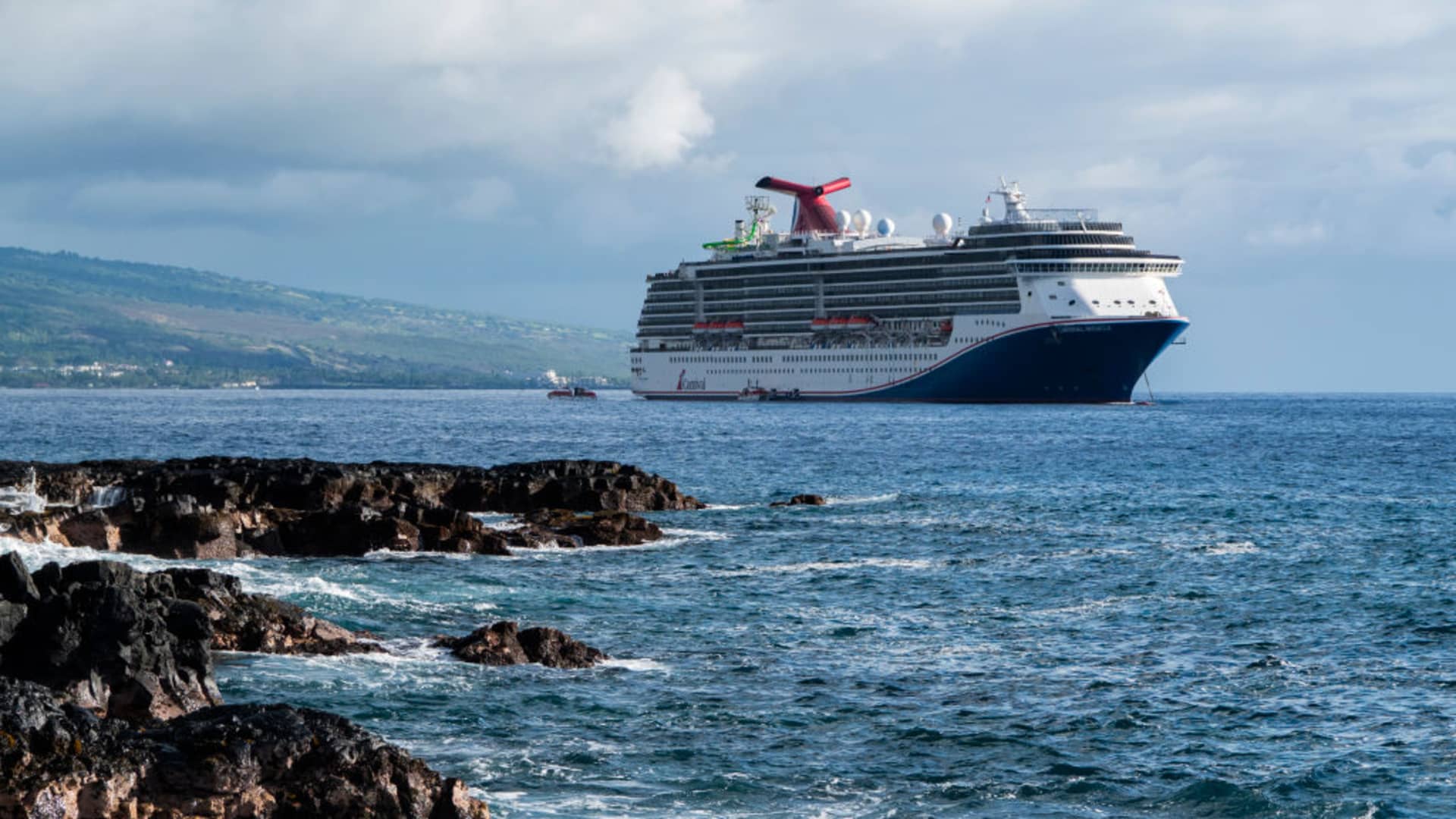
The Carnival Miracle cruise ship anchors on the Big Island of Hawaii on January 14, 2024.
Kevin Carter | Getty Images
The global cruise industry is reporting record demand and renewed consumer enthusiasm, but executives from the world’s largest cruise lines say the sector is also facing some of the most complex challenges it has seen in decades.
“We are no longer an alternative vacation. We are a vacation,” Carnival Corp. said CEO Josh Weinstein during a keynote panel Tuesday at Seatrade Global, a cruise industry conference.
As demand increases, passengers get younger; a third of cruise passengers are now under 40, according to the 2026 State of the Cruise Industry Report released by the Cruise Lines International Association, or CLIA. A third of trips are multigenerational, often families traveling together. And nearly a third of cruise passengers take boat vacations several times a year, according to the report.
The cruise industry welcomed 37 million passengers worldwide last year and expects to reach 42 million annually by 2029, according to CLIA.
“This dominant demand prepares us very well for volatility,” Weinstein said.
A resilient business in an uncertain world
At least six cruise ships remain stuck in the Persian Gulf due to the Strait of Hormuz standoff. One of them is the MSC Euribia.
Although around 1,500 passengers were safely evacuated following Dubai airport closures and missile warnings after the United States and Israel launched an attack on Iran in late February, there are still a few crew members on board to maintain the ship.
“Obviously we live day by day. The situation is very fluid,” said Pierfrancesco Vago, executive chairman of MSC Cruises, during the Seatrade Global opening speech.
The halt to maritime traffic in the strait has already disrupted routes in the Middle East and southern Europe. Threats of blockades, mines on the sea floor and on-again, off-again negotiations leave cruise executives wondering when they will be able to move their ships.
“Morning is one thing, lunch time is another, dinner is yet another,” Vago said of the numerous and often contradictory announcements from government leaders. “We need to stay calm and really be ready to move as soon as the opportunity and opportunity presents itself.”
Despite these challenges, cruise executives say the industry has never been better positioned to absorb shocks.
“Every crisis we’ve faced — financial, geopolitical or health-related — we’ve adapted,” Carnival’s Weinstein said. “There’s no reason to believe it will be any different this time.”
Fuel costs, sustainability and the desire to consume less
Fuel price volatility has once again brought energy strategy to the forefront for the cruise industry, particularly for Carnival, which does not hedge fuel prices.
“No one asks us for coverage when prices are low,” Weinstein said. “But our strategy remained consistent: use less fuel.”
The cruise industry aims to reach net zero emissions by 2050, but CEOs agree they can’t achieve that goal by saving fuel alone.
Industry leaders view biofuels, green methanol and synthetic liquid natural gas (produced by combining captured carbon with hydrogen) as the most promising solutions to meet their fuel needs.

Royal Caribbean Group CEO Jason Liberty said cruise lines already invest hundreds of millions of dollars each year in technology and energy innovation, but the availability of alternative fuels remains the bottleneck.
“It’s not about what we want to use,” Liberty said. “It’s about what’s scalable and available.”
“We’re also going to face strong competition with other sectors for these fuels. There’s no guarantee we’ll get them,” added Bud Darr, CLIA president and CEO.
A favorable wind for growth
Even as the industry navigates rough seas, cruise lines are searching for their next avenues of growth.
Technological advancements in artificial intelligence are being used to reduce food waste, map routes and routes, and increase efficiency. Cruise line executives say the most important application is reducing friction in the customer experience.
“A more flexible work environment has been a significant demand driver for us,” Liberty said. Most Royal Caribbean ships now host a Starlink connection for fast onboard internet access.
Private destinations, i.e. exclusive ports or islands owned or controlled by a cruise line, remain a priority for investment. Royal Caribbean, for example, currently has three private destinations on its itineraries but will have eight by 2028.
The company is currently developing a major land hub in Puerto Williams, Chile, to reduce or eliminate the time Antarctic-bound passengers must spend transiting the unforgiving seas of the Drake Passage.
And the luxury segment, although only a small percentage of the overall industry, is growing rapidly. Customers are increasingly interested in health, wellness and longevity – and these trends are also showing up in their vacation habits.
Small ships and river cruises cater to specialist ecotourism interests, off-the-beaten-path locations – those yet to be discovered by social media influencers – and food or art enthusiasts.
Tourism demand driven by social media has also triggered backlash from some destinations overwhelmed by crowds. The cruise industry works with destinations on what it calls managed and predictable tourism.
Vago said MSC has worked with Dubrovnik, Croatia, for example, to coordinate the flow of visitors to the medieval city, who want to spend tourism but without destroying residents’ quality of life.
“A lot of these coastal communities really appreciate this. We plan ahead. We create routes three years in advance,” Vago said.
“The strength of this industry lies in its ability to evolve without losing its soul,” Liberty said. “This soul is hospitality.”
Leadership change and new perspective
HAS Norwegian Cruise Line Holdingsthe challenge for new CEO John Chidsey is to right the ship.
During his first earnings conference call, just days after taking the helm in February, Chidsey acknowledged that the company had made numerous missteps.
Margins are under pressure. Stocks have been volatile. Critics have questioned the push to expand Caribbean cruise itineraries before Norwegian’s private island destination is completed.
Earlier this year, Elliott Investment Management took an activist stake in Norwegian, which may have prompted the board to make a management change.
Chidsey told CNBC that Elliott’s goals align with his own and that he intends to create a culture of accountability and urgency in which teams work together rather than separated into silos.

The Seatrade conference was a first in the cruise industry for Chidsey, former CEO of Subway, Burger King and Avis.
When asked what a “sandwich guy knows about cruising,” Chidsey didn’t miss a beat, insisting that he’s “a turnaround guy, not a sandwich guy.”
“I didn’t know anything about fast food when I went there. I think having a new perspective is really what the Norwegian needs,” he said. “And it’s all about execution.”