


On February 17, the Chinese animated film “Ne Zha 2” took its place among the 10 best films of all time, with its box office haul to $ 1.66 billion and climb. This step has followed the global success of video games “Black myth: Wukong”. The two are emblematic of the acceleration of cultural exports of China and the expansion of the soft power.
At the national level, such successes resonate deeply within a society undergoing a cultural rejuvenation focused on the state, cultivating a strong nationalism focused on culture. By strategically aligning the expansion of the soft power about this rebirth of traditional culture, the Chinese government exploits symbolic achievements to improve its internal political legitimacy. While China continues to integrate culture into its global strategy, this interaction between external recognition and internal legitimacy will remain at the heart of its prosecution of the soft power.
Cultivate a cultural rejuvenation at home
Despite the historic campaigns of the Chinese Communist Party (CCP) against traditional culture, the management of Xi Jinping has placed culture at The heart of the great rejuvenation plan of China. XI actively embraces the traditional Chinese culture, cropping the preservation and development of an excellent traditional culture as a party mission.
This change is obvious in the ideological framework evolutionary of the CCP. On July 1, 2016, during the celebration of the 95th anniversary of the Party Foundation, XI notably added “culture confidence” to the “three secrets” established in the 18th party congress, thus formulating the “” “Four confidences. “This has marked an explicit elevation of cultural identity in the CCC’s discourse of legitimacy, blurring the border of culture and ideology.
More recently, XI thought on culture was officially introduced during the National Conference on Propaganda, ideological and cultural work in October 2023. Although the ideological foundation remains deeply rooted in party doctrine, its practical implementation has increasingly highlighted the renewal and The promotion of traditional Chinese culture compared to communist ideological accounts. Underline The role of traditional culture in the modernization of Chinese styleBeijing suggests that this heritage should be invigorated to fuel contemporary national development.
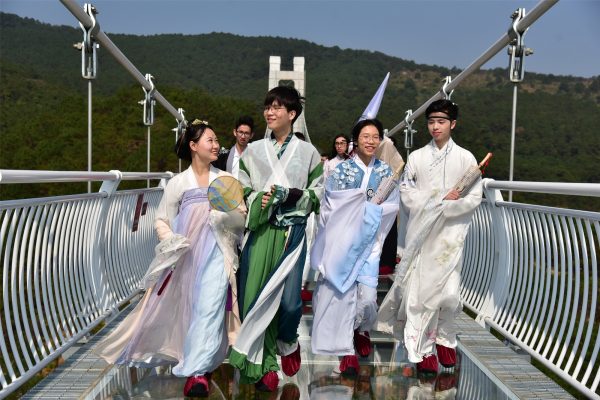
In this context, an increase in cultural enthusiasm has become obvious in Chinese society. An example is The popularity of han clothes (hanfu), especially among the young generation. In 2023, the number of companies registered with Han clothing in China increased 355.25% In annual shift, market size exceeding 14.4 billion yuan. The Chinese Hanfu market should continue to grow, reaching a planned yuan of 24.28 billion by 2027.
This cultural resurgence also strengthens a Axed on culture Nationalism, where the pride of the Chinese heritage is increasingly defining national identity. For example, many Chinese are very proud to see foreigners carrying traditional Chinese outfits, such as the Leakor participate in cultural festivities. While the foreign assessment of Chinese traditions is celebrated, reverse cultural exchanges – such as Chinese individuals wearing Japanese kimonos – PROVEVE Souvenir a nationalist reallage. Likewise, while the international adoption of Chinese holidays is welcome, the domestic celebration of Western festivals as Christmas frequently arouses criticism, with certain schools and governments discouraging or even prohibiting such observances.
The social media landscape more amplifies these dynamics. Trendy videos Foreigners who eat Chinese cuisine or trips through China generate significant online traffic in China, strengthening the story of the world attraction of Chinese culture. These tendencies illustrate how cultural nationalism is not only imposed by the State but also reinforced by popular feeling, shaping both the interior identity and external projection of the soft power.
The expansion of the influence of culture abroad to build a large image of power at home
In the context, China has actively expanded its cultural influence abroad through two key tactics: deepening engagement with international institutions and promoting the global export of cultural products. These efforts are not only intended to improve China’s soft power on the world scene, but also to strengthen its large image of power at the national level.
The growing interaction with international institutions has been particularly materialized by heritage diplomacy and the holding of international conferences. By becoming the The biggest contributor to UNESCOChina has systematically high its civilizational stature. In 2024, China has 44 articles on the UNESCO intangible cultural heritage list and 57 UNESCO World Heritage Sites, making it the first and second most enlisted country in the world. Domestic media often represented The main role of China in heritage conservationlinking international recognition to national cultural pride. Recognition of the United Nations of Chinese culture – UNESCO 2024 Recognition of the Chinese New YearFor example – is celebrated not only as a contribution to the world cultural heritage but also as a diplomatic victory.
At the same time, China has institutionalized its influence through platforms such as the Beijing culture forum, the Nishan forum on global civilization and other multilateral forums, promoting “cultural connectivity” under its direction. In addition, in 2023, XI introduced the World Civilization Initiativeaimed at showing China’s ability to provide public goods to the international community.
The second strategy revolves around the global export of Chinese cultural products, trying to merge the success of the market with ideological validation. The success of films such as “Ne Zha” and “The Wandering Earth” highlights the growing capacity of China to shape the global entertainment markets. In the game industry, “Genshin Impact” and “Black Myth: Wukong” have acquired massive international suites, bringing a Chinese mythology and aesthetic to a global audience.
THE 2024 Report on the International Communication Index of Chinese Cultural Symbols (CSIC) Has stressed that traditional culture is experiencing resurgence among the exported cultural products of China. These commercial achievements are used at the national level as proof that the cultural industries of China are no longer limited to national borders but actively influence global cultural trends.
More importantly, the export of cultural products also has an economic motivation. The development of the Chinese cultural industry also stimulates the development of related industries, such as cultural tourism, catering and cinema and television. This becomes essential for China in the national context of an economic slowdown and a pivot to the so-called “new productive forces”.
Conclusion
However, although these cultural exports strengthen the international image of China, their greatest impact is in China itself. The PCC strategically presents these successes as validation of the civilizational force of China, strengthening national nationalism and consolidating its legitimacy. The more China’s cultural products are adopted abroad, the stronger the perception of the influence of China. Thanks to these efforts, China’s cultural diplomacy is used to double objective: to strengthen its international image while deepening inner confidence in its role of great power. While China continues to integrate culture into its global strategy, this interaction between external recognition and internal legitimacy will remain at the heart of its prosecution of the soft power.
In addition, the extent to which China’s cultural diplomacy can arouse foreign support is uncertain. The success of the American soft power, for example, is not only built on Hollywood but also on a broader spectrum of values, such as human rights and democracy. Although China maintains that its cultural products transmit universal values, such as hard work, family ties and friendship, it remains shortly how these products can result in an effective soft power.
In addition, while nationalism continues to increase worldwide, the spread of Chinese culture abroad can cause the resistance of other nations, which potentially causes obstacles to Chinese cultural exports. It is crucial for Chinese cultural products to adapt to local markets, rather than promoting only a unique version of Chinese culture. The success of this strategy will depend on a patient, an increasing approach – which carefully balances the material advantages with an influence of the soft power.