
Close Menu
Crazy Peks NewsCrazy Peks News
  • Home
  • America
  • Asia
  • Europe
  • Business & Money
  • Politics
  • Technology
  • Sports
  • Entertainment
  • Privacy Policy
  • Get In Touch
Facebook X (Twitter) Instagram
Trending
  • only 26% of companies have a complete view of their AI costs, while 50% have some visibility and 22% have none or only see costs after billing (Wall Street Journal)
  • Trump Melts Down and Leaves to Meet the Press When Asked for Evidence of Election Rigging
  • At the early 2025 senior management meeting where Apple admitted its AI failures; Tim Cook became intimately involved in Apple’s AI roadmap around the same time (Mark Gurman/Bloomberg)
  • Memory chip suppliers say CXMT’s DDR5 prices match those of Samsung, SK Hynix and Micron, and that they have a supply advantage in customer markets because they don’t prioritize HBM (Hassan Mujtaba/Wccftech)
  • Q&A with Google DeepMind’s Director of AGI Economics Alex Imas and Epoch AI’s Phil Trammell on what’s left in short supply after AGI, the redistribution of AI wealth, and more (Dwarkesh Patel/Dwarkesh Podcast)
  • ASML CEO Christophe Fouquet applauds EU tech sovereignty plans, but says substantial EU involvement in leading ‘strategic projects’ is cause for concern (Toby Sterling/Reuters)
  • How LinkedIn is transforming into a ‘post-grind’ social network as it courts top influencers, who build audiences on business-friendly topics (Isabella Kwai/New York Times)
  • in May, hyperscalers’ unsecured bond supply reached $155 billion year-to-date, more than 45% higher than total 2025 issuance; some IA-infra bond sales are 4 times oversubscribed (Caleb Mutua/Bloomberg)
Facebook X (Twitter) Instagram
Crazy Peks NewsCrazy Peks News
Demo
  • America
  • Asia

    Can ASEAN’s green goals survive the data center boom? – The diplomat

    June 4, 2026

    Hong Kong’s Victoria Park remains silent on anniversary of Tiananmen crackdown – Radio Free Asia

    June 3, 2026

    Eco-brutalist resistance in Central Asia – The Diplomate

    June 3, 2026

    Uzbekistan’s new migration destination? America. – The diplomat

    June 3, 2026

    Trump’s new AI order raises the stakes in Sino-US tech competition – The Diplomat

    June 3, 2026
  • Europe
  • Business & Money

    ‘Backrooms’ Producer Peter Chernin Thinks Hollywood Needs to Change

    June 6, 2026

    Boeing CEO announces 737 Max production will start on new line on July 6

    June 5, 2026

    Family offices are investing in sports, from pickleball to smart soccer balls

    June 5, 2026

    Record Broadway Ticket Sales Show Consumers Are Splurging on Experiences

    June 5, 2026

    Lululemon (LULU) first quarter 2026 results

    June 4, 2026
  • Politics

    Trump Melts Down and Leaves to Meet the Press When Asked for Evidence of Election Rigging

    June 7, 2026

    Trump holds sit-down event in Wisconsin as apparent decline deepens

    June 5, 2026

    Trump’s lawsuit against the BBC massively backfired

    June 5, 2026

    Trump is erased as Kennedy Center begins removing his name

    June 4, 2026

    Scott Bessent collapses in front of Congress as he tries to defend Trump for not caring about Americans

    June 4, 2026
  • Technology

    only 26% of companies have a complete view of their AI costs, while 50% have some visibility and 22% have none or only see costs after billing (Wall Street Journal)

    June 7, 2026

    At the early 2025 senior management meeting where Apple admitted its AI failures; Tim Cook became intimately involved in Apple’s AI roadmap around the same time (Mark Gurman/Bloomberg)

    June 7, 2026

    Memory chip suppliers say CXMT’s DDR5 prices match those of Samsung, SK Hynix and Micron, and that they have a supply advantage in customer markets because they don’t prioritize HBM (Hassan Mujtaba/Wccftech)

    June 7, 2026

    Q&A with Google DeepMind’s Director of AGI Economics Alex Imas and Epoch AI’s Phil Trammell on what’s left in short supply after AGI, the redistribution of AI wealth, and more (Dwarkesh Patel/Dwarkesh Podcast)

    June 7, 2026

    ASML CEO Christophe Fouquet applauds EU tech sovereignty plans, but says substantial EU involvement in leading ‘strategic projects’ is cause for concern (Toby Sterling/Reuters)

    June 7, 2026
  • Sports
  • Entertainment
Crazy Peks NewsCrazy Peks News
Home » Australia’s take on the evolving quad – The Diplomat
Asia

Australia’s take on the evolving quad – The Diplomat

Frank M. EverettBy Frank M. EverettMay 28, 2026No Comments
Facebook Twitter Pinterest LinkedIn WhatsApp Reddit Tumblr Email
Share
Facebook Twitter LinkedIn Pinterest Email


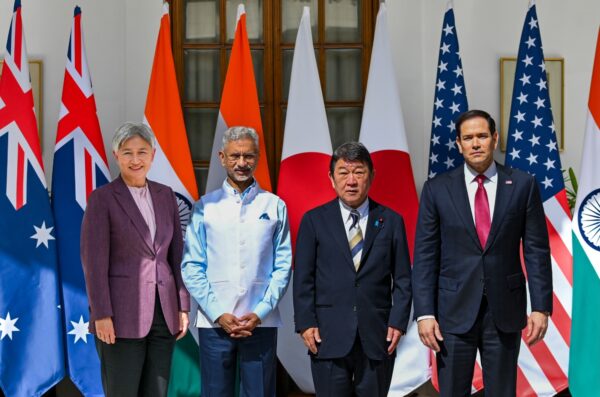
Australian Foreign Minister Penny Wong visited New Delhi this week for the last meeting of Quad foreign ministers. Despite concerns that the group may not hold up amid the current realignment of the U.S. worldview under President Donald Trump, the meeting made clear that the Quad could still prove useful to each of its members with its emphasis on economic resilience, technological coordination and supply chain security. The bloc is increasingly concerned with regional systems rather than conventional defense.

For Australia, this change is particularly significant. Canberra has long discussed that Indo-Pacific stability depends not only on military deterrence, but also on the protection of trade flows, energy supplies, critical technologies and economic sovereignty. The New Delhi meeting suggests that this conception of security is taking root within the Quad.

THE joint statement reflected this broader understanding of security. Maritime surveillance, cybersecurity, critical minerals, telecommunications, artificial intelligence, energy supply, disaster response and infrastructure resilience have all been treated as interconnected elements of the regional order. The group is now defining its role in collectively managing vulnerabilities in these areas across the Indo-Pacific.

For Australia, the major pillar of this cooperation is the new Quad project Critical Minerals Initiative Framework. The framework aims to coordinate the investment, extraction, processing, refining and recycling of strategic minerals among Quad members and other trusted partners. Although China is rarely mentioned in Quad statements, the intention of the initiative is clear: reduce reliance on Chinese-controlled supply chains for materials critical to advanced manufacturing, renewable technologies, semiconductors, batteries and defense industries.

Australia occupies a central position in this agenda. The country has significant reserves of lithium, cobalt, nickel and other essential minerals, but has historically exported these resources largely in raw form – with processing usually carried out in China. New Quad initiative aligns with Canberra’s ambition to move further along the value chain by developing national refining and processing capacity. Australia now wants position oneself not only as a career, but as an indispensable industry partner within a supply chain of “trusted partners”.

The other major pillar emerging from the New Delhi meeting is energy security. This was of course a tricky question to address given that the war between the United States and Iran has played a significant role in disrupting supply chains and making oil more expensive. THE energy security statement has highlighted new threats to shipping routes and how Indo-Pacific economies depend on maintaining consistent deliveries. In this area, Australia has long been vulnerable, being heavily dependent on imported refined fuel and having limited strategic reserves.

Australia has placed maritime lines of communication at the heart of its activities. national defense strategy. It centered the idea of ​​itself as a maritime nation primarily concerned with fragile supply lines and maritime choke points. Although the United States may be close to oil self-sufficiency, Japan and India also rely heavily on these supply lines. This has been reflected in the Quad’s language on energy security, which treats this issue not just as a simple national economic issue, but as a collective strategic challenge requiring coordination among partners.

This is the logic that underpins Australia’s contemporary security arrangements, since AUKUS agreement until the deepening of Australian politics bilateral relationship with Japan. For Canberra, the Quad complements these arrangements with initiatives focused on specific issues, while also including India as a state critical to the balance of power in the Indian Ocean. The overlapping aspects of the Quad with other agreements are seen as strengthening Australia’s capabilities within a network of relationships and initiatives.

The goal of the Quad now seems to be find practical problems it can work collectively, as part of a broader agenda to protect the Indo-Pacific from coercion and disruption. Security is no longer seen as simply the defense of territory, but now involves protecting the functioning of society itself – its commercial networks, its technological systems, its industrial capacity and its economic autonomy.

Here, it appears that the Quad is heavily influenced by Australia’s decision to view its security as defending a “way of life.” Canberra see more and more the defense of liberal democratic society as inseparable from the resilience of the economic and technological systems that support it. The evolution of the Quad suggests that this understanding is now shared more widely by the major democracies of the Indo-Pacific.

Australias Diplomat evolving Quad
Share. Facebook Twitter Pinterest LinkedIn Tumblr Telegram Email
Frank M. Everett

Related Posts

Can ASEAN’s green goals survive the data center boom? – The diplomat

June 4, 2026

Hong Kong’s Victoria Park remains silent on anniversary of Tiananmen crackdown – Radio Free Asia

June 3, 2026

Eco-brutalist resistance in Central Asia – The Diplomate

June 3, 2026
Leave A Reply Cancel Reply

© 2026 Crazy Peks News | All rights reserved.
  • Home
  • Privacy Policy
  • Get In Touch

Type above and press Enter to search. Press Esc to cancel.