


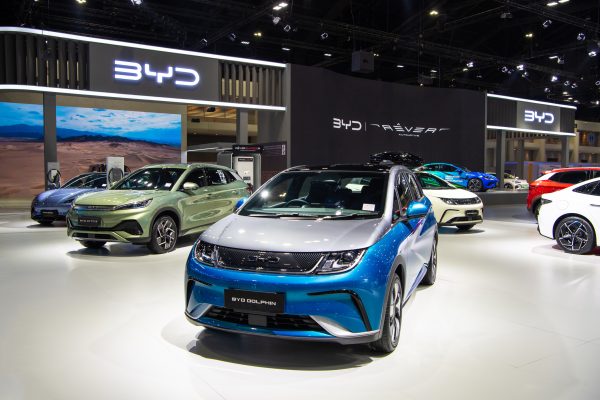
Chinese electric vehicle giant BYD recently released its first quarter earnings report for 2026, which triggered a strong market reaction: BYD experienced its slowest quarterly performance in six years. Its profits fell 55 percent year-on-year to 4.1 billion yuan, while revenue fell 12 percent to 150 billion yuan, accompanied by a 30 percent drop in vehicle deliveries.
In recent years, China’s new energy vehicle (NEV) sector has seen an influx of new entrants, such as Xiaomi and Geely. As a relentless and escalating price war persists, BYD’s market dominance is emblematic of the industry. Indeed, its rise and fall is an indicator of the trajectory of the entire Chinese auto industry.
Many industry experts, scholars, and practitioners are currently researching the NEV manufacturing sector. They focus largely on industrial and manufacturing analyses, with abundant data and assessments. Yet the crux of the matter is that the NEV industry is not fundamentally an industrial issue, but rather a sensitive geopolitical issue. This is the underlying reason why the Chinese state has spared no political expense to boost its growth, even at the cost of sacrificing the internal combustion engine industry. In this regard, researchers who limit their analysis to strictly industrial terms have committed a fundamental misdirection.
The only major manufacturing sector in which China has a real chance of becoming a leader and maintaining global competitiveness is NEVs. Other sectors, such as semiconductors or robotics, enjoy considerable prestige and offer some hope of success, but the Chinese offer remains far from international standards.
It is widely recognized that in the global geopolitical struggle, supply chain strategy currently constitutes China’s main strategic lever. It possesses the capacity to shift and disrupt existing balances of power, thereby elevating China’s global strategic position and forcing other countries to act cautiously. A prime example of this is the mobilization of lithium resources to execute blockades and counter-blockades, as well as the implementation of sanctions and counter-sanctions regarding rare earth minerals. Therefore, even if only from the perspective of its geostrategic interests, China must prioritize the effectiveness of these strategic levers.
However, the prospects for this strategic lever appear less than optimistic when looking at the current trajectory of the NEV sector.
The relative strategic utility of supply chain maneuvers is rooted in globalization. It remains effective only because the wave of globalization has not yet fully receded and the global manufacturing apparatus still retains a certain degree of functional dependence on integrated production systems. Once deglobalization is complete, such a strategy will lose its power.
Even though many observers have observed such a situation, their analytical framework remains imperfect. By measuring the problem in a single dimension, they argue that China’s advantages in systematized, low-cost production across many supply chain nodes are both irreplaceable and durable, so the country’s long-term supply chain can still act as a strategic lever.
However, the question is not so simple. The most obvious flaw in supply chain strategy is that the main challenge does not come from competing within the same dimension. It is not about winning a price war, but rather the possibility of a technological revolution and rapid development.
The ultimate adversary of such a supply chain strategy is technology. Once technological advancements trigger a generational upgrade, the existing supply chain system risks dissolving. The advent of the steam engine made the plow ox obsolete; the advent of the computer relegated the abacus to history; and the emergence of the jet engine fundamentally transformed aviation, as no modern mainstream airline would continue to operate antiquated propeller planes. Therefore, given that traditional manufacturing supply chains are exclusively tailored to existing products, a disruptive technological leap naturally has a disruptive impact. This is the most significant vulnerability and inherent flaw in supply chain strategy.
This challenge has already emerged and is now manifesting itself. The NEV itself represents a major challenge for the legacy automobile manufacturing sector, whose technological orientation is characterized by generational replacement. Manufacturing companies producing gasoline and diesel vehicles are already showing signs of decline. Compared with internal combustion engine vehicles, the NEV industry itself is a technological advancement and optimization. Furthermore, since NEV manufacturing has a higher degree of industrial digitalization, it is subject not only to intense competition, but also to an even more accelerated pace of technological renewal and upgrade.
The technological evolution of the NEV has by no means reached a plateau. Even as China’s NEV sector grows, Western technological advances are paving the way for a new generation of upgrades that threaten to render existing NEV supply chains obsolete.
First, there is the emergence of new battery technologies, notably solid-state batteries. While the ultimate winner remains to be seen, this trajectory will determine who commands the future market after the upgrade.
Second, there is competition on integrated manufacturing costs. While China’s manufacturing industry previously enjoyed a relative advantage, this advantage is constantly at risk of being blunted by Tesla, whose high-density production line mode of production has significantly reduced costs, resulting in highly competitive pricing that could potentially marginalize NEV’s Chinese manufacturing base.
Third, the question of autonomous driving technology. Tesla maintains a substantial lead in this area, and if it achieves widespread market adoption, the result will be a revolutionary leap forward.
These three aspects of technological advancement – i.e. advanced battery chemistry, integrated vehicle manufacturing, and autonomous driving – will leverage generational upgrades to restructure the NEV manufacturing supply chain. Previous supply chain advantages could disappear, existing demand could evaporate, and established markets could be supplanted. Under such circumstances, China’s current supply chain strategy would be rendered ineffective.
How much time is left before this scenario comes true? Based on average industry cycles, we estimate a window of three to five years. In other words, China’s current advantages in specific segments of the supply chain are likely to be eroded over this period. Unless China consistently achieves significant breakthroughs in technological advancement, the window of opportunity remains remarkably narrow.
Overall, supply chain strategy constitutes a key geopolitical lever for China. Recognizing this, China’s quest for technological autonomy and a resilient, self-sustaining industrial chain is essential to its global position, and its ability to sustain innovation amid increasing competition will ultimately define its future international influence.