



The war in Iran could drive up global food prices as the conflict disrupts fertilizer shipments on one of the world’s most critical trade routes.
While energy markets have focused on oil supply risks, analysts say threats to fertilizer supply chains through the Strait of Hormuz could also lead to long-term economic problems due to food inflation.
“Beyond energy, another risk that receives less attention is the potential ripple effect on food prices, as fertilizer shortages drive up agricultural costs,” Stephanie Roth, chief economist at Wolfe Research, said in a note written Tuesday.
Roth estimates that the disruption could increase “food at home” inflation by about 2 percentage points, adding about 0.15 percentage points to overall U.S. inflation, on top of energy’s increase of about 0.40 percentage points.
These potential price increases come as U.S. consumers face sustained increases in food, housing and energy prices. Domestic food inflation climbed 2.4% year over year in February, the Bureau of Labor Statistics said Wednesday.
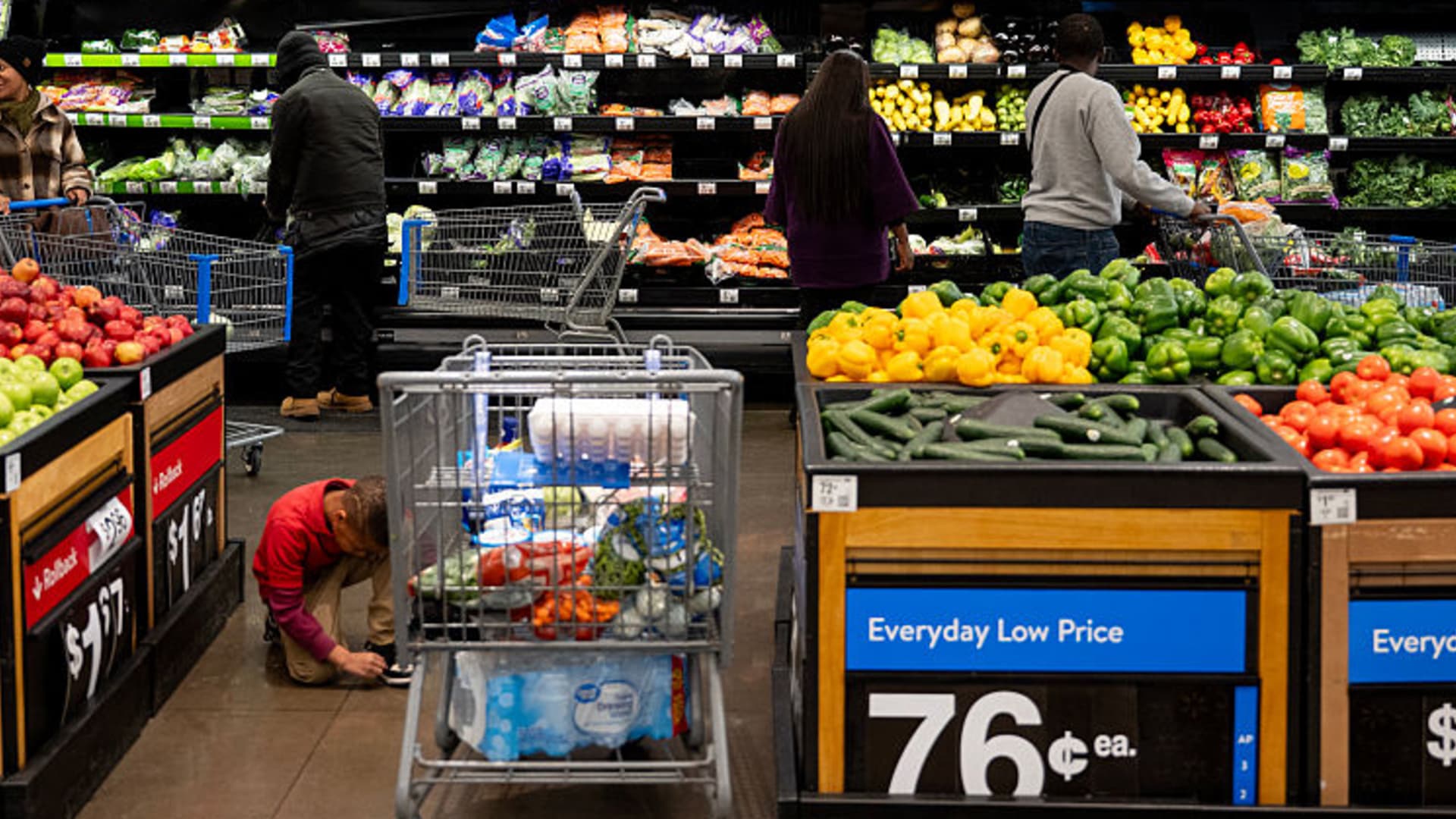
Customers shop at Walmart in Little Rock, Arkansas on January 22, 2026.
Will Newton | Getty Images
More than a third of fertilizer traded globally passes through the Strait of Hormuz, making it a critical artery for agricultural supply chains. Commercial traffic on the route has been largely halted since the war began late last month, disrupting shipments just as farmers across the Northern Hemisphere prepare their fields for spring planting.
Timing is crucial because fertilizers are applied early in the crop cycle and help determine yields later in the year.
“If fertilizer supplies tighten during this time, farmers may reduce application rates,” Roth said in the note. This could reduce yields of crops like corn, soybeans, wheat and rice, and increase agricultural costs.
Fertilizer economists are also concerned and say prices are already rising.
Between the weeks ending Feb. 27 and March 6 — the start of the war — the price of a short ton of urea fertilizer imported into the United States jumped 30 percent, according to data collected by industry advocacy group The Fertilizer Institute.
Urea – a nitrogen-based fertilizer widely used to increase crop yields – is one of the most widely traded fertilizers in the region.
Higher fertilizer prices for farmers and retailers could ultimately increase food costs for consumers if trade disruption persists, said Veronica Nigh, chief economist at the Fertilizer Institute.
“This is an overall impact on fertilizer costs,” Nigh said. “I imagine in this scenario, those costs would be passed on to consumers much more, which is something we’ve never seen before.”
The United States depends on global fertilizer markets and imports about 20 percent of its total consumption, although nitrogen fertilizers like urea come from a broader group of suppliers, including Canada, Trinidad and Tobago, Russia and elsewhere.
The ripple effect could extend across the globe and beyond commodities. Asia and Africa are particularly dependent on fertilizer exports from the Gulf region. Countries like India rely heavily on supplies from the Gulf, while several African economies rely on imported materials used to produce fertilizer.
Although disruptions in fertilizer shipments could reduce crop yields for farmers and increase costs for households, fertilizer producers could benefit.
CF Industries hit an all-time high on Monday and shares are up nearly 10% over the past week, the company’s biggest multi-day gain since 2022.
Correction: This story has been revised to reflect that the Iranian conflict is disrupting fertilizer shipments through the Strait of Hormuz. A previous version misspelled the name of the body of water between the Persian Gulf and the Gulf of Oman.