


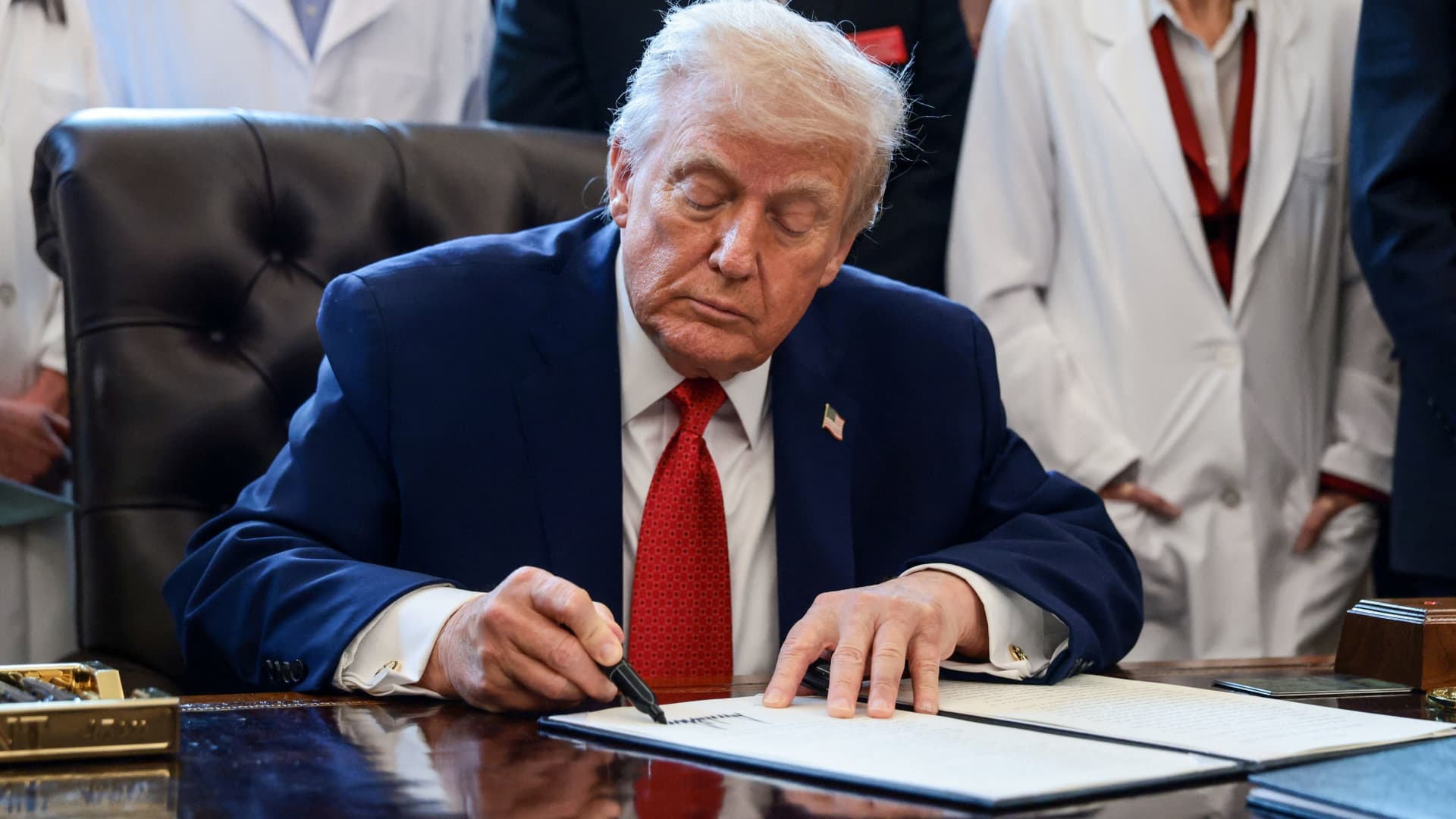

President Donald Trump’s decision Thursday to sign an executive order easing federal restrictions on marijuana — and paving the way for a Medicare pilot program covering CBD — caps a yearlong, coordinated campaign by the cannabis industry that combined traditional lobbying, large political donations, data-driven messaging and direct outreach to the president’s inner circle, industry insiders told CNBC.
Despite the Republican Party’s longstanding opposition to loosening drug laws — including a small wave of bills from lawmakers seeking to tighten the rules after the executive order — industry advocates claimed a victory. They view the executive order as a success in reframing marijuana not as a social issue but as a business-friendly policy, ultimately winning the favor of a president famous for his sobriety.
“I’ve never been inundated by so many people about” the reclassification of marijuana, Trump said during a signing ceremony in the Oval Office on Thursday.
Three figures have emerged as the primary architects of this policy shift, according to several insiders, including a CEO of a New York Stock Exchange-traded cannabis company, who requested anonymity to speak candidly. The main players were Howard Kessler, a Palm Beach billionaire and longtime friend of the president; Kim Rivers, CEO of cannabis giant Trulieve; and longtime Trump pollster Tony Fabrizio, the people said.
The billionaire
U.S. President Donald Trump presents an executive order with Howard Kessler (R) that Trump signed in the Oval Office of the White House December 18, 2025 in Washington, DC.
Anna Moneymaker | Getty Images
Kessler, known for his pioneering affinity credit cards, has been in Trump’s orbit since at least 2005, attending Trump’s wedding to Melania Trump and appearing at Mar-a-Lago and state dinners.
A leukemia survivor, Kessler began advocating for the medical benefits of cannabis for older adults in 2019, founding the Commonwealth Project to advance the cause. In September, Trump shared a Commonwealth Project video on Truth Social that said CBD coverage was “the most important senior health initiative of the century.”
Other prominent members of the Trump administration highlighted Kessler’s influence on Thursday.
During the signing ceremony, Health and Human Services Secretary Robert F. Kennedy Jr. said, “We would not be here today” without Kessler.
“God bless you for being a pain in our side,” Dr. Mehmet Oz, head of the Centers for Medicare and Medicaid Services, joked to Kessler in the Oval Office. Oz added that Kessler promised to permanently stop calling the president about the matter once the order was signed.
Kessler did not respond to a request for comment.
The White House said Trump’s executive order would open access to new treatments.
“The presence of several leaders from law enforcement groups and veterans at the Oval Office signing is indicative of how President Trump continues to push the envelope in support of our nation’s heroes,” White House spokesman Kush Desai said in a statement.
The CEO of the industry
Kim Rivers, CEO of Trulieve, one of the largest U.S. cannabis companies, has also had a close relationship with the Trump administration, people familiar with the matter told CNBC, including through a personal connection to Trump’s chief of staff, Susie Wiles.
Although Wiles is not a registered lobbyist for Trulieve, she previously worked at Ballard Partners, a Florida lobbying firm that represents the company.
“They [the Trump administration] “We want to see products that are safe, regulated and tested,” Rivers told CNBC’s “Fast Monday” Thursday night, adding that she interprets the White House language as a signal that the administration intends to rein in a chaotic market rather than expand it unchecked.

“Millions of Americans use medical cannabis,” Rivers said. “The president is very clear that he wants people to be able to have access to safe, regulated, researched products in controlled environments.”
Rivers attended two pre-inauguration events, including a dinner for Vice President JD Vance, and reportedly participated in a $1 million plate fundraiser at Trump’s New Jersey golf club in August, where she urged him to reclassify marijuana, the Wall Street Journal first reported.
Trulieve’s campaign spending also supported Trump. Federal Election Commission filings show Trulieve donated $750,000 to Trump’s inauguration committee and $250,000 to his MAGA Inc. super PAC.
The company reportedly played a key role in securing Trump’s support for a ballot initiative in Florida to legalize recreational cannabis for adults over 21. Although the initiative failed, Florida Division of Elections records show Trulieve spent more than $100 million on the election.
The sounder
The president also received data from his pollster, Fabrizio, who has his own ties to this issue.
American Rights and Reform, a cannabis-backed super PAC, paid the Fabrizio-led company six figures to conduct a poll that found broad voter support for delay, according to FEC filings.
At the signing ceremony Thursday, Trump referenced Fabrizio’s data several times, pointing to a survey released in March that illustrated broad voter support for easing restrictions. The data showed that young voters, aged 18 to 34, made up the vast majority in favor of reform, around 80%.
Fabrizio’s son, AJ Fabrizio, is also a prominent figure in the cannabis industry and a CEO who has said he turned to medical marijuana to treat his own epilepsy.
AJ Fabrizio created his own brand of cannabis extracts called IVXX – a line of carbon dioxide-extracted hash oil made exclusively for Terra Tech Corp., a publicly traded cannabis company that owns dispensaries such as The Green Door in San Francisco and Blum in Oakland, California.
In interviews, AJ has described moving from skepticism to advocacy after cannabis stopped his seizures. He also compared the future of cannabis to that of “Standard Oil” – saying in a recent podcast interview that just as Rockefeller turned petroleum byproducts into a petrochemical empire, the cannabis industry is poised to revolutionize materials, medicine and nutrition.