


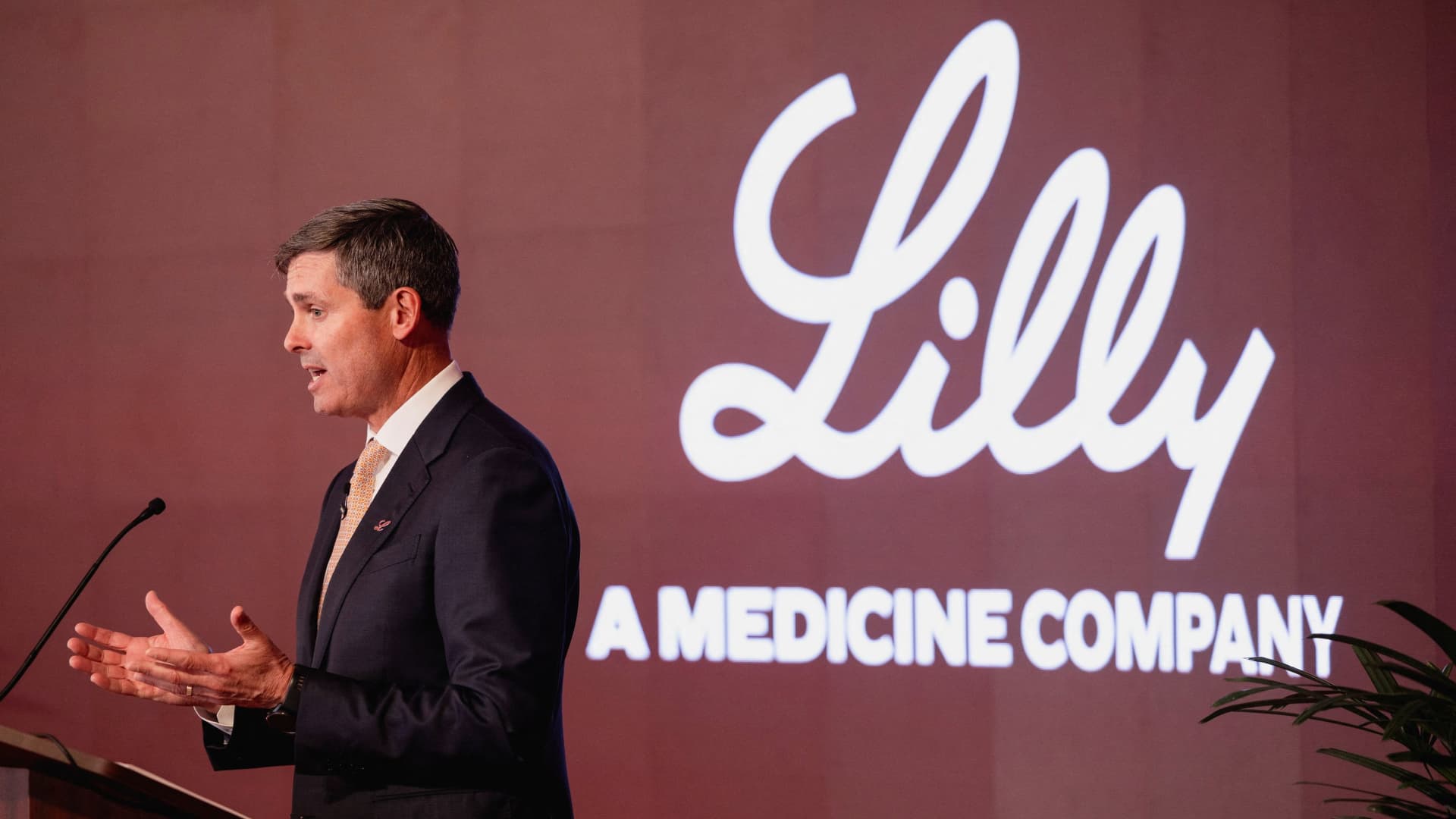
Elie Lilly And Nvidia are teaming up to build what they call the pharmaceutical industry’s “most powerful” supercomputer and so-called AI factory to help accelerate drug discovery and development in the sector, the companies announced Tuesday.
This is the latest push by Nvidia and the pharmaceutical industry to leverage AI to help reduce the time it takes to bring cures to patients, while reducing costs at every stage of drug discovery and development. The process typically takes about 10 years on average from giving a drug to the first human to its market launch, Diogo Rau, Eli Lilly’s chief information and digital officer, said in an interview.
Eli Lilly plans to complete construction of the supercomputer and AI factory in December. They will be put online in January. But the new tools probably won’t generate significant returns for the company’s business or that of any other drugmaker until the end of the decade.
“The things that we’re talking about discovering with this kind of power that we have now, we’re really going to see the benefits of that in 2030,” Rau said.
Industry efforts to use AI to get medicines to people more quickly are still in their early stages. There are no drugs on the market designed using AI, but progress is evident in the number of AI-discovered drugs entering clinical trials, recent AI-driven investments, and partnerships between drugmakers.
Eli Lilly will own and operate the supercomputer, which will be powered by more than 1,000 Blackwell Ultra GPUs – a new family of chips from Nvidia – connected over a unified, high-speed network. The supercomputer will power the AI Factory, a specialized computing infrastructure that will develop, train and deploy large-scale AI models for drug discovery and development.
The supercomputer “is really a new scientific instrument. It’s like a huge microscope for biologists,” said Thomas Fuchs, director of AI at Eli Lilly. “It really allows us to do things we couldn’t do before at such a scale.
Scientists will be able to train AI models on millions of experiments to test potential drugs, “dramatically expanding the scope and sophistication” of drug discovery, according to a statement from Eli Lilly.
While finding new drugs That’s not the only goal of the new tools, that’s “where the big opportunity is,” Rau said.
“We hope to be able to discover new molecules that we could never have found with humans alone,” he said.
Multiple AI models will be available on Lilly TuneLab, an AI and machine learning platform that allows biotech companies to access drug discovery models that Eli Lilly has trained over its years of proprietary research. This data is worth $1 billion.
Eli Lilly launched this platform in September to expand access to drug discovery. tools across the industry.
“It’s really powerful to be able to give an additional starting point to these startups that might otherwise take a few years of spending their capital to get to this point,” said Kimberly Powell, Nvidia’s vice president of healthcare, adding that the company is “excited to participate” in the effort.
In exchange for access to AI models, biotech companies should bring in some of their own research and data to help train them, Rau noted. The TuneLab platform uses what’s called federated learning, meaning businesses can take advantage of Lilly’s AI models without either party directly sharing the data.
Eli Lilly also plans to use the supercomputer to shorten drug development and speed up the delivery of treatments to patients.
The company said new AI science agents can support researchers and advanced medical imaging can give scientists a clearer view of disease progression and help them develop new biomarkers – a measurable sign of a biological process or condition – for personalized care.
“We would really like to deliver on this promise of precision medicine,” Powell said. “Without AI infrastructure and foundation, we’ll never get there, right? So we’re doing everything we need to build, and now we’re seeing this real takeoff, and Lilly is a perfect example of that.”
Precision medicine is an approach that tailors disease prevention and treatment based on a person’s genetic differences, environment and lifestyle.