


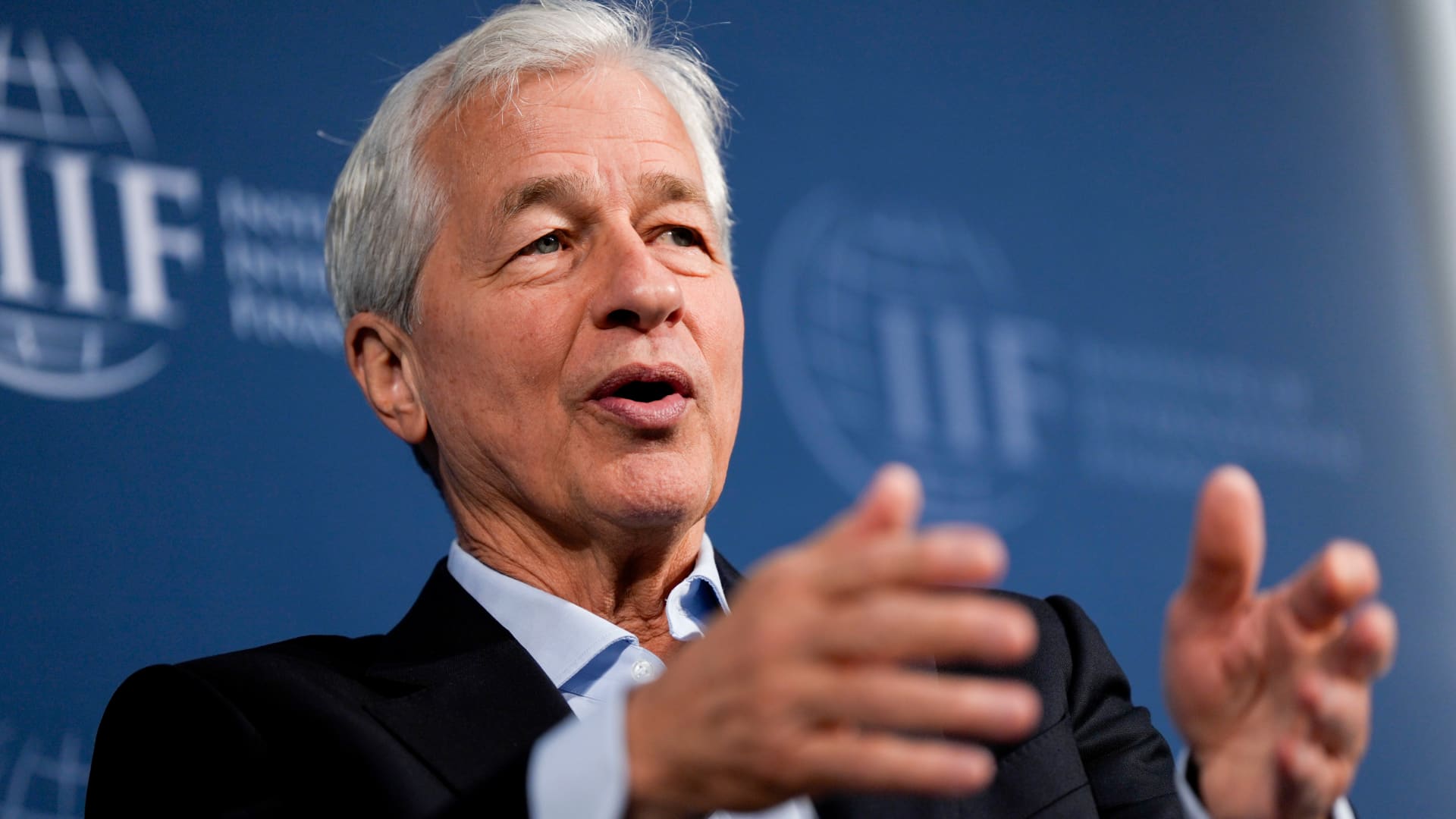
Jamie Dimon, Managing Director of JPMorgan Chase & Co., at the Institute of International Finance (IIF) during the IMF and World Bank Annual Meetings in Washington, DC, U.S., Thursday, October 24, 2024.
Kent Nishimura | Bloomberg | Getty Images
The era of artificial intelligence on Wall Street and its impact on workers has begun.
The big banks, including JPMorgan Chase And Goldman Sachs unveil plans to reinvent their businesses around AI, a technology that enables mass production of knowledge work.
That means that even in a blockbuster year for Wall Street, where trading and investment banks generate billions of dollars in excess revenue — not typically a time when the industry tightly controls headcount — firms are hiring fewer people.
JPMorgan said in its third-quarter earnings report Tuesday that while profits jumped 12% from a year earlier to $14.4 billion, headcount rose only 1%.
The bank’s executives have been asked to avoid hiring staff as JPMorgan rolls out AI across its business, Chief Financial Officer Jeremy Barnum told analysts.
JPMorgan is the world’s largest bank by market capitalization and a financial heavyweight on Main Street and Wall Street. Last month, CNBC was the first to report JPMorgan’s plans to inject AI into every customer and employee experience and every behind-the-scenes process at the bank.
The bank has “a very strong bias against a knee-jerk response to any given need to hire more people,” Barnum said Tuesday. JPMorgan had 318,153 employees as of September.
JPMorgan CEO Jamie Dimon told Bloomberg this month that AI would eliminate some jobs, but the company would retrain affected people and its overall workforce could increase.
“Constrain the workforce”
At rival investment bank Goldman Sachs, CEO David Solomon on Tuesday released his own vision for how the company would reorganize itself around AI. Goldman just had a quarter where its profits jumped 37%, to $4.1 billion.
“To fully benefit from the promise of AI, we need greater speed and agility across all facets of our operations,” Solomon told employees in a memo this week.
“This doesn’t just mean revamping our platforms,” he said. “That means taking a holistic view of how we organize our people, make decisions, and think about productivity and efficiency.”
The result for its workers: Goldman would “limit headcount growth” and lay off a limited number of employees this year, Solomon said.
Goldman’s AI project will take years to implement and will be measured against goals such as improving the customer experience, higher profitability and productivity, and enriching the employee experience, according to the memo.
Even with these projects, which focus first on reengineering processes such as client onboarding and sales, Goldman’s overall headcount is growing this year, according to bank spokeswoman Jennifer Zuccarelli.
Inspired by technology?
Comments on AI from America’s largest banks mirror those of tech giants including Amazon And Microsoftwhose leaders have asked their employees to prepare for AI-related disruption, including hiring freezes and layoffs.
Companies across industries have become more outspoken this year about the possible impacts of AI on employees, as the models underlying the technology become more capable and investors reward companies seen as ahead of the curve in AI.
In the banking industry, the prevailing view is that workers in operational roles, sometimes called back and middle office, are typically most exposed to disruption to their jobs from AI.
For example, in May, a JPMorgan executive told investors that operational and support staff would decline by at least 10% over the next five years, even as business volumes increased thanks to AI.
At Goldman Sachs, Solomon appeared to warn the firm’s 48,300 employees that the next few years could be uncomfortable for some.
“We do not make these decisions lightly, but this process is part of the long-term dynamism that our shareholders, our clients and our citizens expect from Goldman Sachs,” he said in the note. “The firm has always managed not only to adapt to change, but also to anticipate and accept it.”
